The Sun
Edvard Munch · 1911
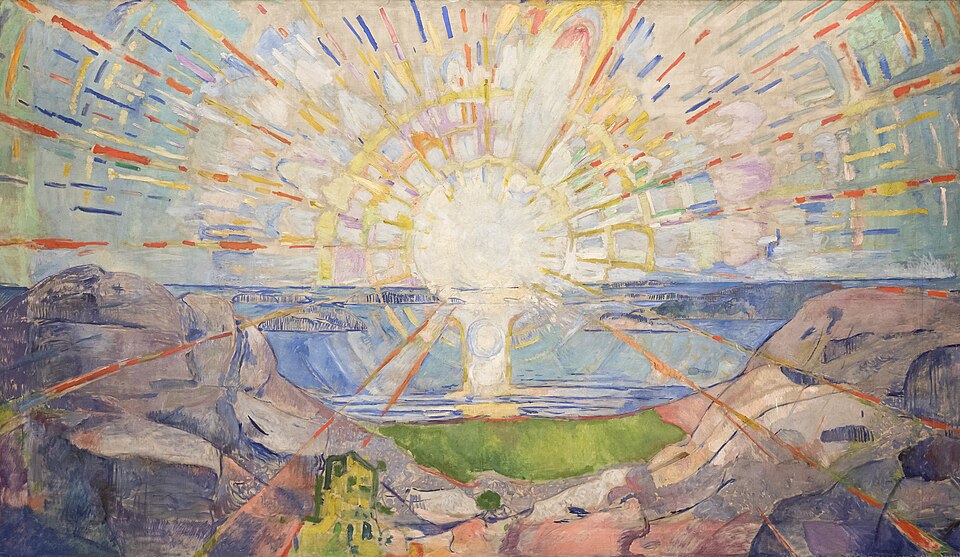
A huge white sun rises over a Norwegian coast, its rays breaking into every colour of the rainbow. After years of crisis, Munch made it the heart of his decorations for the university hall in Oslo.
The story behind the painting
The Sun was painted in 1911 for a competition to decorate the Aula, the great hall of the University of Kristiania, today Oslo, for its centenary that year. In April 1909 Munch returned to Norway after seven months of treatment at Daniel Jacobson's clinic in Copenhagen, and on 15 May he entered the competition. His proposals, like those of his rivals, were rejected several times. Only a mix of public pressure, a fundraising drive and outside offers such as one from the University of Jena led to the commission being granted in 1914. The eleven paintings were first shown to the public on 11 September 1916.
What to look for
At the centre, in Ulrich Bischoff's words, a giant sun spreads its field of rays over an ideal coastal landscape. Hans Dieter Huber locates it at Kragerø, the small southern coastal town where Munch had settled after 1909. Between two rounded rocks of the skerries, the eye falls on a bay where the sea reflects the low morning sun. The composition is almost perfectly mirror symmetrical, with large, clear, hard edged forms. Munch revived a striped brush technique he had used since 1907. The white sun's rays take on all the colours of the rainbow, over a light grey and silvery base tone matched to the hall's grey marble walls.
Meaning and intent
Munch saw the Aula paintings as growing out of his Frieze of Life: the frieze showed the sorrows and joys of the single person seen up close, while the university pictures showed the great, eternal forces. He called the sun the source of life and light, and its rays reach into the neighbouring panels, where figures walk toward it. The sun worship fitted the spirit of the time, when the sun was hailed as a source of health. Munch also gave it a personal meaning, tracing it back to his painting Spring of 1889: the sun in the Aula was the same sun that shone through the window there, the sun of Osvald from Ibsen's Ghosts.
Legacy
At first another picture, The Human Mountain, was meant for the centre, but the jury rejected it as unusable, and the sun grew ever bigger and stronger until it became the centre itself. The other main works of the cycle are History and Alma Mater. The commission reconciled Munch with his homeland and brought him recognition long denied there. The cycle is counted, with the Frieze of Life, among his main works, and Matthias Arnold called it his most important decorative work. The paintings remain together, the only group of Munch's works still in the arrangement he planned. The size, 455 by 780 cm, makes it monumental.
¿Sabías que…?
- Painted in 1911 for the centenary decoration of the University of Kristiania's Aula.
- The centre of an eleven-part cycle, first shown on 11 September 1916.
- The landscape is located at Kragerø on the south Norwegian coast.
- The only group of Munch's works still in the arrangement he planned.
Sobre el artista
Edvard Munch (1863-1944)
Más obras de Edvard Munch
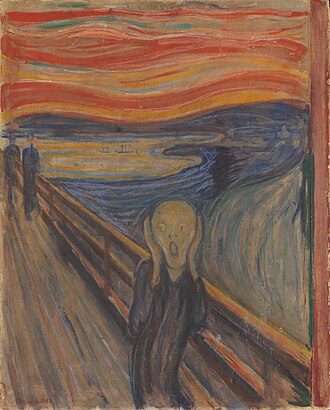 El grito - Edvard Munch (1893)
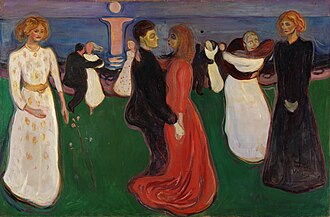 La danza de la vida - Edvard Munch
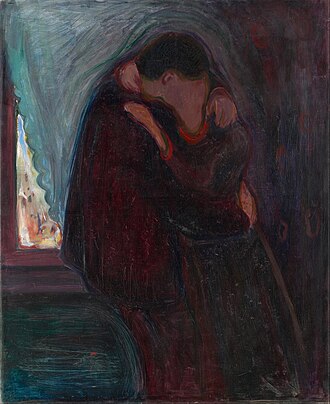 El Beso - Edvard Munch (1897)
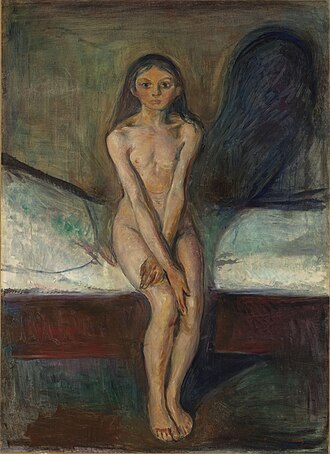 Pubertad - Edvard Munch (1895)
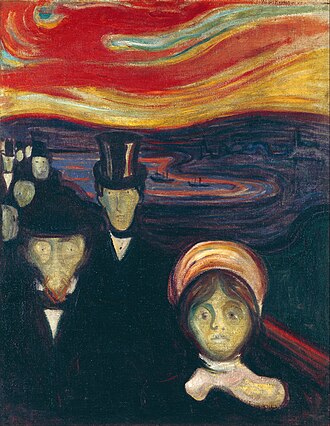 Ansiedad - Edvard Munch (1894)
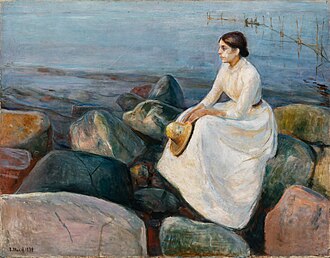 Inger en la playa - Edvard Munch (1889)
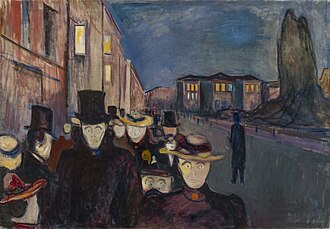 Tarde en Karl Johan - Edvard Munch (1892)
 Noche en Saint-Cloud - Edvard Munch (1890)