Pubertad
Edvard Munch · 1895
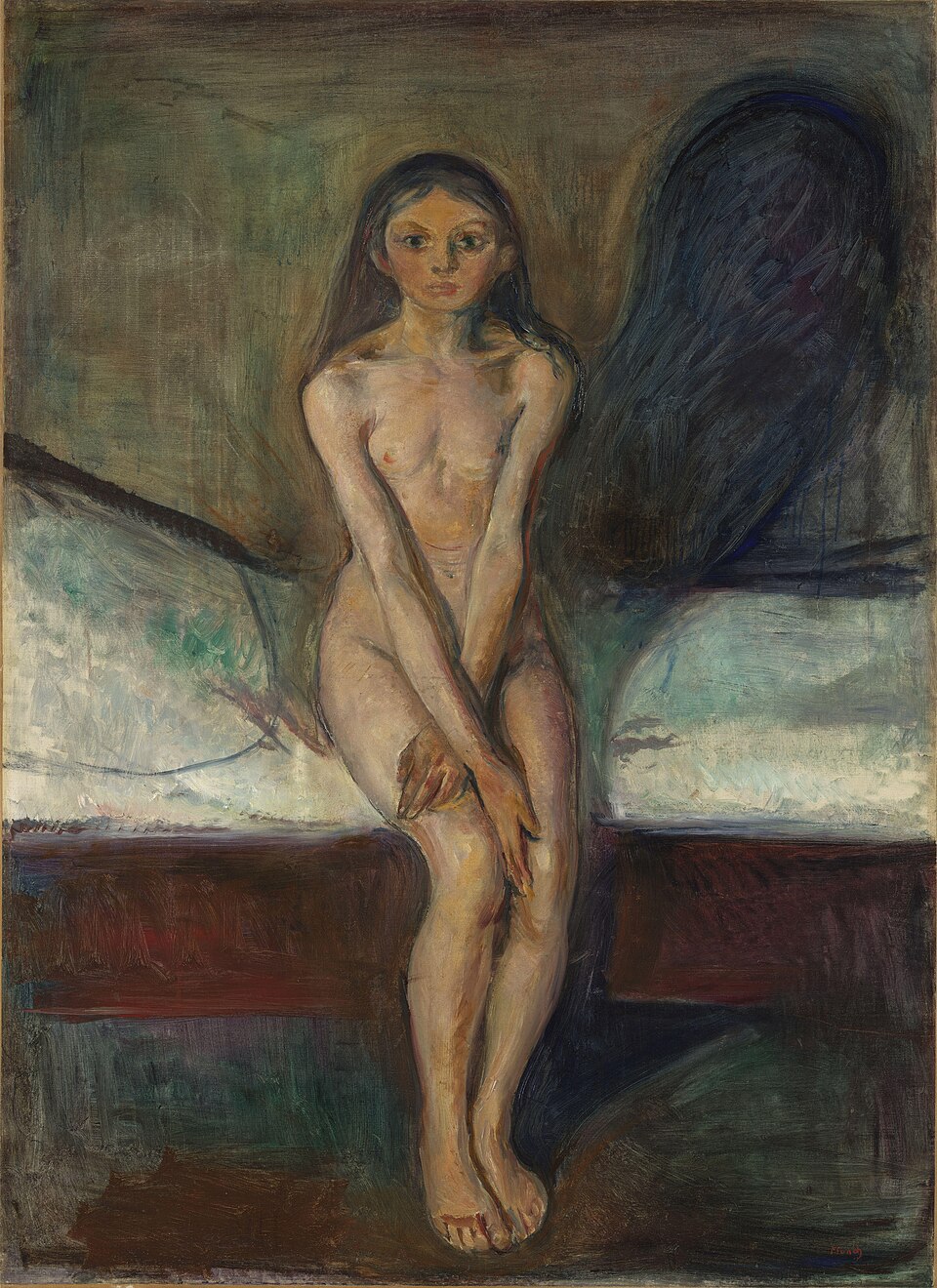
A young girl sits on the edge of a bed, arms crossed before her, eyes wide open. Behind her rises a dark shadow that seems larger than she is. Munch turned the fear and uncertainty of growing up into one of his most haunting images.
The story behind the painting
Wikipedia dates Puberty to 1894 to 1895, while Wikidata gives 1895. By then Munch had made a name for himself in Berlin, where he lived among a circle of friends who, according to the article, deepened his own troubled feelings about sexuality. Munch claimed that this painting was a copy of an earlier version he had first made in 1885 or 1886, and that the earlier canvas had been lost in a studio fire. The picture belongs to The Frieze of Life, the informal cycle of paintings and prints on love, anxiety and death that Munch worked on through the 1890s and returned to for the rest of his career.
What to look for
The girl sits on the edge of the bed, her legs pressed together. One hand lies between her knees, the other rests on her right thigh. She stares straight ahead with wide open eyes and a closed mouth, her long hair falling over and behind her shoulders. Light enters from the left. Behind her, on the wall, a dark and ominous shadow spreads out, not quite matching her shape. The room is plain and the colours restrained, so everything draws the eye back to her stillness and her gaze. The canvas is large, about 151.5 by 110 cm, which gives the small figure and her shadow a strong presence.
Meaning and intent
The motif is often read as a symbol of anxiety and fear, and of the physical and psychological changes of a young person on the way to adulthood. The shadow behind the girl seems to hold what she cannot yet name. Munch gave the image several titles over time: first The Young Model, then Puberty, and later At Night. As the source puts it, the image can sustain readings from a view of a model by an artist to an evocation of nocturnal fears. The painting is linked both to Symbolism, from which Munch emerged, and to Expressionism, in which he became a pivotal figure.
Legacy
Critics have long compared the work to an etching by the Belgian artist Félicien Rops, Don Juan's Greatest Love, published in 1882 in Jules Barbey d'Aurevilly's Les Diaboliques. The first publication devoted to Munch, by Przybyszewski in 1894, already noted the similarity. Munch always denied any influence. The historian Arne Eggum suggested that the likeness is why Munch insisted on his lost earlier version, though Eggum gave the etching's date as 1886, when the source says it was 1882. Munch also made the motif as a lithograph and an etching. Puberty is seen as a turning point in how he put his feelings into art, and it hangs in the National Museum in Oslo.
¿Sabías que…?
- Wikipedia dates it 1894-1895; Wikidata gives 1895.
- Part of Munch's cycle The Frieze of Life.
- Munch said it copied an earlier version lost in a studio fire.
- Also made as a lithograph and an etching.
Sobre el artista
Edvard Munch (1863-1944)
retrato · desnudo · melena · cama · mama · castaño claro · almohada · Galería Nacional de Noruega · Museo Nacional de Arte, Arquitectura y Diseño
Más obras de Edvard Munch
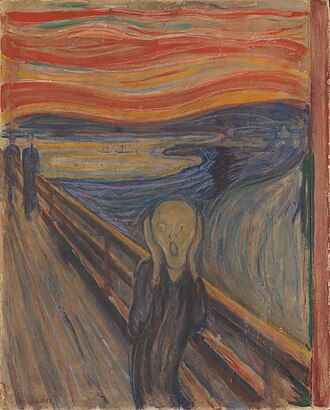 El grito - Edvard Munch (1893)
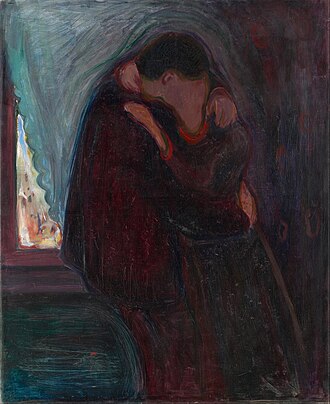 El Beso - Edvard Munch (1897)
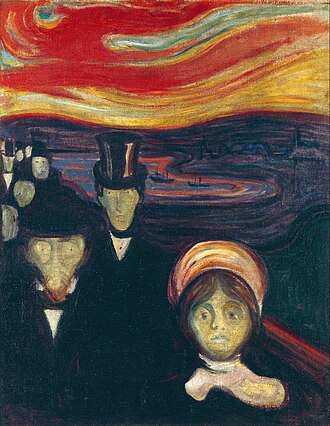 Ansiedad - Edvard Munch (1894)
.jpg) Inger en la playa - Edvard Munch (1889)
Inger en la playa - Edvard Munch (1889).jpg) Tarde en Karl Johan - Edvard Munch (1892)
Tarde en Karl Johan - Edvard Munch (1892)%2C%20NG.M.01111.jpg) Noche en Saint-Cloud - Edvard Munch (1890)
Noche en Saint-Cloud - Edvard Munch (1890) Autorretrato con cigarrillo - Edvard Munch (1895)
%2C%20Kunsthalle%20Bremen.jpg) La madre muerta y su hija - Edvard Munch (1899)
La madre muerta y su hija - Edvard Munch (1899)