La tormenta
Edvard Munch · 1893
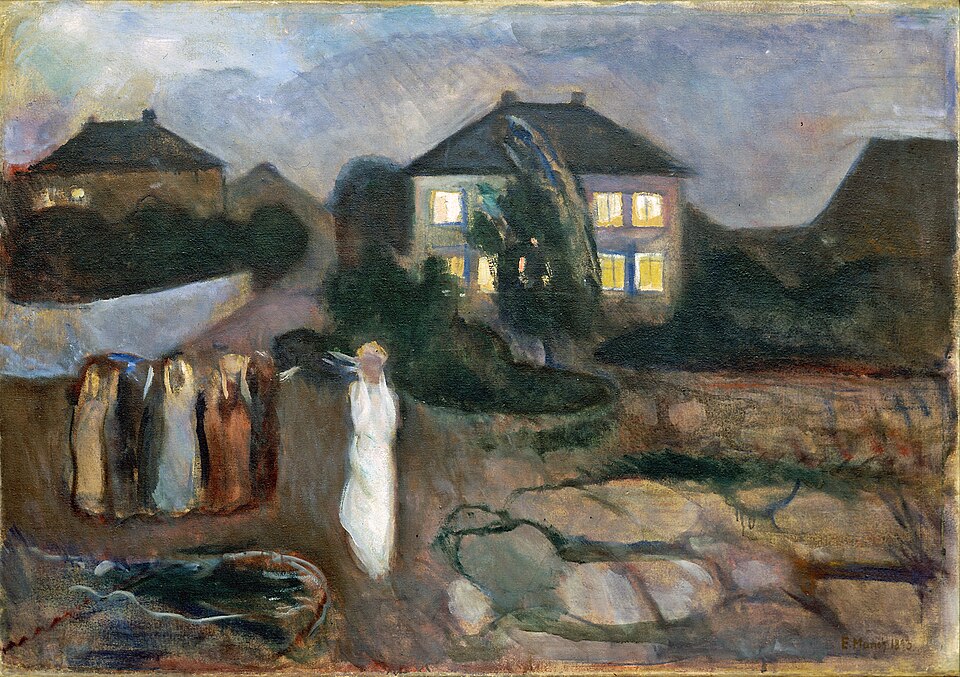
On a summer evening in Åsgårdstrand a sudden storm bent the trees, and a group of women gathered on the shore. Munch painted them with their hands pressed to their ears, in the same year as The Scream.
The story behind the painting
Munch painted The Storm in 1893 at Åsgårdstrand on the Oslofjord, a well-known seaside resort for people from the Norwegian capital. Jens Thiis, later director of the National Gallery in Oslo, wrote in his memoirs that the picture recorded a real event. He had stayed that summer in the very hotel lit up in the background. After a fine summer day a storm broke out, and a group of women gathered on the beach to watch for their fisherman husbands trying to reach the shore. According to Thiis, Munch painted the scene the next day, and the woman in white was Ragna Vilhelmine Dons, whom Munch would marry in 1895.
What to look for
The light is the bluish red dusk of a Nordic summer night, and a strong wind pushes the trees to the left. The house behind is lit from inside, and its yellow was partly scraped away to make it glow brighter. On the beach in front stands a group of women in dresses of different colours, their bodies only sketched. Slightly left of centre one woman in a white dress has stepped away from the group and walks toward the jetty. All of them hold their hands over their ears. Look also for the bright star in the sky: in some reproductions it is missing, because image software removed it as an unwanted white spot.
Meaning and intent
For Ulrich Bischoff, Munch built a dramatic image of nature out of naturalistic parts, until it became an inner landscape. The safe, well lit house the women have left stands against the powerful forces of the dark night. Their gesture is a shield against the wind, but also an expression of inner tension, and in a figurative sense the state of a society stretched to breaking point, as in the plays of Henrik Ibsen. Ann Temkin, a curator at MoMA, stresses the contrast between the closed group of five or six women and the isolated figure, and sees in it Munch's feeling of standing outside society as an artist. The hands on the ears recall The Scream, painted the same year.
Legacy
The astrophysicist Donald W. Olson of Texas State University established that a storm matching this description did strike Åsgårdstrand on the evening of 19 August 1893. He identified the bright star as Arcturus, the brightest star in the constellation Boötes, which places the storm at around nine in the evening. A woman in a white dress returns in other major works by Munch, such as The Woman in Three Stages and The Dance of Life. The painting belonged to H. Irgens Larsen and his wife and was given to the Museum of Modern Art in New York in 1974. Bischoff notes that it is less known in Europe than in the United States.
¿Sabías que…?
- Painted in 1893 at Åsgårdstrand on the Oslofjord.
- Records a real storm, dated by an astrophysicist to the evening of 19 August 1893.
- The bright star in the sky is identified as Arcturus.
- Given to the Museum of Modern Art, New York, in 1974.
Sobre el artista
Edvard Munch (1863-1944)
Más obras de Edvard Munch
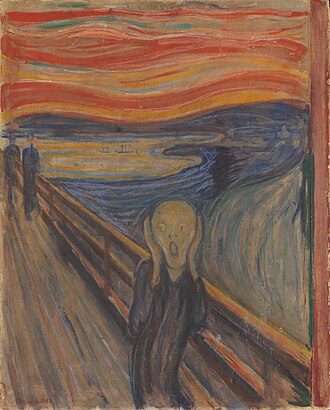 El grito - Edvard Munch (1893)
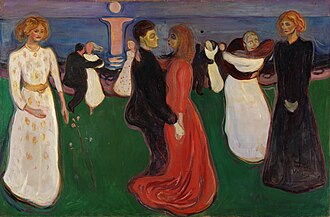 La danza de la vida - Edvard Munch
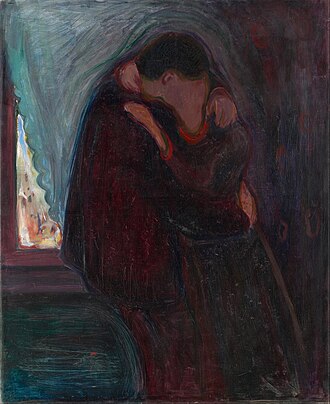 El Beso - Edvard Munch (1897)
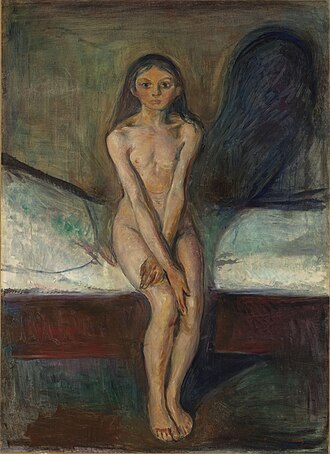 Pubertad - Edvard Munch (1895)
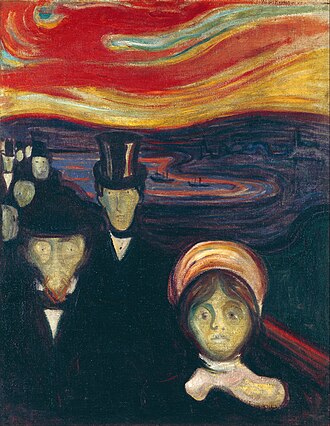 Ansiedad - Edvard Munch (1894)
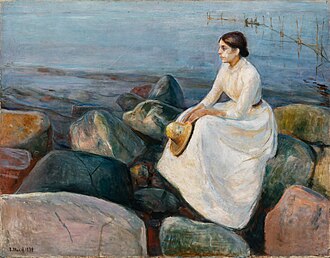 Inger en la playa - Edvard Munch (1889)
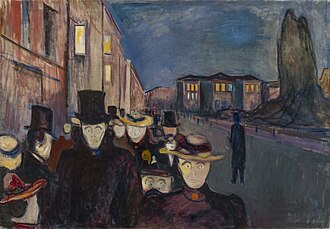 Tarde en Karl Johan - Edvard Munch (1892)
 Noche en Saint-Cloud - Edvard Munch (1890)