The Royal End
Paul Gauguin · 1892
%20-%20Google%20Art%20Project.jpg)
A severed head rests on a white cushion, mourners nearby, strange carved figures on the walls. Gauguin painted it in Tahiti in 1892 on rough cloth, and for decades it was, in a Getty curator's words, the most famous Gauguin no one had seen.
The story behind the painting
In 1891 Gauguin sailed to Tahiti expecting an untouched Eden, but found Papeete heavily Europeanised. After three months he moved to the village of Mataiea, where he painted dozens of pictures. In June 1892 he wrote to his friend Daniel de Monfreid that he had just finished a severed head nicely arranged on a white cushion, in a palace and guarded by women, all of his own invention. The death of King Pomare V soon after Gauguin arrived, and a guillotine execution he had seen years earlier, are both thought to have shaped the work.
What to look for
The cloth is coarse, like burlap, which stresses the rustic feel of the imaginary palace. Colours run from muted purples and browns to yellows, reds and vivid pinks. The head lies on a low table or platter with only a hint of blood. A nude woman crouches nearby in despair, and a figure outside the room seems to announce the death to people further away. Tiki-like figures and geometric patterns fill the interior. At upper left the words ARii MATAMOE are written in crisp capitals: noble or royal, and sleeping eyes, here meaning death.
Meaning and intent
Pomare V was never beheaded or displayed in this way, and such rituals were at best uncommon in Tahiti. Gauguin later wrote in Noa Noa that the death of the last Tahitian king seemed to him a metaphor for native culture disappearing under Europeans. He mixed Tahitian, Javanese, French and Peruvian motifs, and the head echoes European images of John the Baptist and Orpheus. The scholar Elizabeth Childs saw him trying to prove himself to the Paris market; a Getty curator thought he meant to shock Parisians; Scott C. Allan called it a symbolic self-portrait.
Legacy
Durand-Ruel showed it in Paris in November 1893 with 40 other new Gauguins, but it did not sell then. The painter Henry Lerolle bought it at Drouot in 1895, and it later passed through Emile Roche and the lawyer Georges Leven; Leven's heirs sent it to a Geneva gallery during the war. A Swiss collector kept it after 1946 and lent it only once. In March 2008, after eight years of talks, the J. Paul Getty Museum announced its purchase. Curator Scott Schaefer called it the ultimate still life, and after a light cleaning it went on public view.
¿Sabías que…?
- Painted in Tahiti in 1892 on coarse cloth.
- ARii MATAMOE means noble and sleeping eyes, implying death.
- Shown by Durand-Ruel in Paris in 1893.
- At the J. Paul Getty Museum since 2008.
Sobre el artista
Paul Gauguin (1848-1903)
mesa · Museo J. Paul Getty · cojín · cabeza humana · palacio
Más obras de Paul Gauguin
 ¿De dónde venimos? ¿Qué somos? ¿Adónde vamos? - Paul Gauguin (1897-1898)
%201889.jpg) El Cristo amarillo - Paul Gauguin (1889)
El Cristo amarillo - Paul Gauguin (1889)%201892%2C%20oil%20on%20canvas%2C%20101%20x%2077%20cm.jpg) ¿Cuando te casas? - Paul Gauguin (1892)
¿Cuando te casas? - Paul Gauguin (1892) Mujeres de Tahití - Paul Gauguin (1890)
.jpg) La visión tras el sermón - Paul Gauguin (1888)
La visión tras el sermón - Paul Gauguin (1888)El espíritu de los muertos vela - Paul Gauguin (1892)
 Van Gogh pintando girasoles - Paul Gauguin (1888)
%20The%20Metropolitan%20Museum%20of%20Art1.jpg) Ia Orana Maria - Paul Gauguin (1891)
Ia Orana Maria - Paul Gauguin (1891)
Obras de artistas relacionados
 La noche estrellada - Vincent van Gogh (1889)
.jpg) Terraza de café por la noche - Vincent van Gogh (1888)
Terraza de café por la noche - Vincent van Gogh (1888) Paseo a orillas del mar - Joaquín Sorolla (1909)
 Triste herencia - Joaquín Sorolla (1898)
 Baile en el Moulin de la Galette - Pierre-Auguste Renoir (1876)
 El almuerzo de los remeros - Pierre-Auguste Renoir (1881)
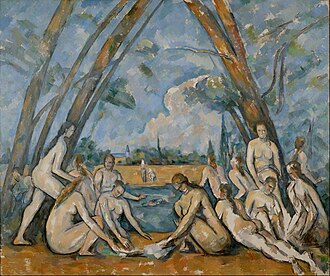 Las grandes bañistas - Paul Cézanne (1900s)
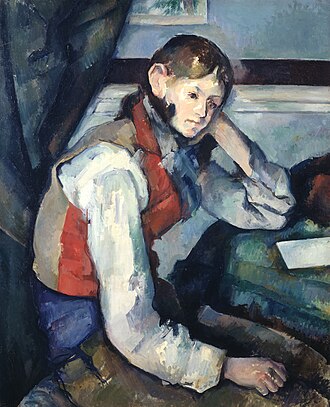 The Boy in the Red Vest - Paul Cézanne
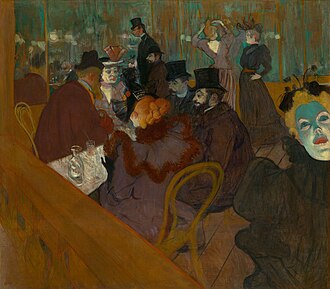 En el Moulin Rouge - Henri de Toulouse-Lautrec (1892)
%20Rousse%20(La%20Toilette)%20-%201889%20-%20Henri%20de%20Toulouse-Lautrec%20-%20Mus%C3%A9e%20d'Orsay%2C%20Paris.jpg) La toilette - Henri de Toulouse-Lautrec (1896)
La toilette - Henri de Toulouse-Lautrec (1896)