The Martyrdom of S. Catherine
Pedro Pablo Rubens · 1615
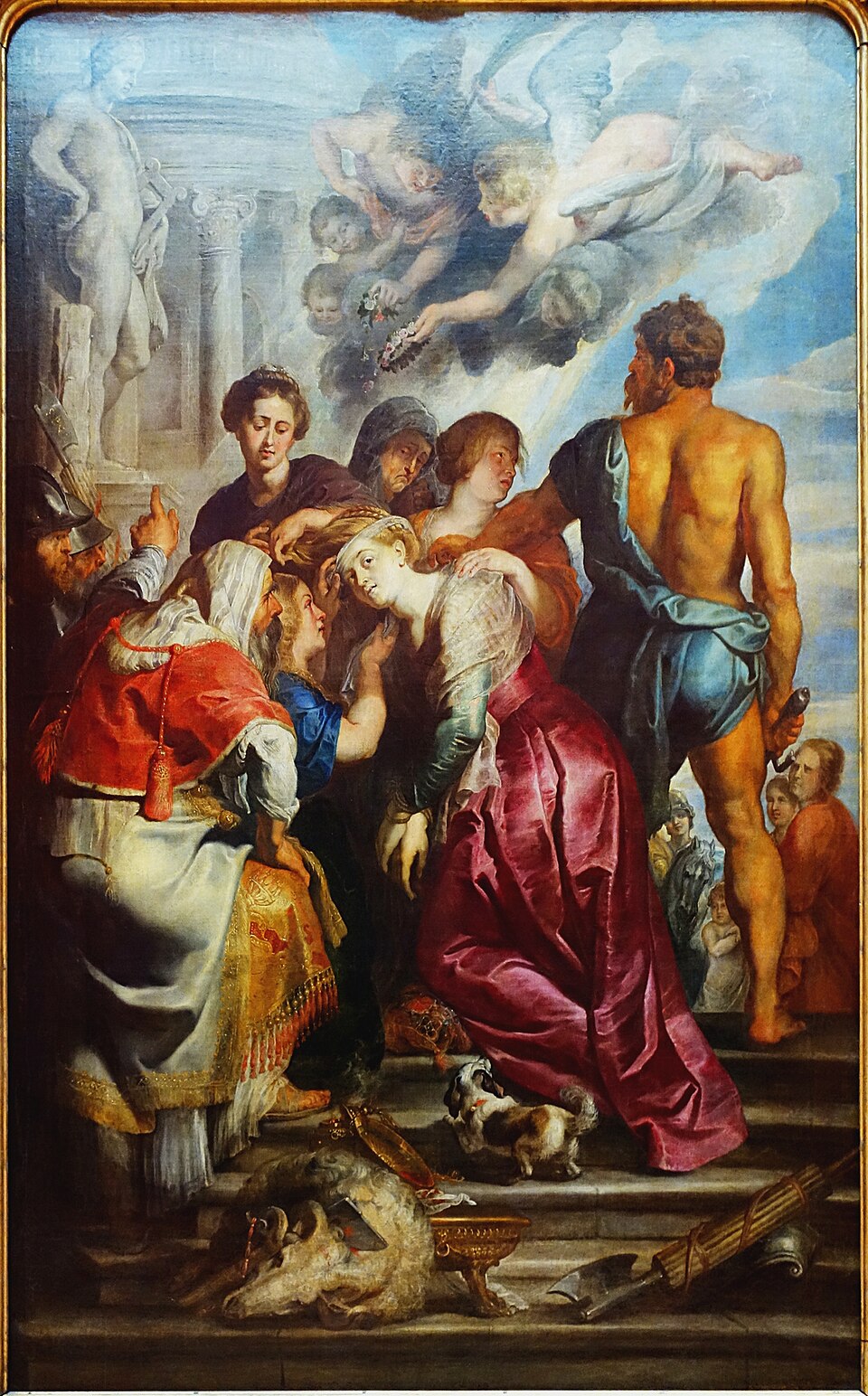
A young saint in a pink dress kneels on the steps of a pagan temple, women baring her shoulders, the executioner waiting, while angels already fly down with a crown of flowers. Rubens painted this suspended instant for a church altar in Lille around 1615.
The story behind the painting
The painting was a gift from Jean de Seur and his wife to the church of Sainte-Catherine in Lille, to adorn its high altar. Jean de Seur was a counsellor to the Archdukes Albert and Isabella and later an official of their finances, and he was a parishioner of the church, where he was buried in 1621. The choice of subject follows the dedication: in the Golden Legend, Catherine of Alexandria, an Egyptian princess, refused to marry the emperor Maxentius in order to devote herself to Christ, survived the torture of the wheel, which miraculously broke, and was then beheaded.
What to look for
Rubens shows the moment just before the beheading. The saint kneels on the steps of a monumental staircase at the foot of a statue of Apollo, before the colonnade of an ancient temple. One woman is about to blindfold her, a second lifts her hair and a third uncovers her shoulders. She is framed by two men seen from behind, a philosopher on the left and the executioner on the right. Near a lictor's bundle of rods lies a ram, with a great blade resting there. Above, angels descend with a crown of flowers, and a small dog watches from the bottom of the picture.
Meaning and intent
The pagan statue of the sun god set against the Christian martyr creates a theological contrast: paganism fades before her sacrifice. Splitting the gestures among the women slows the action and delays the fatal moment, raising the tension, while the symmetrical framing turns the execution into a spectacle. Painted in the context of the Catholic Reformation, the work acts like a painted sermon. Light seems concentrated on the saint's body, setting her apart from the surrounding darkness, and rich colour and sensual paint speak to the senses, inviting the faithful to meditate on constancy in faith under persecution.
Legacy
The painting's journey reflects the fate of church heritage. During the French Revolution the church of Sainte-Catherine was turned into a barn and much of its furnishing destroyed. In the nineteenth century the interior was remodelled in a Neo-Gothic style, and the present frame, decorated with symbols such as the broken wheel of the martyrdom, comes from that campaign. The work was classified as a historic monument object on 15 April 1896. Since 1965 it has been kept in the Palais des Beaux-Arts de Lille. It measures 390 by 249 cm, a tall altarpiece meant to be seen from the nave.
¿Sabías que…?
- Painted around 1615 for the high altar of Sainte-Catherine in Lille.
- Donated by Jean de Seur, an official of the Archdukes Albert and Isabella.
- Shows the moment before the saint's beheading.
- In the Palais des Beaux-Arts de Lille since 1965.
Sobre el artista
Pedro Pablo Rubens (1577-1640)
arte religioso · mujer · ángel · perro · Catalina de Alejandría · Palais des Beaux-Arts de Lille · Apolo · corona
Más obras de Pedro Pablo Rubens
 La elevación de la cruz - Peter Paul Rubens (1609)
 Rapto de las hijas de Leucipo - Peter Paul Rubens (1618)
 Autorretrato con su esposa Isabel Brant - Peter Paul Rubens (1600s)
 Sansón y Dalila - Peter Paul Rubens (1600s)
 Descendimiento de Cristian - Peter Paul Rubens (1611)
 Head of Medusa - Peter Paul Rubens (1618)
 Helena Fourment saliendo del baño - Peter Paul Rubens (1638)
 El jardín del amor - Peter Paul Rubens (1632)
Obras de artistas relacionados
 La noche estrellada - Vincent van Gogh (1889)
 Terraza de café por la noche - Vincent van Gogh (1888)
 La cena de Emaús - Caravaggio (1601)
 La vocación de San Mateo - Caravaggio (1609)
 Las meninas - Diego Velázquez (1656)
 La rendición de Breda - Diego Velázquez (1635)
 Saint Francis in Meditation - Francisco de Zurbarán (1639)
 Inmaculada Concepción - Francisco de Zurbarán (1661)
 Triple retrato de Carlos I - Anthony van Dyck (1635)
 Charles I (1600-1649) with M. de St Antoine - Anthony van Dyck (1636)
 La ronda de noche - Rembrandt van Rijn (1642)
 Autorretrato - Rembrandt van Rijn (1659)