La guirnalda de frutas
Pedro Pablo Rubens · 1610s
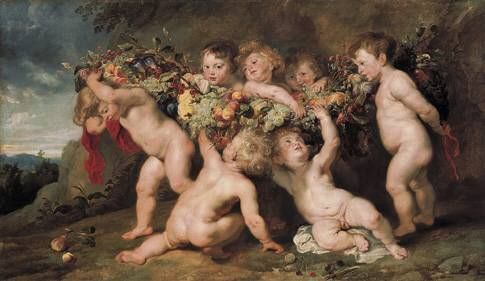
A band of plump children strain to carry a huge garland of fruit, and some of them were Rubens's own. Three Antwerp painters shared this one canvas, and it became one of the most famous pictures of putti in the history of art.
The story behind the painting
The Fruit Garland, also called The Wreath of Fruit, was made in Rubens's Antwerp workshop around 1616 to 1617, according to the French Wikipedia article, while Wikidata gives only the 1610s. It was a joint work: Rubens painted the children as putti, the still-life specialist Frans Snyders painted the garland of fruit, and the landscape painter Jan Wildens completed the background. Rubens used his own children, Clara, Serena and Albert, born to his wife Isabella Brant between 1611 and 1615, as models for the putti.
What to look for
Look at how the chubby, naked bodies of the children echo the round, fleshy forms of the fruit they carry, giving the whole canvas a Baroque energy. The putti, like cupids or little Erotes, struggle under the weight of the heavy garland, which Snyders painted with the care of a still life. Behind them stretches the landscape by Wildens. The canvas is large, about 120 by 204 cm. A similar arrangement of children and fruit appears in a sketch, The Image of Ceres by Jan Brueghel the Elder, now in the Hermitage in Saint Petersburg.
Meaning and intent
The fruit garland is an allegorical motif which, like the horn of plenty, stands for happiness and the fullness of life. It grew out of fertility symbols from Greek and Roman mythology and was cultivated in Italian Renaissance painting, for example by Andrea Mantegna, whose work Rubens had studied in Italy. The putti underline that symbolism. Because of the Brueghel sketch, the painter and writer Hermann Knackfuss supposed that Rubens developed his motif from that image. The work is sometimes also called The Luck of Time.
Legacy
The painting entered the Dusseldorf collection of Johann Wilhelm, Elector Palatine, and in the 18th century hung in the Rubens room of his gallery in Dusseldorf Castle, where visitors included the travel writer Georg Forster. Like most of that collection, it moved to Munich in 1806 and was shown in the Pinakothek, opened in 1836, where it left an unforgettable impression on Jacob Burckhardt. In Munich it was reproduced again and again: lithograph, galvanograph, engravings, a photograph by Franz Hanfstaengl, a copy, and even a painting on porcelain.
¿Sabías que…?
- Painted jointly by Rubens, Frans Snyders and Jan Wildens.
- Rubens's children Clara, Serena and Albert were models for the putti.
- Dated 1616 to 1617 by Wikipedia, the 1610s by Wikidata.
- Moved from Dusseldorf to Munich in 1806.
Sobre el artista
Pedro Pablo Rubens (1577-1640)
Colecciones de Pinturas del Estado de Baviera · Johann Wilhelm von der Pfalz collection
Más obras de Pedro Pablo Rubens
 La elevación de la cruz - Peter Paul Rubens (1609)
 Rapto de las hijas de Leucipo - Peter Paul Rubens (1618)
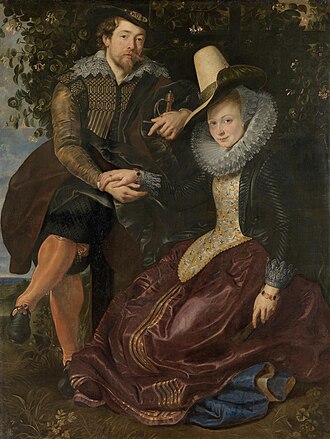 Autorretrato con su esposa Isabel Brant - Peter Paul Rubens (1600s)
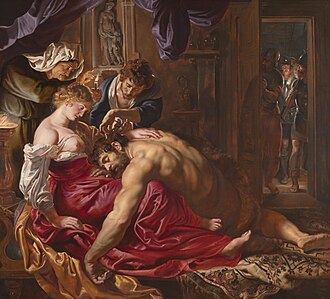 Sansón y Dalila - Peter Paul Rubens (1600s)
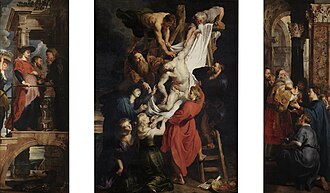 Descendimiento de Cristian - Peter Paul Rubens (1611)
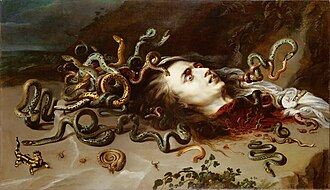 Head of Medusa - Peter Paul Rubens (1618)
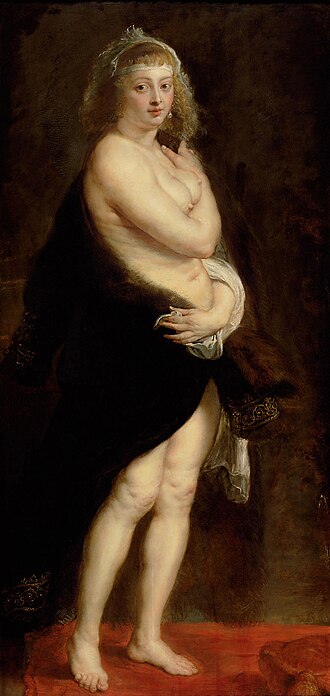 Helena Fourment saliendo del baño - Peter Paul Rubens (1638)
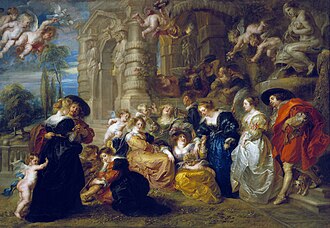 El jardín del amor - Peter Paul Rubens (1632)
Obras de artistas relacionados
 La noche estrellada - Vincent van Gogh (1889)
 Terraza de café por la noche - Vincent van Gogh (1888)
 La cena de Emaús - Caravaggio (1601)
 La vocación de San Mateo - Caravaggio (1609)
 Las meninas - Diego Velázquez (1656)
 La rendición de Breda - Diego Velázquez (1635)
 Saint Francis in Meditation - Francisco de Zurbarán (1639)
 Inmaculada Concepción - Francisco de Zurbarán (1661)
 Triple retrato de Carlos I - Anthony van Dyck (1635)
 Charles I (1600-1649) with M. de St Antoine - Anthony van Dyck (1636)
 La ronda de noche - Rembrandt van Rijn (1642)
 Autorretrato - Rembrandt van Rijn (1659)