Almuerzo de campesinos
Diego Velázquez · 1618
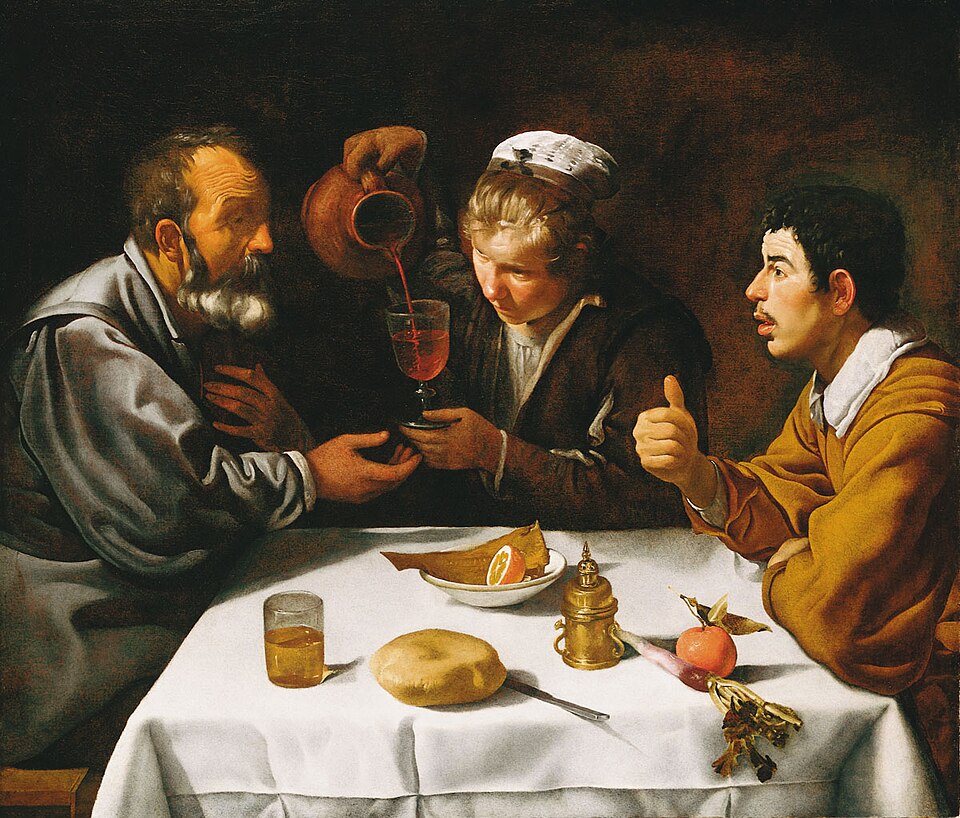
Three country people share a simple meal, one man mid-story, another holding out his cup for more wine. A very young Velázquez studied every face and every loaf with remarkable care.
The story behind the painting
The Farmers' Lunch, in Spanish Almuerzo de campesinos, is one of the earliest paintings by Diego Velázquez, an oil on canvas. Its date differs slightly between our sources: Wikipedia gives 1617, while Wikidata records 1618. Either way, the painter was still a teenager from Seville. Velázquez was baptized there in 1599 and trained under Francisco Pacheco, whose school taught proportion and perspective. In these early years he specialized in bodegones, kitchen and tavern scenes with prominent still lifes, and he was among the first Spanish artists to work in this everyday subject. This picture belongs to that world, combining a still life of food and drink with three comic farmers whose faces the young artist studied closely.
What to look for
Begin with the younger man. He gestures with his right hand, and his lips are half open, as if we have arrived in the middle of his story. Beside him an older man listens attentively, holding his cup up toward a woman so she can refill it with wine. Now let your eyes drift down to the table, where the still life waits: fish, bread, a carrot, a lemon and a copper vessel. Notice how the painting moves between two kinds of attention, the lively exchange among the three people and the quiet, solid presence of the objects. The work measures 96 by 112 centimeters, so these figures appear close and almost life sized.
Meaning and intent
The painting is a genre scene, a slice of ordinary life rather than history or legend. Its farmers are presented with humor, yet the artist looks hard at their physiognomy, the particular shape and expression of each face. This care fits what is said of his early Seville work more broadly: realism, dramatic lighting, and ordinary people depicted with dignity and close observation. Telling a story, listening, pouring wine: these small gestures become the subject itself. Placing them beside humble foods lets the painting celebrate both people and things, inviting us to find interest in a plain meal that most artists of the time would not have thought worth painting.
Legacy
The Farmers' Lunch is in the Museum of Fine Arts in Budapest. It is closely related to another early work, The Lunch of about 1617, whose composition is very similar, so the two are often mentioned together, though they remain separate paintings. They belong to the bodegón period that led toward later Seville works such as Old Woman Frying Eggs and The Waterseller of Seville, the latter described as the peak of Velázquez's bodegones. Seen in Budapest today, this small gathering of laughing farmers offers a rare glimpse of a great painter at the very start of his career, already convinced that ordinary life deserved a serious look.
¿Sabías que…?
- One of Velázquez's earliest paintings, oil on canvas
- Dated 1617 by Wikipedia and 1618 by Wikidata
- Its composition is very similar to Velázquez's The Lunch (c. 1617)
- Collection: Museum of Fine Arts, Budapest
Wikipedia · Wikipedia: Diego Velázquez · Wikidata
Sobre el artista
Diego Velázquez (1599-1660)
Más obras de Diego Velázquez
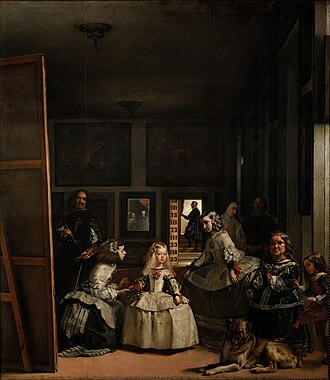 Las meninas - Diego Velázquez (1656)
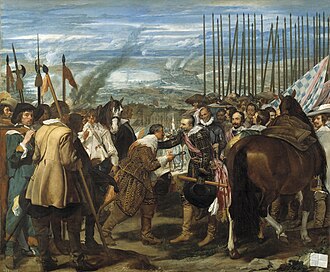 La rendición de Breda - Diego Velázquez (1635)
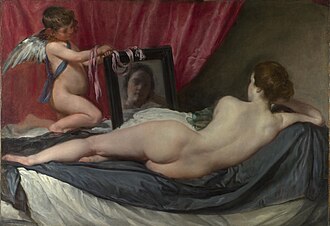 Venus del espejo - Diego Velázquez (1644)
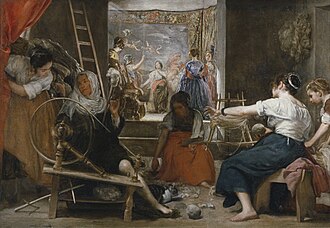 Las Hilanderas - Diego Velázquez
.jpg) Inocencio X - Diego Velázquez
Inocencio X - Diego Velázquez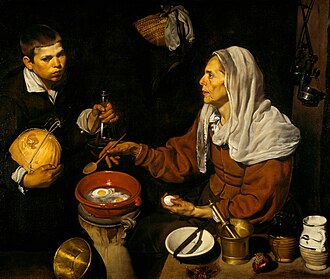 Vieja friendo huevos - Diego Velázquez (1618)
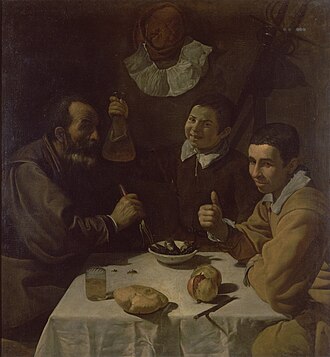 El almuerzo - Diego Velázquez (1617)
.jpg) El triunfo de Baco - Diego Velázquez (1628)
El triunfo de Baco - Diego Velázquez (1628)
Obras de artistas relacionados
 La cena de Emaús - Caravaggio (1601)
 La vocación de San Mateo - Caravaggio (1609)
 La ronda de noche - Rembrandt van Rijn (1642)
 Autorretrato - Rembrandt van Rijn (1659)
 La joven de la perla - Johannes Vermeer (1665)
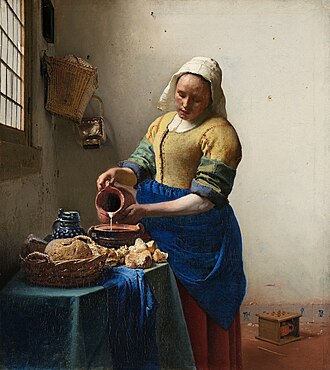 La lechera - Johannes Vermeer (c. 1658)