The Crystal Palace
Camille Pissarro · 1871
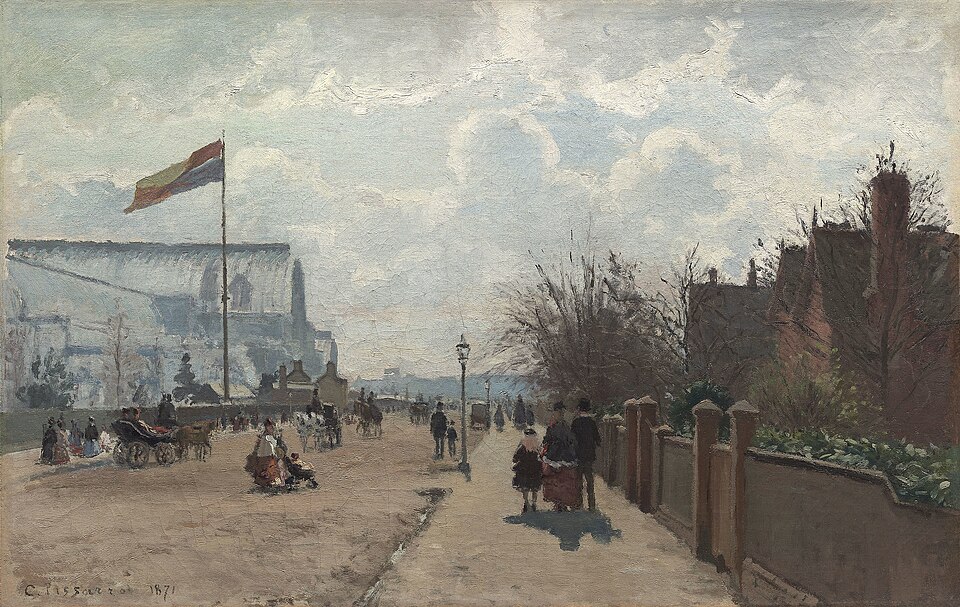
A quiet suburban street in early spring, long shadows, a woman pushing a pram, and at the edge of the frame one of the largest buildings in the world. Pissarro painted it in 1871, as a refugee from war.
The story behind the painting
After the Franco-Prussian War began in 1870, Pissarro fled Louveciennes with his pregnant partner Julie Vellay and their children, first to his friend Ludovic Piette in Lassay-les-Châteaux. There a daughter, Adèle-Emma, was born on 21 October and died on 5 November 1870. The family then sailed to England and settled in West Norwood, south London, near his mother and brother. In London he met Claude Monet and the dealer Paul Durand-Ruel, and he married Julie on 14 June 1871, just before returning to France.
What to look for
The canvas, 47.2 by 73.5 cm, shows Crystal Palace Parade in Sydenham on an early spring day: bare trees, a few carriages, an open carriage suggesting mild weather. A man, woman and child walk away from us, their long shadows falling toward the viewer in low backlight. A woman crosses the street with a pram. No face is visible. Lamp posts, a flagpole and fence posts cut vertical lines; modest brick houses stand on the right. The glass and iron palace is cropped at the left edge, painted in greys. The sky moves with lively brushwork. It is signed and dated C. Pissarro 1871.
Meaning and intent
The famous building is not the subject but a backdrop to everyday suburban calm. Unlike other painters, Pissarro showed the back of the palace, not its grand front. The road running straight toward the viewer is thought to come from Meindert Hobbema's The Avenue at Middelharnis, which entered the National Gallery in March 1871; Pissarro replaced Hobbema's trees with lamps and a flagpole, joining Dutch Baroque and the modern world. The woman with the pram may allude to the birth and loss of his youngest daughter.
Legacy
The palace, built for the 1851 Great Exhibition and rebuilt in Sydenham, burned down in 1936, so the painting keeps a view that no longer exists. Pissarro painted it again, probably in early summer 1871, in Le Crystal Palace, Upper Norwood. This canvas has been in the Art Institute of Chicago since 1972. Other painters treated the building differently: William White Warren showed it from Penge across green meadows, Daubigny sketched it from the park side in 1866, and Jacques-Émile Blanche filled almost his whole 1907 canvas with it.
¿Sabías que…?
- Painted in 1871 while Pissarro was a war refugee in London.
- Shows Crystal Palace Parade in Sydenham.
- Composition linked to Hobbema's The Avenue at Middelharnis.
- In the Art Institute of Chicago since 1972.
Sobre el artista
Camille Pissarro (1830-1903)
paisaje urbano · Instituto de Arte de Chicago
Más obras de Camille Pissarro
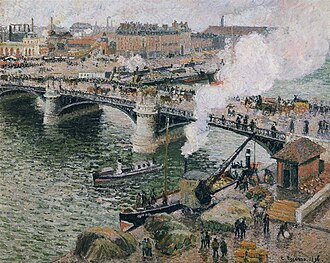 Pont Boieldieu in Rouen, Rainy Weather - Camille Pissarro (1896)
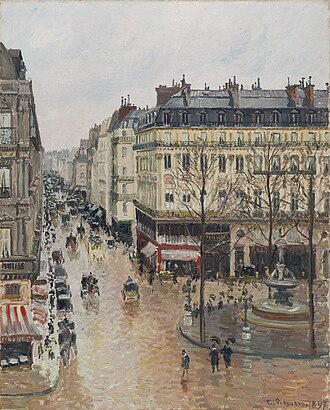 Rue Saint-Honoré por la tarde. Efecto de lluvia. - Camille Pissarro (1897)
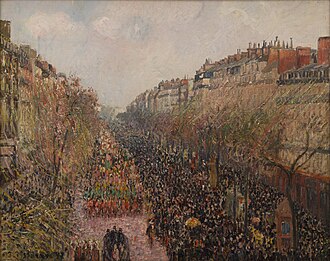 Boulevard Montmartre, Mardi Gras - Camille Pissarro (1897)
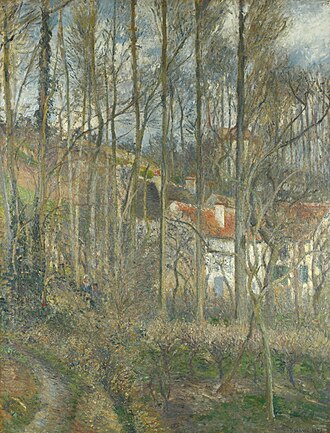 The Côte des Bœufs, Pontoise - Camille Pissarro (1877)
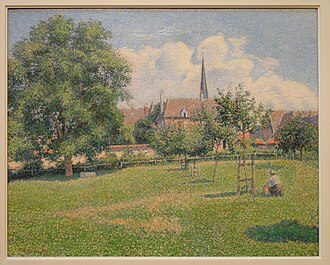 The House of the Deaf Woman and the Belfry at Eragny - Camille Pissarro (1886)
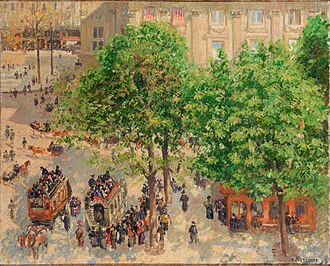 Place du Theatre-Francais in Spring - Camille Pissarro (1898)
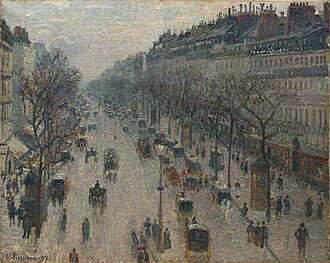 The Boulevard Montmartre on a Winter Morning - Camille Pissarro (1897)
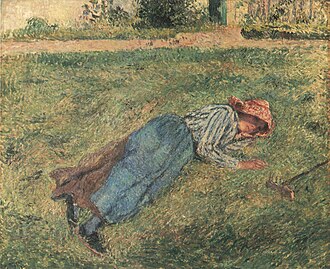 The Nap, Peasant Woman Lying in the Grass, Pontoise - Camille Pissarro (1882)
Obras de artistas relacionados
 Impresión, sol naciente - Claude Monet (1872)
 Nenúfares - Claude Monet (1906)
 Almuerzo sobre la hierba - Édouard Manet (1863)
 Olympia - Édouard Manet (1863)
 Baile en el Moulin de la Galette - Pierre-Auguste Renoir (1876)
 El almuerzo de los remeros - Pierre-Auguste Renoir (1881)
 La cuna - Berthe Morisot (1872)
 Summer's Day - Berthe Morisot (1879)
 El ajenjo - Edgar Degas (1875)
 Die Bellelli Familie - Edgar Degas (1858)
 El canal del Loing - Alfred Sisley (1892)
 The Watering Pond at Marly with Hoarfrost - Alfred Sisley (1876)