La anunciación
El Greco · 1610
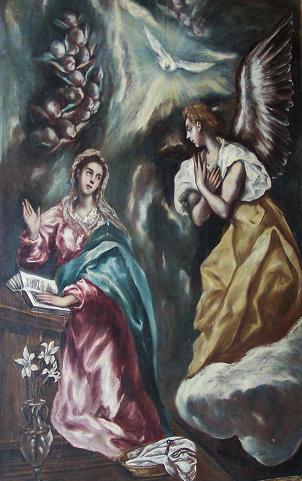
A strong light pours from the dove of the Holy Spirit into the centre of the canvas, and Mary's veil seems to dissolve as it falls on her shoulders. This late Annunciation, kept in Sigüenza, is a work of great emotion.
The story behind the painting
The Annunciation is one of the most repeated subjects in El Greco's work, and this version belongs to the painter's last period, dated around 1610 to 1614 in the article and 1610 in Wikidata. It derives from his Annunciation in the Toledo Museum of Art in Ohio. The episode, told in the Gospel of Luke (1:26-39), is the moment the archangel Gabriel announces to the Virgin Mary that she will be the mother of Jesus through the Holy Spirit. The painting is now in the Museo Diocesano de Arte Antiguo in Sigüenza, and probably came from a suppressed convent, since it is not recorded in Sigüenza in the eighteenth century.
What to look for
Find the dove first: El Greco makes it the focus, with a strong light that fills the central space of the picture. Then look at the lilies, symbols of purity, which in this version and in one variant in the Museo de Santa Cruz appear in a vase on the left. Mary's face keeps its pure, untroubled calm, but the half transparent veil over her head and shoulders seems like a seething mass of forms dissolving into paint. The canvas is oil on canvas and measures 152 by 99 cm.
Meaning and intent
The colours and folds of the robes and the symbolic lilies are examples of the Venetian school that El Greco had absorbed in his youth. Yet the painting also shows the daring of his last years, when forms begin to melt and light seems to burst from within. The contrast is the heart of the work: a still, pure face, and around it a veil and a light that seem alive and moving, as if the mystery being announced were already changing the world around her.
Legacy
The attribution is debated, and the article states both views. Sánchez Cantón and other authors attribute the work to El Greco. Harold Wethey, who catalogued it as number 43, believed that although the drawing must be El Greco's, the emotional qualities and the execution are too weak to be by his own hand. Tiziana Frati lists it as 167-a. Whoever held the brush, the canvas carries the composition El Greco developed from the Toledo, Ohio, prototype into his final years.
¿Sabías que…?
- Derived from El Greco's Annunciation in Toledo, Ohio.
- Dated about 1610 to 1614; Wikidata says 1610.
- Measures 152 by 99 cm, in the Museo Diocesano, Sigüenza.
- Attributed to El Greco by Sánchez Cantón; Wethey doubted his hand.
Sobre el artista
El Greco (1541-1614)
arte religioso · Virgen María · manierismo · ángel · Anunciación
Más obras de El Greco
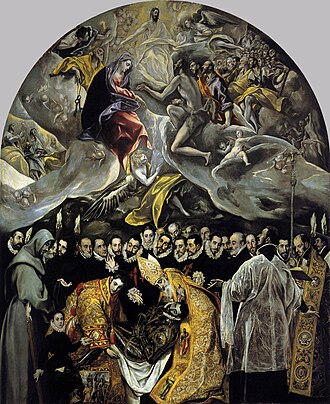 El entierro del Conde de Orgaz - El Greco (1586)
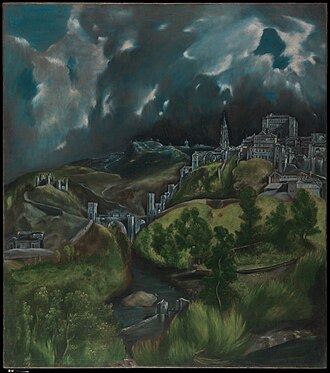 Vista de Toledo - El Greco (1596)
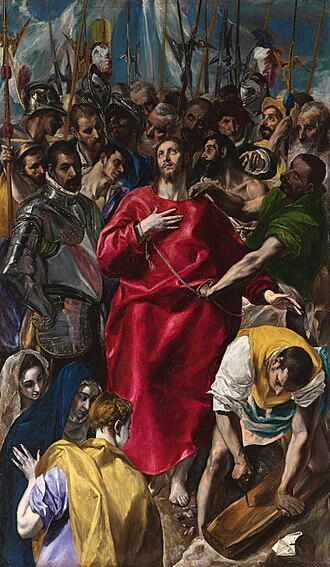 El expolio - El Greco (1570s)
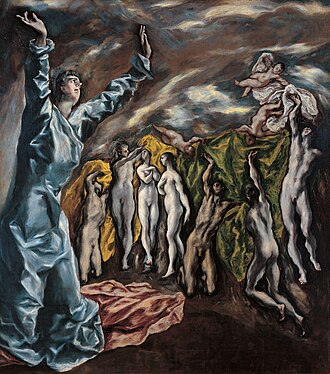 Visión del Apocalipsis - El Greco (1610)
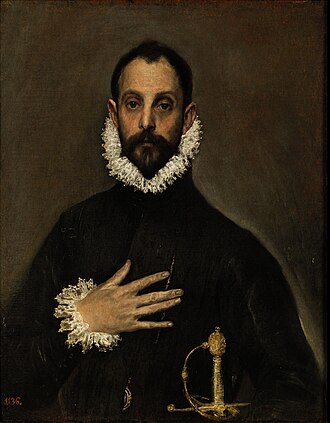 El caballero de la mano en el pecho - El Greco (1580)
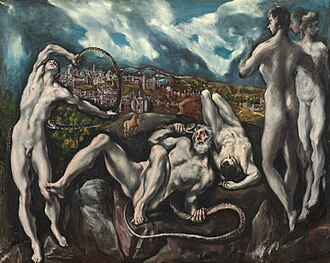 Laocoonte - El Greco (1610s)
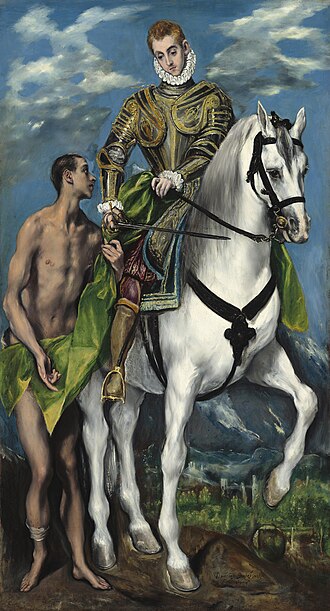 San Martín y el mendigo - El Greco (1597)
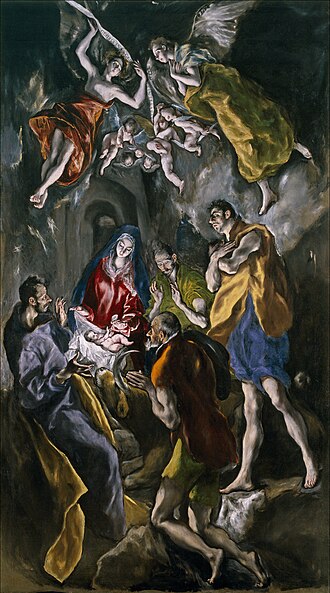 Adoración de los pastores - El Greco (1612)
Obras de artistas relacionados
 Las bodas de Caná - Paolo Veronese (1560s)
 Cena en casa de Leví - Paolo Veronese (1573)
 La Última Cena - Jacopo Tintoretto (1563)
 San Marcos liberando al esclavo - Jacopo Tintoretto (1540s)
 Venus de Urbino - Titian (1538)
 La Asunción de la Virgen - Titian (1510s)
 La cena de Emaús - Caravaggio (1601)
 La vocación de San Mateo - Caravaggio (1609)
 Los embajadores - Hans Holbein the Younger (1533)
 El cuerpo de Cristo en la tumba - Hans Holbein the Younger (1520s)