Santiago el Mayor, peregrino
El Greco · 1590s
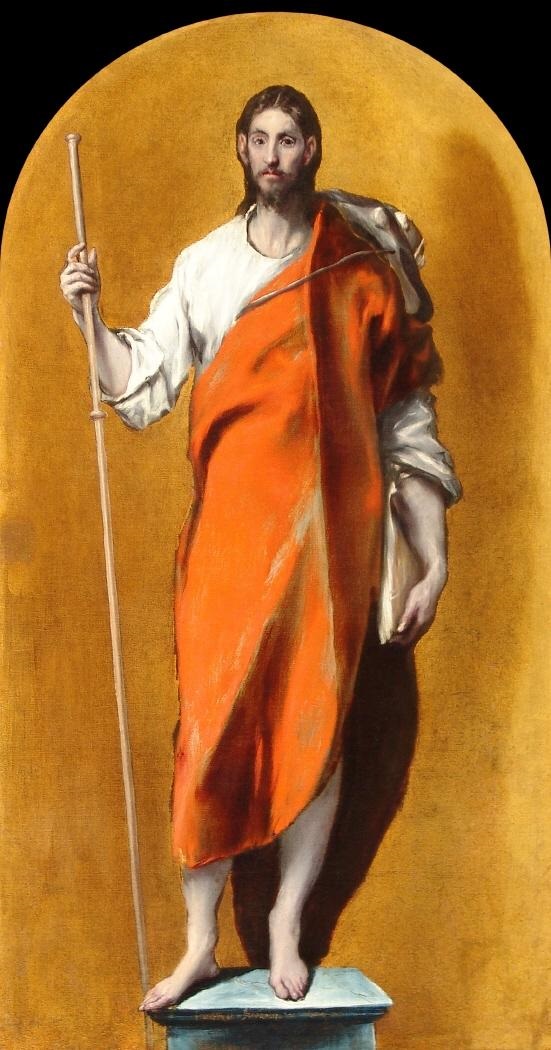
Saint James stands as a pilgrim, red-orange mantle over white, against a golden niche. El Greco rarely painted him alone, and this canvas once crowned a lost altarpiece in Toledo.
The story behind the painting
Apart from his series of apostles, El Greco painted Saint James the Greater very rarely, and there is no record of him painting the saint at the legendary battle of Clavijo, a popular subject in Spain at the time. This canvas belonged to the now vanished altarpiece of Saint Nicholas of Bari in Toledo, where it occupied the top, with a statue of Saint Barbara below and paintings of Saint Augustine and Saint Francis in the predella. Wethey dates it 1590 to 1595 and lists it as number 236.
What to look for
James appears as a pilgrim on the Way of Saint James, with a staff and a hat decorated with scallop shells. He wears a red-orange mantle over a white tunic, standing in a golden yellow niche. The outlines are strongly marked in black, and the red and white of his clothes against the gold background is, in the Spanish Wikipedia account, extraordinary. The figure fills the tall, narrow canvas. He carries a pilgrim's staff.
Meaning and intent
The pilgrim image comes from Romanesque art, when pilgrims who reached Santiago were sold little jet figures of the saint dressed as a pilgrim. José Gudiol saw certain Christ-like features in the face, a young man with a short black beard. The saint is shown not as a warrior but as one of the travellers who walked to his shrine. The scallop shells on his hat are the same sign pilgrims carried.
Legacy
Both Wethey and Gudiol considered this the best of the three paintings from the altarpiece. Gudiol gives its size as 123 by 70 cm. It came from the church of Saint Nicholas of Bari and is now in the Museum of Santa Cruz in Toledo. The altarpiece itself has disappeared, so this canvas is one of the surviving pieces of it. Wethey placed it among El Greco's works of the early 1590s, and it is also catalogued by Gudiol as number 168 and by Tiziana Frati.
¿Sabías que…?
- Painted around 1590-1595, Wethey number 236.
- Once at the top of the altarpiece of Saint Nicholas of Bari, Toledo.
- Shows James with a staff and scallop shells.
- Now in the Museum of Santa Cruz, Toledo.
Sobre el artista
El Greco (1541-1614)
arte religioso · Museo de Santa Cruz
Más obras de El Greco
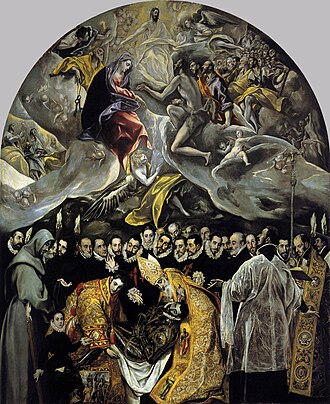 El entierro del Conde de Orgaz - El Greco (1586)
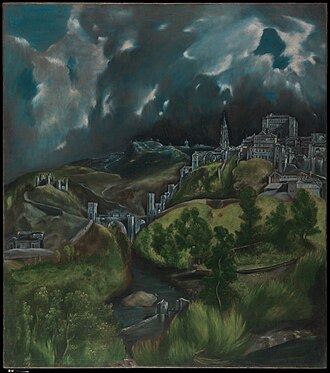 Vista de Toledo - El Greco (1596)
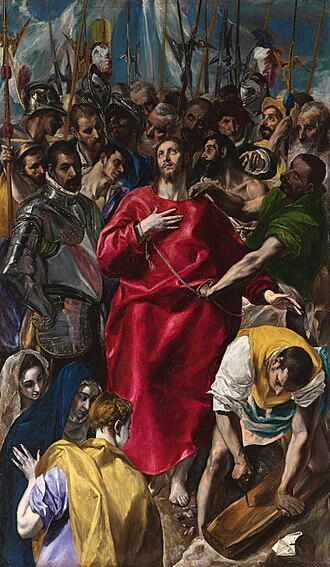 El expolio - El Greco (1570s)
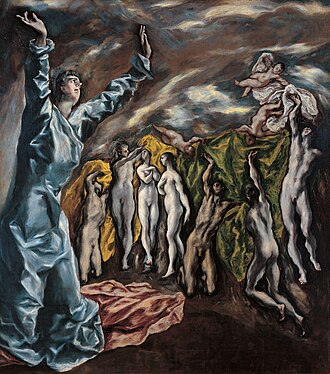 Visión del Apocalipsis - El Greco (1610)
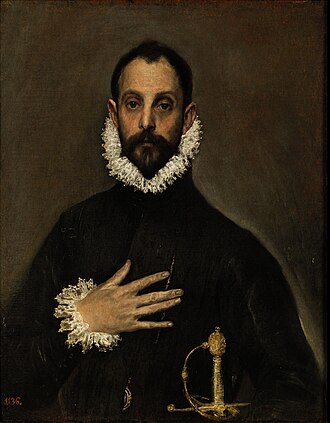 El caballero de la mano en el pecho - El Greco (1580)
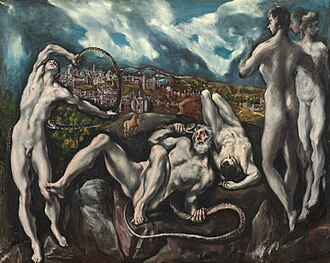 Laocoonte - El Greco (1610s)
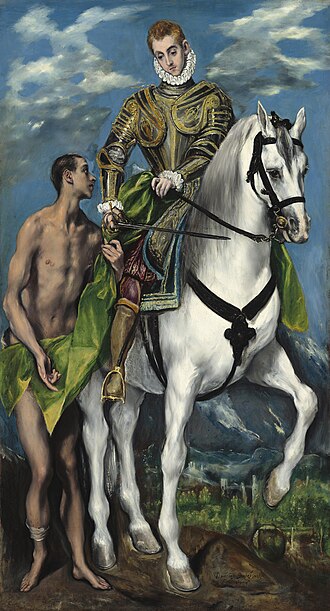 San Martín y el mendigo - El Greco (1597)
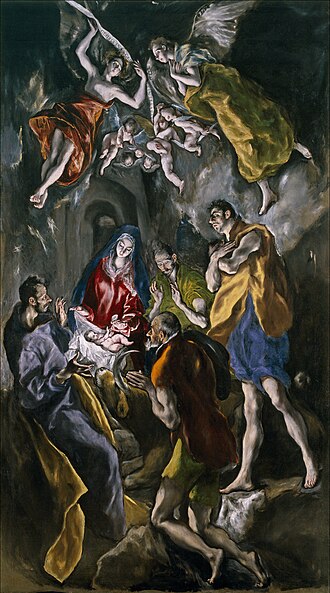 Adoración de los pastores - El Greco (1612)
Obras de artistas relacionados
 Las bodas de Caná - Paolo Veronese (1560s)
 Cena en casa de Leví - Paolo Veronese (1573)
 La Última Cena - Jacopo Tintoretto (1563)
 San Marcos liberando al esclavo - Jacopo Tintoretto (1540s)
 Venus de Urbino - Titian (1538)
 La Asunción de la Virgen - Titian (1510s)
 La cena de Emaús - Caravaggio (1601)
 La vocación de San Mateo - Caravaggio (1609)
 Los embajadores - Hans Holbein the Younger (1533)
 El cuerpo de Cristo en la tumba - Hans Holbein the Younger (1520s)