Autorretrato con halo y serpiente
Paul Gauguin · 1889
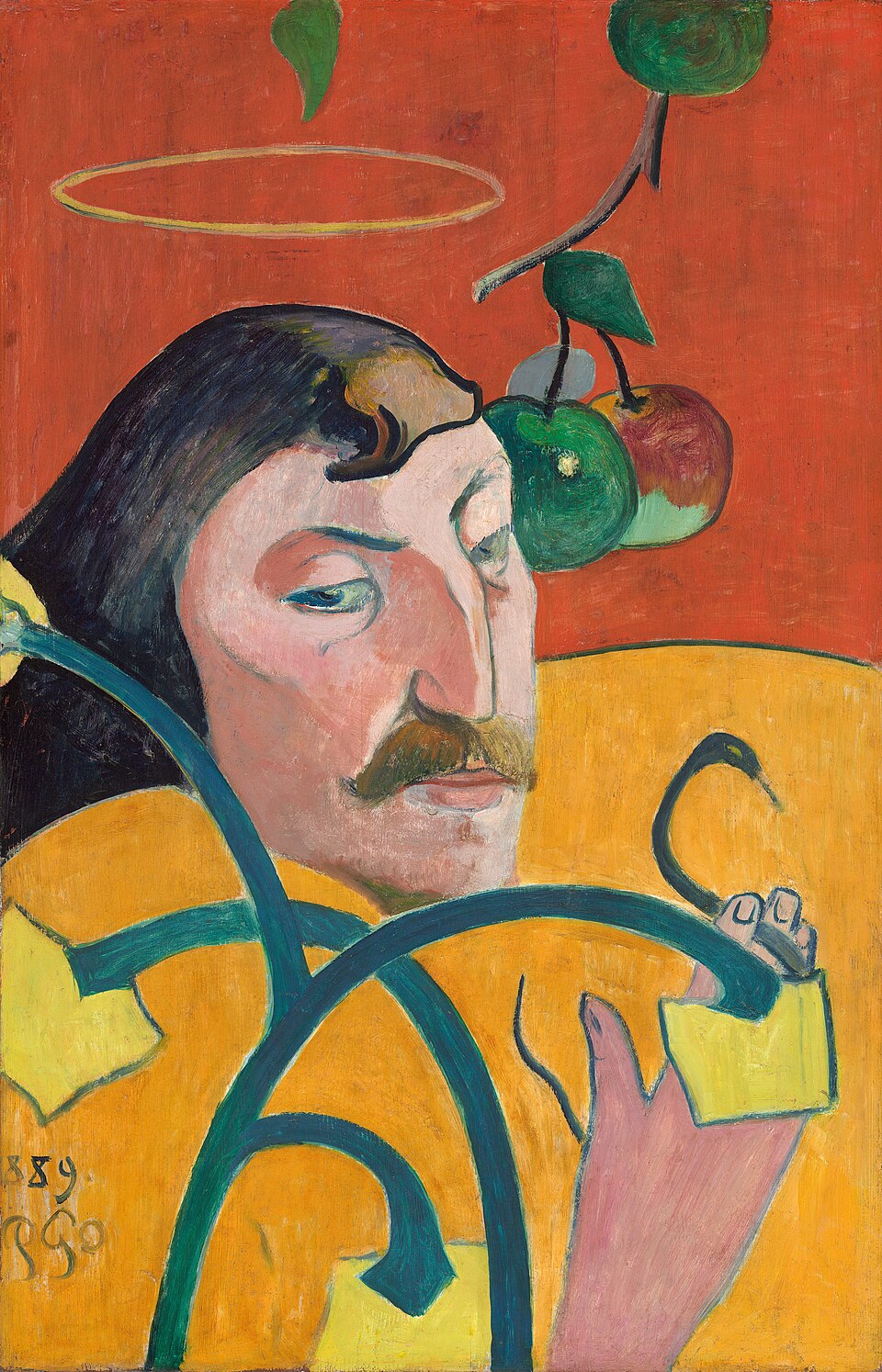
A halo above his head, a snake in his fingers, apples hanging beside him: Gauguin painted himself as saint and sinner at once, on a cupboard door in a seaside inn in Brittany.
The story behind the painting
Tired of crowded Pont-Aven, Gauguin arrived at the fishing village of Le Pouldu on 2 October 1889 and lodged with his friend and student Meijer de Haan at an inn run by Marie Henry. The artists turned its dining room into their canvas, painting walls, ceilings and windows. Gauguin painted this self-portrait on the upper panel of a wooden cupboard door beside the fireplace, with its companion, the Portrait of Jacob Meyer de Haan, on the other side. Both were done between mid-November and mid-December 1889, a year after his weeks with Van Gogh in Arles and years before Tahiti.
What to look for
Gauguin sets himself against a flat red background, a halo above his head, apples hanging beside him, a snake held between his fingers, with plants or flowers in the foreground. The canvas is split in half: above, he is almost angelic, looking away from the apples of temptation; below, the snake completes the duality. Flat colour and strong outlines show the influence of Japanese woodblock prints and cloisonnism. Henri Dorra compares his garment to the saffron robe of a Buddhist monk, perhaps echoing Van Gogh's self-portrait as a bonze. He prepared the wood with a white chalk ground and a combed wave pattern.
Meaning and intent
Philip Conisbee notes that the apples and snake refer to Eden, temptation, sin and the Fall, and Gauguin paints himself as both saint and sinner, part of his personal myth as an artist. Francoise Cachin sees both panels as caricatures. Denys Sutton first called the portrait demonic, a reading supported by its pendant: de Haan, with devilish eyes and red hair like horns, sits beside Milton's Paradise Lost and Carlyle's Sartor Resartus, whose hero is both angelic and diabolical. Jirat-Wasiutynski argues that Gauguin shows himself as a magus, seer and demonic angel. Compared with his self-portrait dedicated to Carriere, this one is more sinister.
Legacy
Gauguin left Le Pouldu on 7 November 1890 and left his work at the inn. Marie Henry, who had refused his advances, took many works with her when she retired, and in 1919 sold the self-portrait with others to Francois Norgelet; it was shown at the Galerie Barbazanges in Paris. It is thought to have passed through Mrs R. A. Workman and Lord Ivor Spencer-Churchill, then dealers, until the American banker Chester Dale acquired it in 1928. On his death in 1962 he bequeathed it to the National Gallery of Art in Washington. It is one of more than forty self-portraits Gauguin made.
¿Sabías que…?
- Painted at Le Pouldu, Brittany, in late 1889.
- Made on a cupboard door in Marie Henry's inn, opposite a portrait of Meijer de Haan.
- Halo, apples and snake show Gauguin as saint and sinner.
- Bequeathed by Chester Dale to the National Gallery of Art, Washington.
Sobre el artista
Paul Gauguin (1848-1903)
autorretrato · Galería Nacional de Arte · aureola · serpiente
Más obras de Paul Gauguin
 ¿De dónde venimos? ¿Qué somos? ¿Adónde vamos? - Paul Gauguin (1897-1898)
 El Cristo amarillo - Paul Gauguin (1889)
 ¿Cuando te casas? - Paul Gauguin (1892)
 Mujeres de Tahití - Paul Gauguin (1890)
 La visión tras el sermón - Paul Gauguin (1888)
El espíritu de los muertos vela - Paul Gauguin (1892)
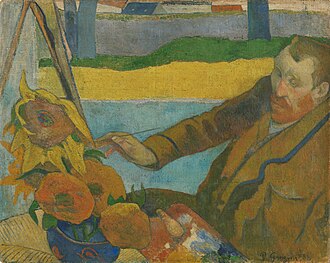 Van Gogh pintando girasoles - Paul Gauguin (1888)
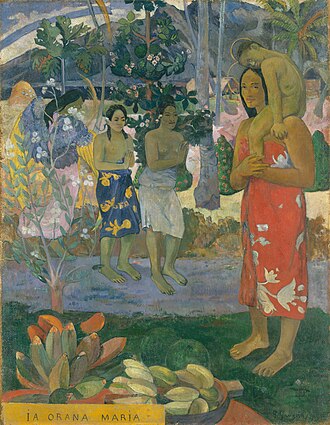 Ia Orana Maria - Paul Gauguin (1891)
Obras de artistas relacionados
 La noche estrellada - Vincent van Gogh (1889)
 Terraza de café por la noche - Vincent van Gogh (1888)
 Paseo a orillas del mar - Joaquín Sorolla (1909)
 Triste herencia - Joaquín Sorolla (1898)
 Las grandes bañistas - Paul Cézanne (1900s)
 The Boy in the Red Vest - Paul Cézanne
 Baile en el Moulin de la Galette - Pierre-Auguste Renoir (1876)
 El almuerzo de los remeros - Pierre-Auguste Renoir (1881)
 En el Moulin Rouge - Henri de Toulouse-Lautrec (1892)
 La toilette - Henri de Toulouse-Lautrec (1896)