Retablo de San Marcos
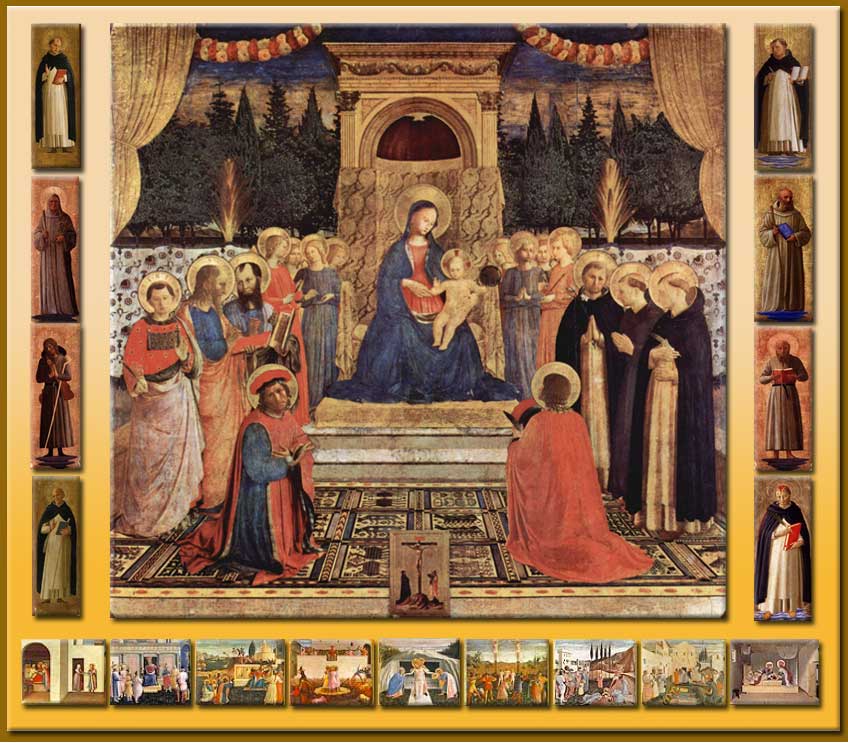
Painted curtains are drawn back as if a performance is about to begin, and there, enthroned in a garden of saints, sit the Virgin and Child. Fra Angelico built this stage for a Florentine convent, and for the powerful family who paid for it.
The story behind the painting
When the Dominican friars took over the church and convent of San Marco in Florence, they found the buildings badly neglected. Cosimo de' Medici and his brother Lorenzo paid for the architect Michelozzo to rebuild them, and the church was rededicated to Saint Mark and also to the Medici patron saints, Cosmas and Damian. In 1438 the brothers acquired the rights to the high altar and set out to replace the old altarpiece. Cosimo commissioned a Dominican friar, Giovanni da Fiesole, later named Fra Angelico by Giorgio Vasari, to paint the new one, along with frescoes for the cells, corridors and cloister. It was completed sometime between 1438 and 1443.
What to look for
The Virgin and Child sit on a throne at the exact meeting point of the picture's vertical and horizontal axes, surrounded by saints and angels. A curtain embroidered with pomegranates divides them from a landscape behind. In front, a carpet of receding squares leads the eye inward, and below the throne Fra Angelico paints a small trompe-l'oeil Crucifixion. Kneeling in the foreground are the two physician saints, Cosmas and Damian, dressed in red. Cosmas looks straight out at us. Damian, on the right, turns inward in prayer, guiding our gaze toward the Virgin. Painted curtains in the upper corners frame the whole scene like a stage.
Meaning and intent
The saints carry a family message. Saint Cosmas has been identified as a portrait of Cosimo de' Medici himself. Saint Lawrence stands for his brother Lorenzo, Saint John the Evangelist for Cosimo's father and son, both named Giovanni, and Saint Francis for Cosimo's son Piero. The work is one of the earliest examples of a sacra conversazione, a sacred conversation, in which the Virgin and saints share one unified space. Some historians note that the Virgin and Child are barely larger than the saints and that the throne is close, which they read as a lessened sense of awe. The open window and the mirror are the painting's two metaphors of perspective.
Legacy
The altarpiece also served Medici politics. During the Festa de' Magi, an extravagant procession sponsored by the family, Florentines would come to San Marco to see the painting as the Three Kings entered the choir to honour the Christ Child. Originally there were nine predella panels telling the legend of Cosmas and Damian. Today only the main panel remains in the convent of San Marco, now a museum, along with two side panels of saints that were bought back as recently as 2007. It is valued as one of the finest early Renaissance paintings for its perspective, its trompe-l'oeil and its weaving of faith with civic power.
¿Sabías que…?
- Completed between 1438 and 1443; size 220 × 227 cm
- Commissioned by Cosimo de' Medici
- One of the earliest examples of a sacra conversazione
- Two side panels were bought back for the museum in 2007
Sobre el artista
Fra Angelico (1400-1455)
arte religioso · Virgen María · Niño Jesús
Más obras de Fra Angelico
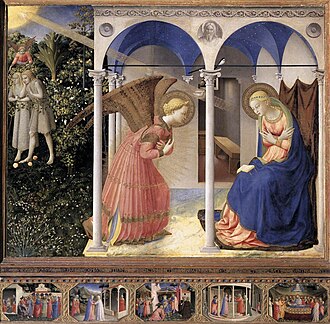 La Anunciación - Fra Angelico (1425)
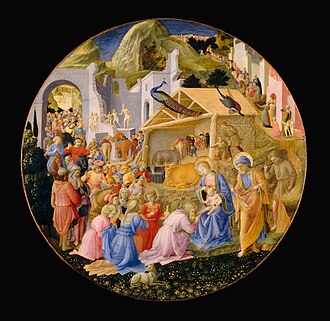 Adoración de los Reyes Magos - Fra Angelico (1430)
%2C%20ante%201432%2C%2001.jpg) Descendimiento de la Cruz - Fra Angelico (1432)
Descendimiento de la Cruz - Fra Angelico (1432)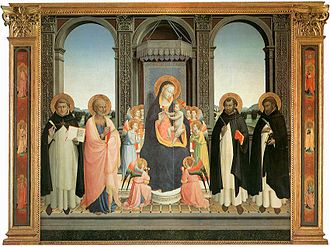 Retablo de Fiesole - Fra Angelico (1422)
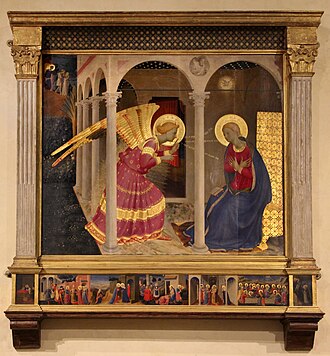 Anunciación de Cortona - Fra Angelico (1430s)
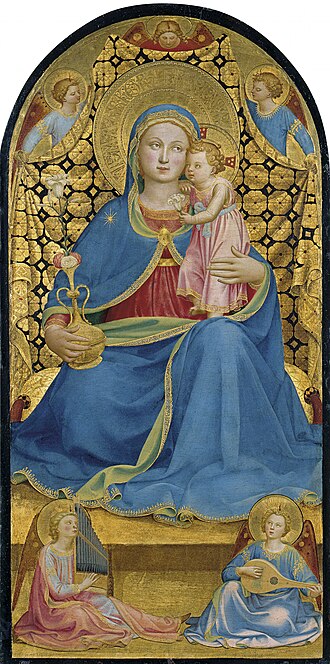 Virgen de la Humildad - Fra Angelico (1433)
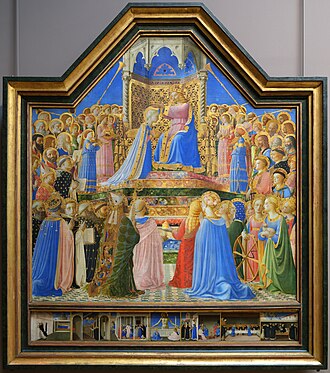 Coronación de la Virgen - Fra Angelico
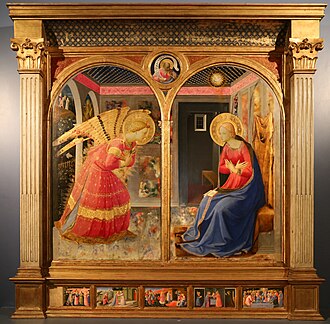 Anunciación de San Giovanni Valdarno - Fra Angelico (1430)
Obras de artistas relacionados
 La Gioconda - Leonardo da Vinci (1503-1519)
 La dama del armiño - Leonardo da Vinci (1490)
 Tondo Doni - Michelangelo (1500s)
 Los tormentos de San Antonio - Michelangelo (1487)