San Juan Evangelista y san Francisco de Asís
El Greco · 1597
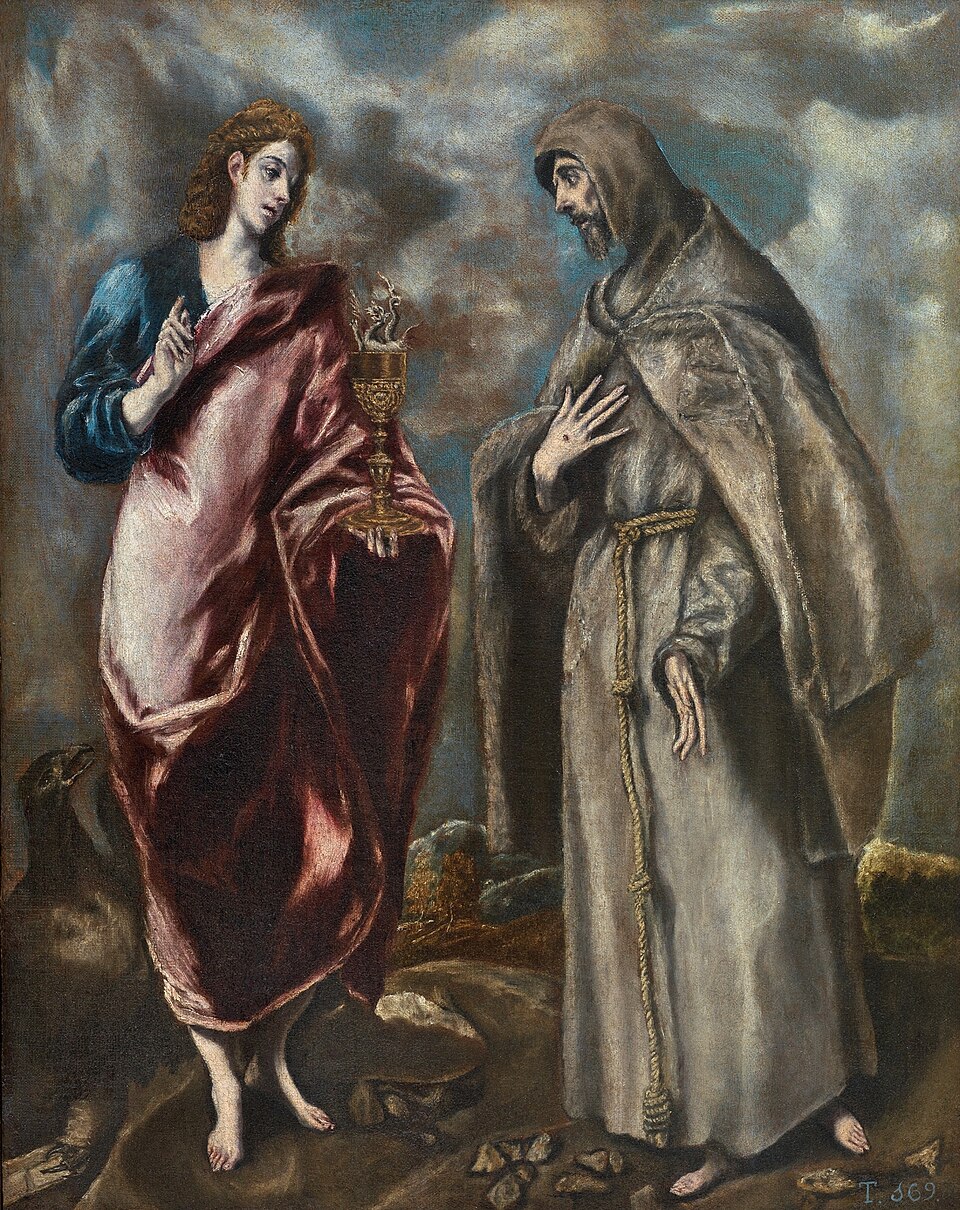
Two barefoot saints who never met in life stand side by side and talk. El Greco paired John the Evangelist and Francis of Assisi, most likely because a patron asked for it, and set them under a sky of grey and bluish clouds.
The story behind the painting
El Greco painted several works of paired saints. Some, like his three versions of Saint Peter and Saint Paul, follow a New Testament episode or carry a doctrinal sense. In others, like this one or Saint Andrew and Saint Francis, the pairing is entirely arbitrary and was probably the wish of the person who ordered the painting. The Counter-Reformation authorities do not seem to have minded. The subject exists in two versions: the main one, about 110 by 86.5 cm, is in the Uffizi in Florence, and this smaller one, 64 by 50 cm, is in the Museo del Prado in Madrid.
What to look for
John stands on the left, facing us but turning his head toward his companion. He is a beardless young man with brown hair, in a large red cloak, the only warm tone in the canvas, over a dark blue tunic. His right index finger points to heaven, and in his left hand he holds a chalice from which a small winged dragon rises. An eagle sits in the lower left corner. Francis, on the right, is the same figure El Greco used in the Saint Francis of the Santa Barbara altarpiece. He wears the grey Franciscan habit and hood, a cord with three knots at his waist, one hand open toward John, the other on his chest showing a stigma.
Meaning and intent
Every object here is a sign. The dragon in the chalice recalls an attempt to poison John told in the Golden Legend of Jacobus de Voragine, and the eagle marks him, among the four evangelists, as the author of the Gospel of John and of the Apocalypse. Francis carries the stigmata, the wounds of Christ, and the knotted cord of his order. Behind the two men lies stony ground, wooded hills in the center and a snowy mountain to the right, so that a conversation between two very different holy lives seems to unfold in an open, timeless landscape.
Legacy
The Madrid canvas is oil on canvas, dated around 1600 by the article, while Wikidata gives 1597. It came to the Prado from the Museo de la Trinidad and is listed in Harold Wethey's catalogue of El Greco as X-389 and by Tiziana Frati as 119-a. Wethey judged it a mediocre canvas from El Greco's school rather than the master's own hand, so this is best seen as the workshop echo of the Florence version, which is signed in Greek letters on a rock and was acquired by the Uffizi in 1976.
¿Sabías que…?
- Two versions exist: Uffizi, Florence, and Museo del Prado, Madrid.
- The Prado canvas measures 64 by 50 cm.
- Dated around 1600 in Wikipedia, 1597 in Wikidata.
- Wethey considered the Prado version a work of El Greco's school.
Sobre el artista
El Greco (1541-1614)
arte religioso · Museo del Prado · manierismo · Juan el Evangelista · Francisco de Asís
Más obras de El Greco
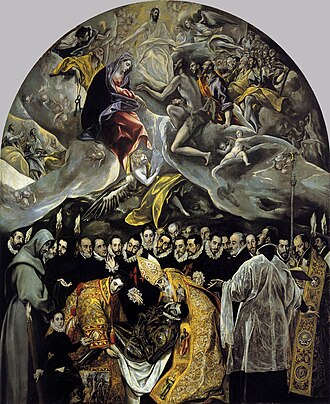 El entierro del Conde de Orgaz - El Greco (1586)
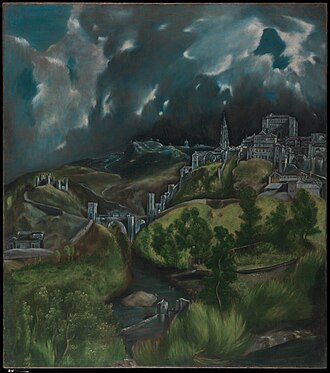 Vista de Toledo - El Greco (1596)
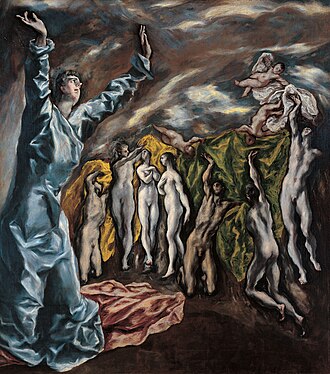 Visión del Apocalipsis - El Greco (1610)
 El caballero de la mano en el pecho - El Greco (1580)
%20-%20Laoco%C3%B6n%20-%20Google%20Art%20Project.jpg) Laocoonte - El Greco (1610s)
Laocoonte - El Greco (1610s) San Martín y el mendigo - El Greco (1597)
.jpg) Adoración de los pastores - El Greco (1612)
Adoración de los pastores - El Greco (1612) Concierto de ángeles - El Greco (1600s)
Obras de artistas relacionados
.jpg) Venus de Urbino - Titian (1538)
Venus de Urbino - Titian (1538) La Asunción de la Virgen - Titian (1510s)
 La cena de Emaús - Caravaggio (1601)
 La vocación de San Mateo - Caravaggio (1609)
 Los embajadores - Hans Holbein the Younger (1533)
 El cuerpo de Cristo en la tumba - Hans Holbein the Younger (1520s)