San Juan Bautista y san Juan Evangelista
El Greco · 1600s
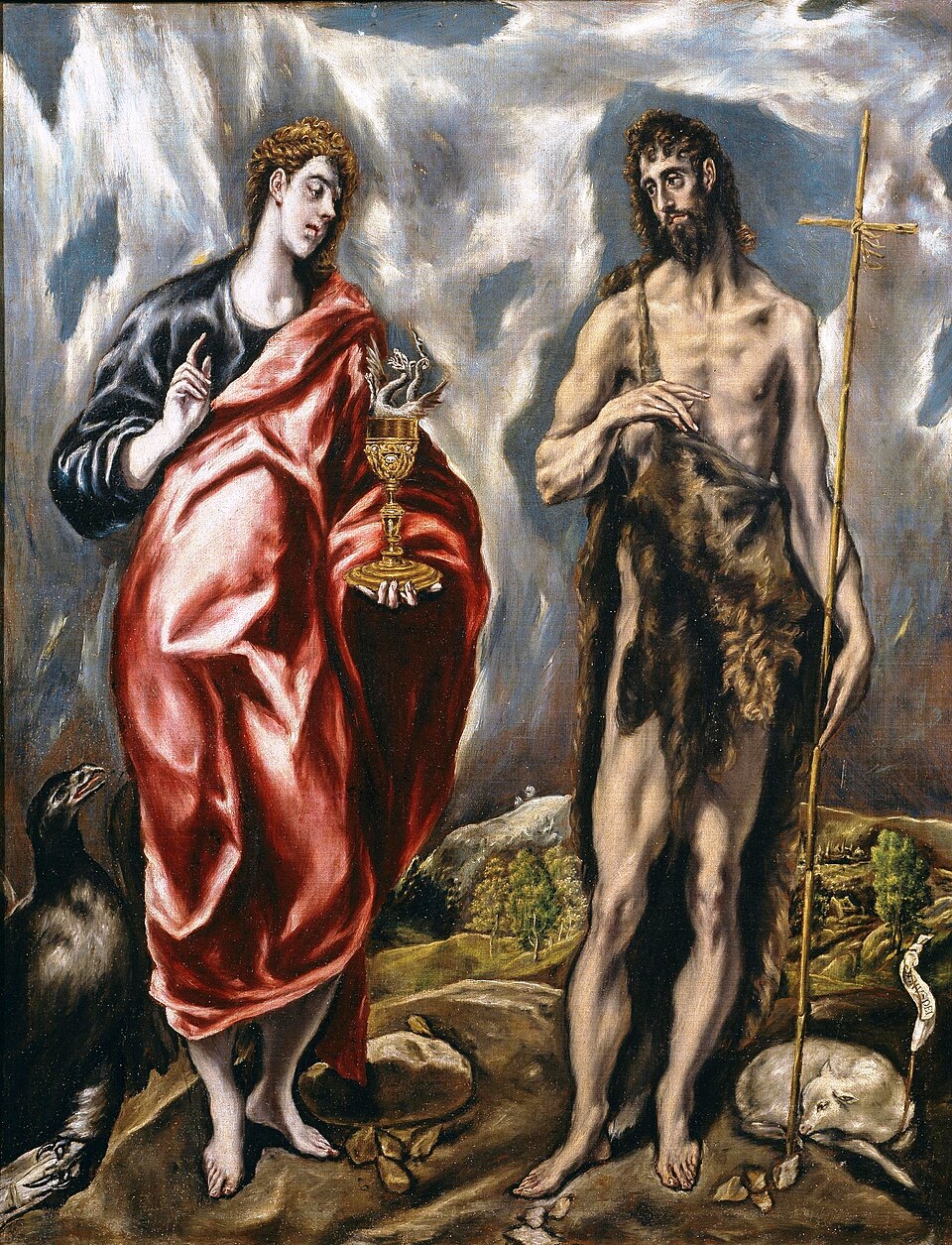
Two saints named John stand side by side as if in conversation: a young evangelist in pink and blue, and a gaunt Baptist in camel skin. It is the only known painting of this pairing by El Greco.
The story behind the painting
El Greco painted this canvas in his final period, between 1600 and 1610. A painting of the same subject is known to have hung in the palace of the Marquis of Villena, and the inventory drawn up by his son Jorge Manuel after his death lists a larger canvas of the theme, yet this is the only one known today. El Greco painted several pairs of saints. Some, like his three versions of Saint Peter and Saint Paul, follow a New Testament episode, but here the pairing seems arbitrary, probably the wish of the person who ordered it.
What to look for
Both figures stand in the foreground. Saint John the Evangelist is a young man in an elegant pink mantle over a blue tunic, holding a chalice with a small dragon, a reference to a poisoning attempt told in the Golden Legend; an eagle, symbol of his gospel, sits at lower left. He turns towards the Baptist, ascetic and wasted in camel skin, holding a thin staff ending in a cross and pointing to a lamb lying on the ground. Behind them stretches a stony landscape, a building that seems a sketch of El Escorial, and a stormy grey blue sky that forms halos around their heads.
Meaning and intent
The lamb is the Agnus Dei, the Lamb of God, as the scroll the Baptist holds makes clear: he points to Christ's sacrifice. The chalice and eagle mark the Evangelist as writer and witness. Joining two saints with no shared story apparently did not trouble the Counter-Reformation authorities. El Greco made a quiet dialogue of youth and austerity, warm colour and bare skin, under a sky that seems to glow around the two heads.
Legacy
The Baptist and the landscape are almost identical to El Greco's Saint John the Baptist in Malagón, except that here the lamb rests on the ground rather than on a rock. The canvas stayed in the church of San Ildefonso in Toledo until 1956, was deposited in the Museo de San Vicente, then in the Museo de Santa Cruz in 1961, and was acquired by the Spanish state for the Prado in 1998. It remains on deposit in Toledo. The Prado gives its size as 110 by 86 cm, while Wethey records 110 by 87.
¿Sabías que…?
- Painted between 1600 and 1610, in El Greco's final period.
- The only known painting of this pairing by El Greco.
- Acquired by the Spanish state for the Prado in 1998.
- On deposit at the Museo de Santa Cruz in Toledo.
Sobre el artista
El Greco (1541-1614)
arte religioso · Museo del Prado · Juan el Bautista · Juan el Evangelista · Museo de Santa Cruz · cruz · cáliz
Más obras de El Greco
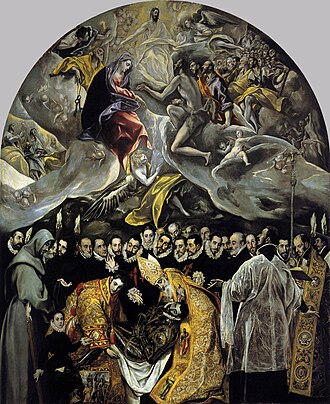 El entierro del Conde de Orgaz - El Greco (1586)
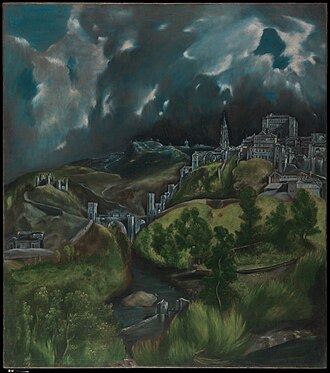 Vista de Toledo - El Greco (1596)
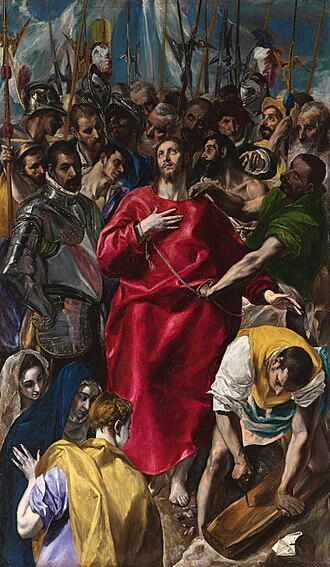 El expolio - El Greco (1570s)
 Visión del Apocalipsis - El Greco (1610)
 El caballero de la mano en el pecho - El Greco (1580)
 Laocoonte - El Greco (1610s)
 San Martín y el mendigo - El Greco (1597)
 Adoración de los pastores - El Greco (1612)
Obras de artistas relacionados
 Las bodas de Caná - Paolo Veronese (1560s)
 Cena en casa de Leví - Paolo Veronese (1573)
 La Última Cena - Jacopo Tintoretto (1563)
 San Marcos liberando al esclavo - Jacopo Tintoretto (1540s)
 Venus de Urbino - Titian (1538)
 La Asunción de la Virgen - Titian (1510s)
 La cena de Emaús - Caravaggio (1601)
 La vocación de San Mateo - Caravaggio (1609)
 Los embajadores - Hans Holbein the Younger (1533)
 El cuerpo de Cristo en la tumba - Hans Holbein the Younger (1520s)