Prometeo encadenado
Pedro Pablo Rubens · 1610s
%20-%20Prometheus%20Bound%20-%20Google%20Art%20Project.jpg)
Chained to a rock, the Titan who gave fire to humanity writhes as a giant eagle tears into him. Rubens painted the body, his colleague Frans Snyders painted the bird, and together they made torment look terrifyingly alive.
The story behind the painting
Rubens opened his own studio in Antwerp in 1610 while serving as court painter to the Archduke and Archduchess in Brussels, and in the same period he was painting The Descent from the Cross. For Prometheus Bound he worked with Frans Snyders, a master of animal and hunting scenes, who painted the eagle. Rubens kept the picture from 1612 to 1618, then traded it with other works to the Englishman Sir Dudley Carleton in exchange for his collection of classical statues. Wikipedia places the painting in the Palais des Beaux-Arts de Lille, while Wikidata lists it at the Philadelphia Museum of Art.
What to look for
The canvas is huge, about 243 by 210 cm, and the foreshortened body is pushed close to the viewer. The eagle's beak rips open Prometheus's torso, exposing bloody entrails. Its talons gouge into his right eye, while his left eye stares at the predator, showing he is aware of his torture. Look at the clenched fists, the writhing legs and the tousled hair. Rubens drew on what he had studied in Rome: the dense musculature and broad frame of Michelangelo's figures in the Sistine Chapel, and the dramatic light and dark of Caravaggio, whose paintings he admired and even copied.
Meaning and intent
The subject comes from the Greek play Prometheus Bound, attributed to Aeschylus. Prometheus had helped Zeus defeat the Titans but angered him by championing mortals and giving them fire and the arts. Zeus had him chained to a rock in Scythia, where an eagle devoured his ever regrowing liver each day. The Greeks saw the liver as the seat of intelligence, soul and life. Rubens shows both a suffering victim and the beauty of the bird that torments him. His brother Philip and teacher Justus Lipsius saw pagan myth as an indirect tribute to the Christian God, an attitude linked to Rubens's art.
Legacy
The painting impressed scholars in Rubens's own circle. Dominicus Baudius, a professor at the University of Leiden and a friend of Rubens's brother, wrote a poem describing how the viewer should react. He imagined the bird so alive that it would fly murderously at the spectators if its chained prey did not hold it back, its flaming eyes darting from one onlooker to the next, and he ended with horror gripping those who watch. The work also shows Rubens's training with Otto van Veen, where he learned composition and the iconography of history painting, and his earlier lessons in landscape, which give the rocky background its weight.
¿Sabías que…?
- Painted by Rubens with Frans Snyders, who painted the eagle.
- Kept by Rubens from 1612 to 1618, then traded to Sir Dudley Carleton for classical statues.
- Based on the Greek play Prometheus Bound, attributed to Aeschylus.
- Sources disagree on its home: Lille (Wikipedia) or Philadelphia (Wikidata).
Sobre el artista
Pedro Pablo Rubens (1577-1640)
pintura mitológica · desnudo · Museo de Arte de Filadelfia
Más obras de Pedro Pablo Rubens
.jpg) La elevación de la cruz - Peter Paul Rubens (1609)
La elevación de la cruz - Peter Paul Rubens (1609)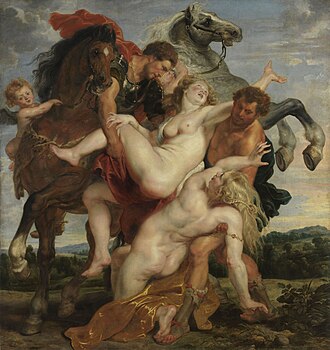 Rapto de las hijas de Leucipo - Peter Paul Rubens (1618)
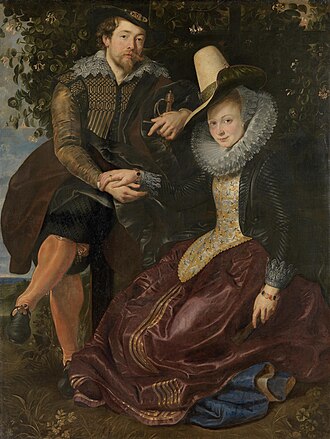 Autorretrato con su esposa Isabel Brant - Peter Paul Rubens (1600s)
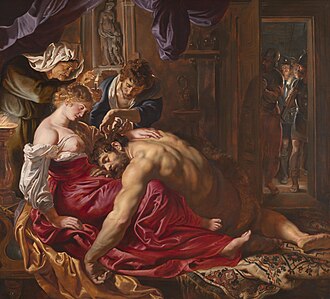 Sansón y Dalila - Peter Paul Rubens (1600s)
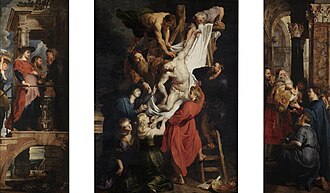 Descendimiento de Cristian - Peter Paul Rubens (1611)
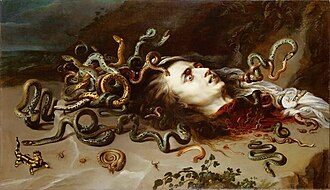 Head of Medusa - Peter Paul Rubens (1618)
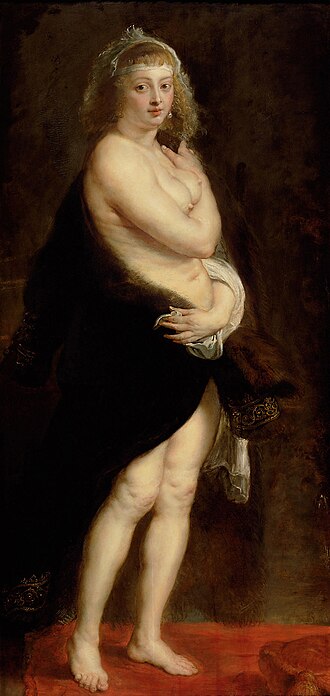 Helena Fourment saliendo del baño - Peter Paul Rubens (1638)
.jpg) El jardín del amor - Peter Paul Rubens (1632)
El jardín del amor - Peter Paul Rubens (1632)
Obras de artistas relacionados
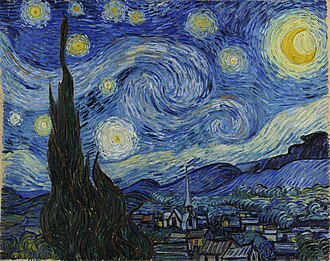 La noche estrellada - Vincent van Gogh (1889)
.jpg) Terraza de café por la noche - Vincent van Gogh (1888)
Terraza de café por la noche - Vincent van Gogh (1888)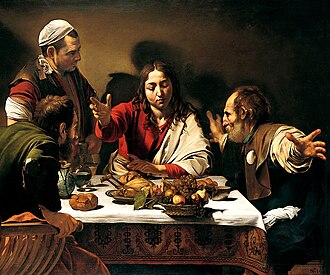 La cena de Emaús - Caravaggio (1601)
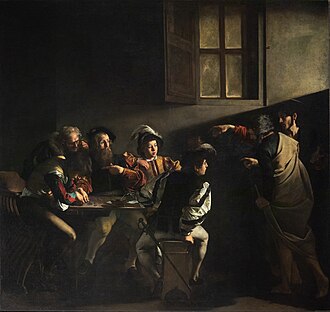 La vocación de San Mateo - Caravaggio (1609)
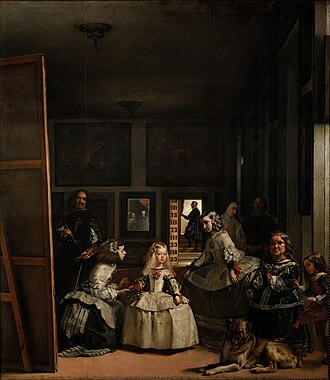 Las meninas - Diego Velázquez (1656)
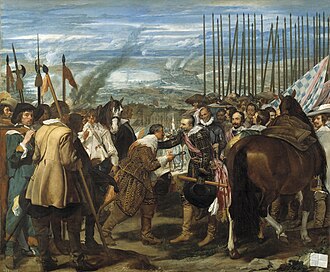 La rendición de Breda - Diego Velázquez (1635)
%20-%20Google%20Art%20Project.jpg) Triple retrato de Carlos I - Anthony van Dyck (1635)
Triple retrato de Carlos I - Anthony van Dyck (1635)%20with%20M.%20de%20St%20Antoine%20-%20Google%20Art%20Project.jpg) Charles I (1600-1649) with M. de St Antoine - Anthony van Dyck (1636)
Charles I (1600-1649) with M. de St Antoine - Anthony van Dyck (1636)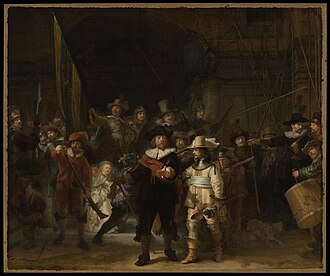 La ronda de noche - Rembrandt van Rijn (1642)
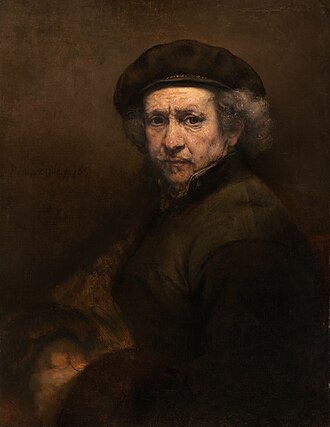 Autorretrato - Rembrandt van Rijn (1659)
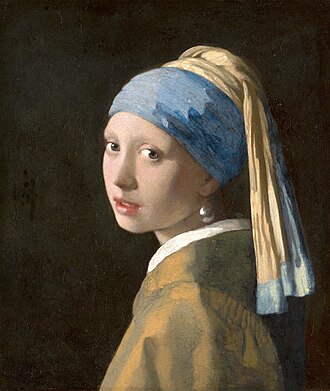 La joven de la perla - Johannes Vermeer (1665)
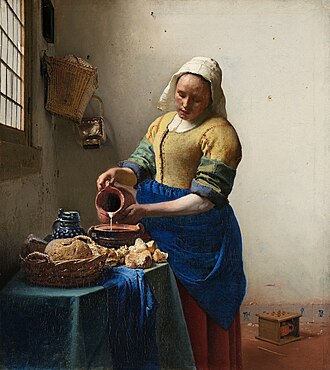 La lechera - Johannes Vermeer (c. 1658)