Retrato de caballero desconocido
El Greco · 1600s
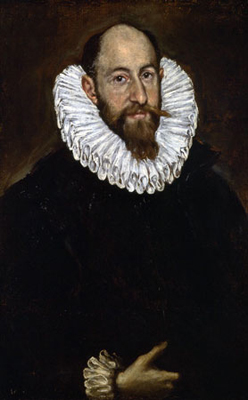
A mature man looks straight at us above a crisp white ruff, one hand on his waist. Nobody knows his name, but El Greco signed the canvas in Greek letters on his shoulder.
The story behind the painting
The sitter's identity is lost; the picture is simply known as a portrait of an unknown gentleman. Its date is uncertain too. The Spanish Wikipedia article titles it around 1605, the specialist Harold Wethey dated it about 1595 to 1600, Pollok House gives about 1590, and Wikidata places it in the 1600s. Wethey listed it as number 141 in his catalogue of El Greco's works, and Tiziana Frati as number 109. Its known history begins in Toledo, with Gabriel Bermúdez, before it was bought by Isidore Taylor for King Louis Philippe of France.
What to look for
This fully finished canvas, about 74 by 47 cm, gives a direct account of a man of mature age who looks at the viewer frankly while resting his right hand on his waist. His head stands out against a white ruff, whose design is repeated in the visible cuff. On the right shoulder, in small cursive Greek letters, is El Greco's fragmentary signature: Domenikos Theotokopoulos made it. The canvas has been trimmed on all four sides, losing part of the right hand. X-rays taken in August 1981 showed it had also been enlarged at the bottom, where the hand and cuff are painted quite differently.
Meaning and intent
The portrait is a penetrating study of character. Its psychological tension, the lengthening of the forms and the handling of the paint suggest, for the source, a fairly late date in El Greco's career. The enlargement at the bottom does not seem to be El Greco's own work and was probably added later. Unlike The Lady in a Fur Wrap, another portrait at Pollok House once attributed to him, this one is signed, and its authorship has never been seriously questioned.
Legacy
After Taylor, the painting belonged to Louis Philippe and hung in his Spanish Gallery at the Louvre from 1838 to 1848. At the sale of the king's property at Christie's in London in 1853 it appeared as a portrait of a gentleman of the time of Philip III, and Colnaghi bought it. It then passed to Sir William Stirling-Maxwell, by inheritance to his son Sir John Stirling Maxwell and to his daughter Anne Maxwell Macdonald, who gave it in 1967. It is now at Pollok House in Glasgow.
¿Sabías que…?
- Signed in Greek on the right shoulder.
- Dated variously from about 1590 to about 1605.
- Shown in Louis Philippe's Spanish Gallery at the Louvre, 1838 to 1848.
- Given in 1967; now at Pollok House, Glasgow.
Sobre el artista
El Greco (1541-1614)
Más obras de El Greco
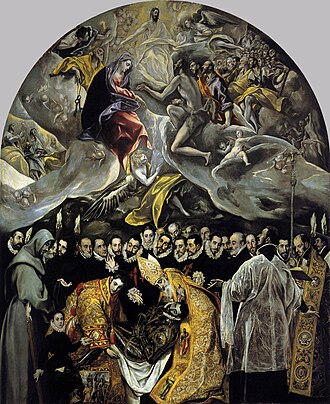 El entierro del Conde de Orgaz - El Greco (1586)
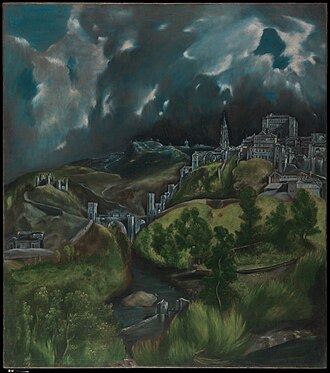 Vista de Toledo - El Greco (1596)
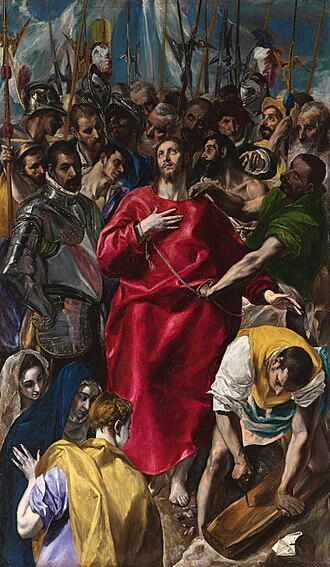 El expolio - El Greco (1570s)
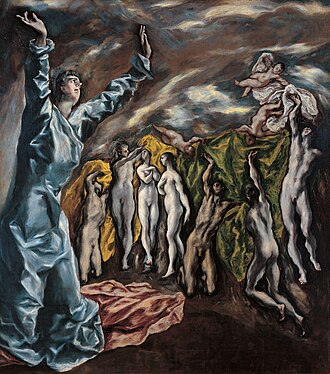 Visión del Apocalipsis - El Greco (1610)
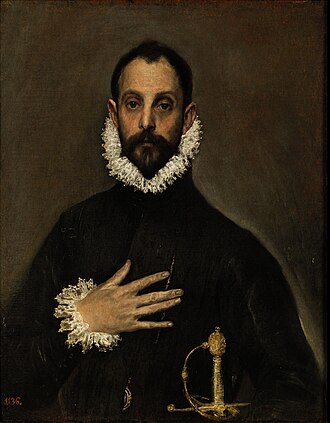 El caballero de la mano en el pecho - El Greco (1580)
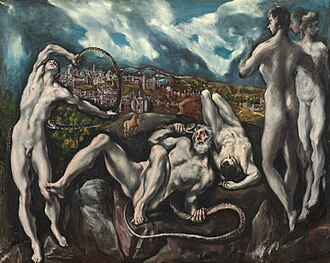 Laocoonte - El Greco (1610s)
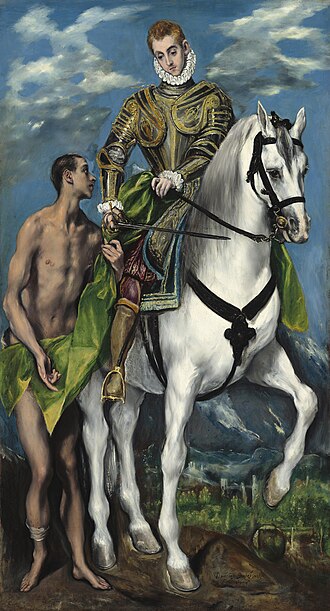 San Martín y el mendigo - El Greco (1597)
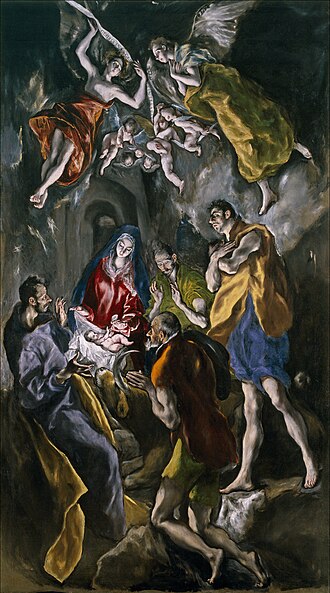 Adoración de los pastores - El Greco (1612)
Obras de artistas relacionados
 Las bodas de Caná - Paolo Veronese (1560s)
 Cena en casa de Leví - Paolo Veronese (1573)
 La Última Cena - Jacopo Tintoretto (1563)
 San Marcos liberando al esclavo - Jacopo Tintoretto (1540s)
 Venus de Urbino - Titian (1538)
 La Asunción de la Virgen - Titian (1510s)
 La cena de Emaús - Caravaggio (1601)
 La vocación de San Mateo - Caravaggio (1609)
 Los embajadores - Hans Holbein the Younger (1533)
 El cuerpo de Cristo en la tumba - Hans Holbein the Younger (1520s)