Felipe IV en Fraga
Diego Velázquez · 1644
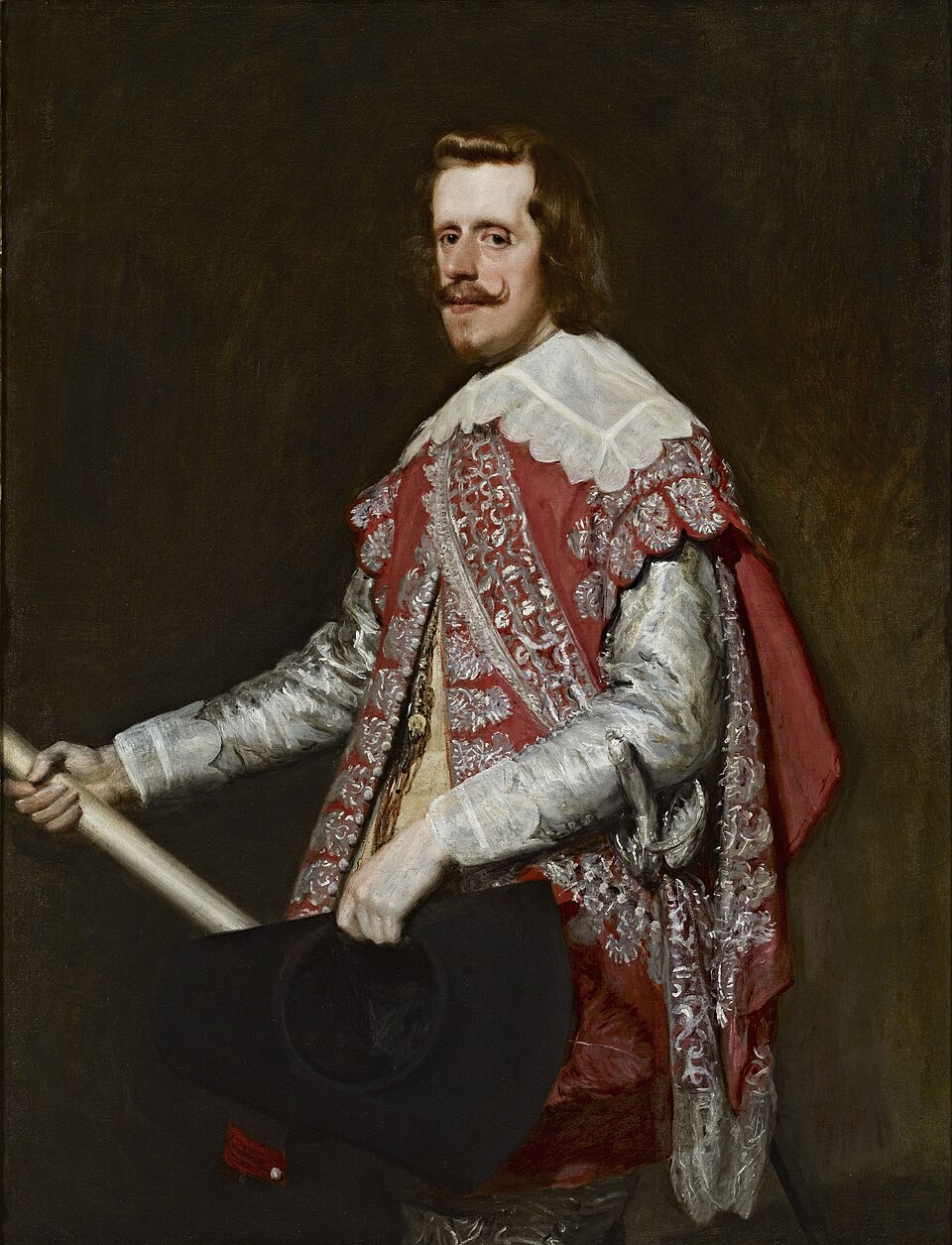
A king in crimson and silver, painted in three sittings in a half-ruined town at war. When the picture reached Madrid, crowds came to a church to see it as if the king himself had come home.
The story behind the painting
In 1644 Philip IV moved his court to Fraga during the Jornada de Aragon, the campaign that recovered Lerida from France during the Reapers' War. There, over three sessions in June 1644, Velazquez painted him. Surviving expense accounts tell us a great deal: masons were paid to open two windows in the throne room where the king was to pose, and the rooms Velazquez used as a studio, which were in ruins, had to be repaired. At the same time he painted a court dwarf known as El Primo, and that picture was sent to Madrid in June.
What to look for
This is a mid-length portrait of the king in campaign dress. The painter Antonio Palomino almost certainly meant this picture when he wrote that Velazquez painted Philip as he entered Lerida, holding a military staff, dressed in crimson plush, with such grace and majesty that it looked like another living Philip. The chronicler Jose Pellicer described the king dressed in red and silver, shown as he was in the field. Look at the staff, the rich red costume and the natural bearing that Palomino admired. Wikidata gives the size as 133.5 by 95 cm.
Meaning and intent
The portrait served the crown at a moment of war. It was finished before the end of June and sent to Queen Elisabeth, who ordered it shown in public. On 16 August 1644, Pellicer noted, it was displayed in the church of San Martin under a canopy embroidered with gold, where many people came to see it and copies were being made. Jonathan Brown suggests the composition may have been inspired by Anthony van Dyck's portrait of the Cardinal-Infante Ferdinand of Austria, in Madrid since 1636.
Legacy
Philip V gave the portrait to his son, the future Duke of Parma, and it left Spain with him in 1748. In 1911 it was acquired by the Frick Collection in New York, where it hangs today. Among the copies, the most valued is at Dulwich in London, long mistaken for the original until Aureliano de Beruete attributed it in 1911 to Juan Bautista Martinez del Mazo, which identified the New York picture as Velazquez's own. A version, most likely a copy, appears in the 1941 film The Maltese Falcon.
¿Sabías que…?
- Painted in three sittings in Fraga in June 1644.
- Shown publicly in the church of San Martin in Madrid in August 1644.
- Left Spain in 1748 and entered the Frick Collection in 1911.
- A copy at Dulwich was long taken for the original.
Sobre el artista
Diego Velázquez (1599-1660)
retrato · Colección Frick · Felipe IV de España
Más obras de Diego Velázquez
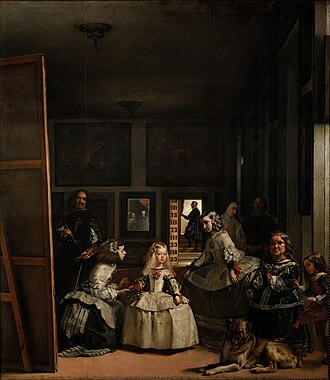 Las meninas - Diego Velázquez (1656)
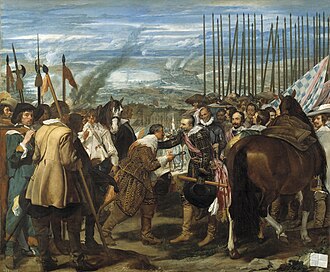 La rendición de Breda - Diego Velázquez (1635)
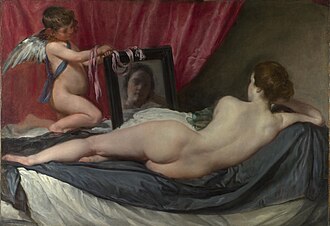 Venus del espejo - Diego Velázquez (1644)
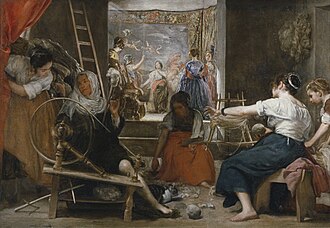 Las Hilanderas - Diego Velázquez
.jpg) Inocencio X - Diego Velázquez
Inocencio X - Diego Velázquez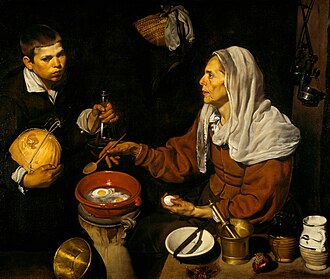 Vieja friendo huevos - Diego Velázquez (1618)
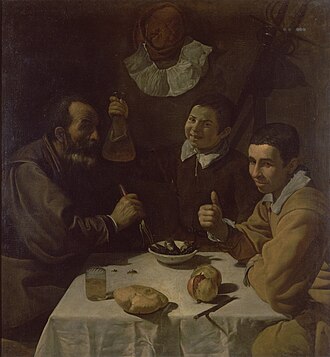 El almuerzo - Diego Velázquez (1617)
.jpg) El triunfo de Baco - Diego Velázquez (1628)
El triunfo de Baco - Diego Velázquez (1628)
Obras de artistas relacionados
 La cena de Emaús - Caravaggio (1601)
 La vocación de San Mateo - Caravaggio (1609)
.jpg) La elevación de la cruz - Peter Paul Rubens (1609)
La elevación de la cruz - Peter Paul Rubens (1609)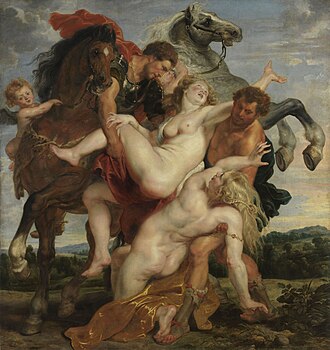 Rapto de las hijas de Leucipo - Peter Paul Rubens (1618)
%20-%20Google%20Art%20Project.jpg) Triple retrato de Carlos I - Anthony van Dyck (1635)
Triple retrato de Carlos I - Anthony van Dyck (1635)%20with%20M.%20de%20St%20Antoine%20-%20Google%20Art%20Project.jpg) Charles I (1600-1649) with M. de St Antoine - Anthony van Dyck (1636)
Charles I (1600-1649) with M. de St Antoine - Anthony van Dyck (1636)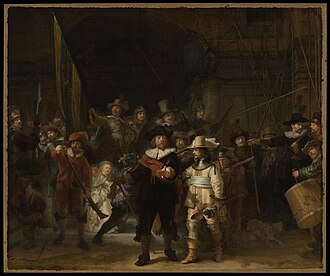 La ronda de noche - Rembrandt van Rijn (1642)
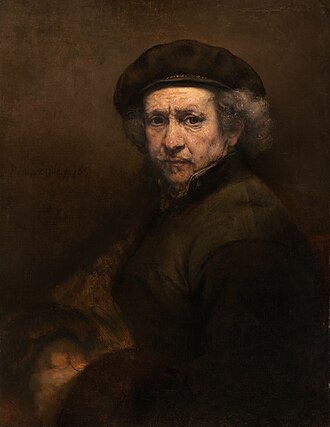 Autorretrato - Rembrandt van Rijn (1659)
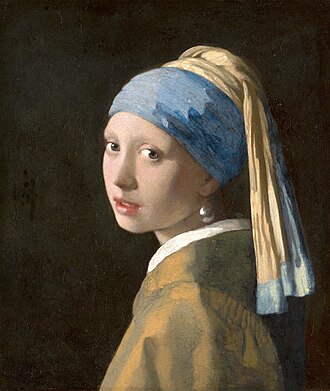 La joven de la perla - Johannes Vermeer (1665)
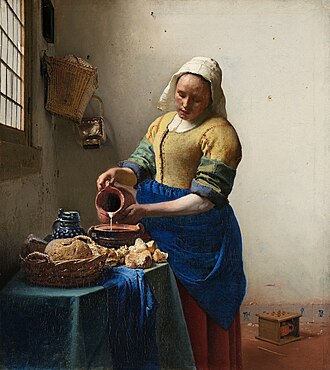 La lechera - Johannes Vermeer (c. 1658)