Portrait of Madame Cézanne with Loosened Hair
Paul Cézanne · 1880s
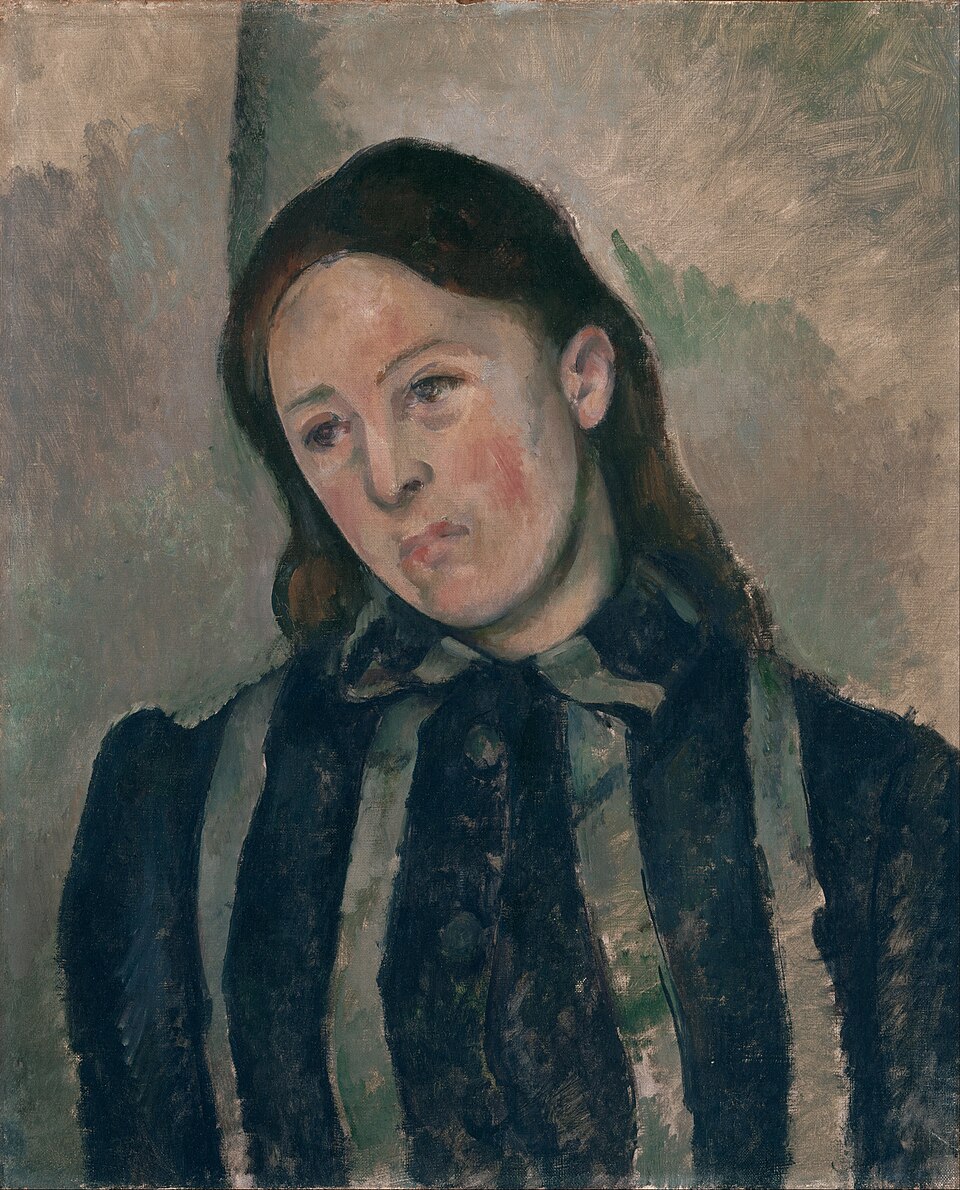
Hortense Fiquet sat for her husband 44 times, though she cared little for his art. In this portrait her hair falls loose, her head tilts, and a tenderness appears that Cézanne may have drawn from himself. Nobody agrees on when he painted it.
The story behind the painting
Hortense Fiquet first posed for Paul Cézanne in 1869 and sat for him in forty-four portraits, during years in which she went from mistress to wife to estranged wife. They married on 28 April 1886, though by then he said he no longer had feelings for her, and after his father's death that year they separated and he moved in with his mother and sister. He once remarked that his wife only cared for Switzerland and lemonade. It is said that an appointment with a dressmaker made her late to his deathbed in 1906. Their only child, Paul, inherited the estate.
What to look for
The picture is flat and rectangular, with little depth but strong symmetry: an almost full-face, centred view with playful deviations, the lean of her head and body and a thick vertical line in the background slightly to the left, on which her head seems to rest. The vertical lines of the dress echo the diagonals of her hair. The dress may be blue-black velvet with bands of grey satin, a striping seen in earlier portraits of her. Unlike the more formal images, her hair falls loosely, her mouth turns down, and the blush of her cheek and the oval of her face recall the critic who said Cézanne painted heads like apples.
Meaning and intent
Elements show the influence of Impressionism, but the work turns to the sitter's inner life. The tilt of her head, her look of submission and the downward mouth suggest someone absorbed in herself, perhaps reflecting the distance between husband and wife. Yet the art historian Meyer Schapiro saw in its shyness and sensitivity a projection of Cézanne's own character. Liliane Brion-Guerry found a delicacy absent from his later, icier portraits, and the Wikipedia article recalls that Hortense had a tireless patience and read to him at night when he could not sleep.
Legacy
Scholars disagree on the date. Lionello Venturi placed it in 1883 to 1887, Georges Rivière in the mid-1870s, and John Rewald, on grounds of style, in the early 1890s, since the fuller face may show Hortense in her forties. Rewald's date is now accepted by the Philadelphia Museum of Art, where the painting hangs; if it is right, this is the last portrait Cézanne made of her. Wikidata simply gives the 1880s. The way costume and background carry the mood looks back to early Netherlandish portraits, especially Rogier van der Weyden.
¿Sabías que…?
- One of 44 portraits of Hortense Fiquet by Cézanne.
- Dated anywhere from the mid-1870s to the early 1890s.
- If Rewald's date is right, it is his last portrait of her.
- In the Philadelphia Museum of Art.
Sobre el artista
Paul Cézanne (1839-1906)
mujer · retrato · Museo de Arte de Filadelfia
Más obras de Paul Cézanne
 Las grandes bañistas - Paul Cézanne (1900s)
 The Boy in the Red Vest - Paul Cézanne
 Cesto de manzanas - Paul Cézanne (1893)
 Rideau, Cruchon et Compotier - Paul Cézanne (1890s)
 Maison devant la Sainte-Victoire près de Gardanne - Paul Cézanne (1880s)
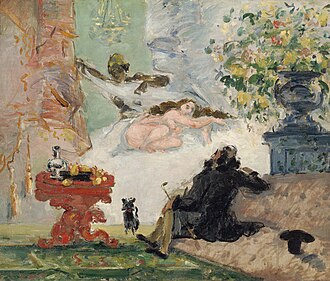 Una Olympia moderna - Paul Cézanne (1873)
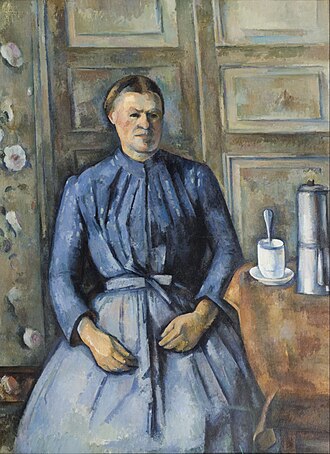 Mujer con cafetera - Paul Cézanne (1895)
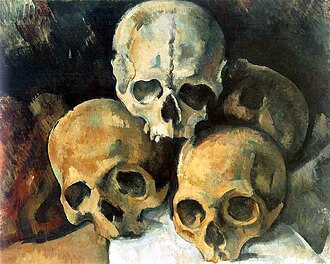 Pyramid of Skulls - Paul Cézanne (1899)
Obras de artistas relacionados
 La noche estrellada - Vincent van Gogh (1889)
 Terraza de café por la noche - Vincent van Gogh (1888)
 ¿De dónde venimos? ¿Qué somos? ¿Adónde vamos? - Paul Gauguin (1897-1898)
 El Cristo amarillo - Paul Gauguin (1889)
 Paseo a orillas del mar - Joaquín Sorolla (1909)
 Triste herencia - Joaquín Sorolla (1898)
 Baile en el Moulin de la Galette - Pierre-Auguste Renoir (1876)
 El almuerzo de los remeros - Pierre-Auguste Renoir (1881)
 En el Moulin Rouge - Henri de Toulouse-Lautrec (1892)
 La toilette - Henri de Toulouse-Lautrec (1896)