Retrato de caballero
Tintoretto · 1554
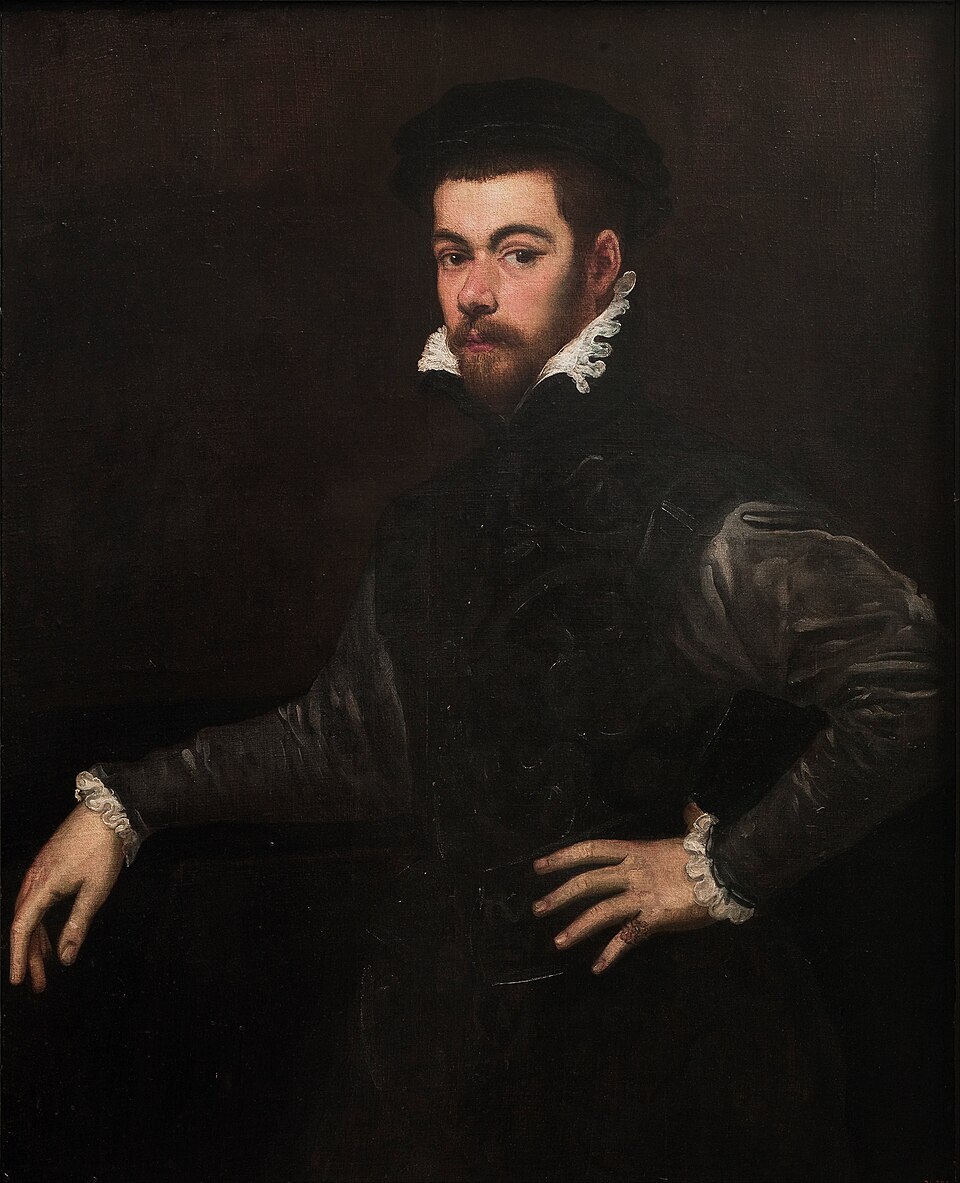
A young Venetian-era gentleman leans on a piece of furniture, hand on hip, a ring on his little finger, and seems about to speak to us. Nobody knows who he was, but Tintoretto made sure we would not forget his face.
The story behind the painting
Tintoretto painted this oil portrait around 1554. The sitter is unknown. Judging by his clothes, he may have been one of the European ambassadors or nobles who sat for Tintoretto in his Venetian studio. The painting later belonged to Gaspar Méndez de Haro y Guzmán: it appears in his inventory, and his heraldic monogram is on the back of the canvas. The Museu Nacional d'Art de Catalunya in Barcelona acquired it in 1944, and it remains part of the museum's permanent collection. The canvas measures about 101.7 by 81.7 cm.
What to look for
The young man is shown more than half-length, turned three-quarters to the left. His right forearm rests on a piece of furniture, while his left hand sits on his hip in a gesture the source calls arrogant, with a ring on the little finger. A black cap covers his head, letting fair hair show at the level of the beard. He wears a dark embroidered doublet with pale, shimmering sleeves that suggest silk. The white collar and cuffs make the skin glow against the darkness of the clothes and the background.
Meaning and intent
With his haughty air, the sitter seems to want to start a conversation with the viewer, a trait of Tintoretto's personal expressiveness. The painter puts the attention on the face and hands, built up with thick impasto, while the clothes are handled with quick, fluid, loose touches. In this way, with few means, he conveys the inner force of the person portrayed. The contrast between the worked face and the freely painted costume is the heart of the picture: the man's presence matters more than the fabric he wears.
Legacy
The date of about 1554 comes from comparison with other portraits of the same moment: the Gentleman in the Barber Institute in Birmingham, the portrait of Lorenzo Soranzo in the Kunsthistorisches Museum in Vienna, and the Gentleman at Christ Church, Oxford. Wikidata places the work within Mannerism and the Venetian school. Today the portrait hangs in Barcelona, an unnamed man whose confidence has outlived his identity, and whose earlier owner left his mark, quite literally, on the back of the canvas.
¿Sabías que…?
- Painted by Tintoretto around 1554.
- The sitter is unknown, perhaps an ambassador or noble.
- Once owned by Gaspar Méndez de Haro, whose monogram is on the back.
- Acquired by the Museu Nacional d'Art de Catalunya in 1944.
Sobre el artista
Tintoretto (1518-1594)
retrato · varón · escuela veneciana · manierismo · Museo Nacional de Arte de Cataluña
Más obras de Tintoretto
 La Última Cena - Jacopo Tintoretto (1563)
 San Marcos liberando al esclavo - Jacopo Tintoretto (1540s)
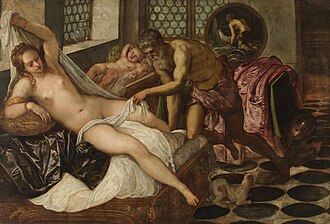 Venus, Vulcano y Marte - Jacopo Tintoretto (1555)
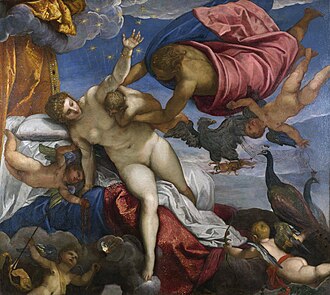 El origen de la Vía Láctea - Jacopo Tintoretto (1575)
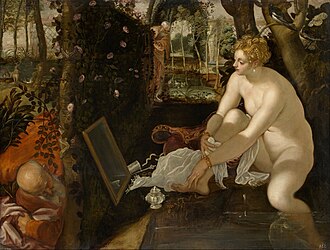 Susana y los viejos - Jacopo Tintoretto (1550s)
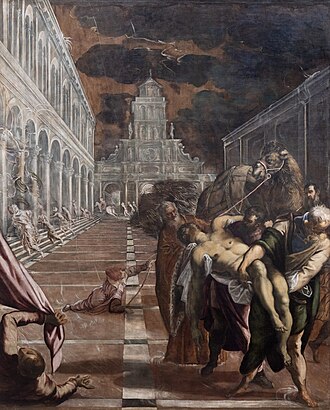 Traslación del cuerpo de San Marcos - Jacopo Tintoretto (1560s)
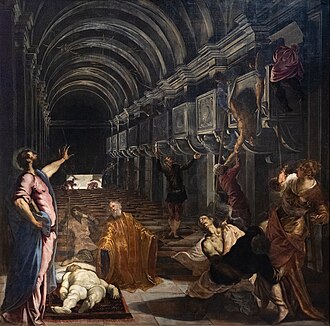 Finding of the body of St Mark - Jacopo Tintoretto (1562)
 Paradise - Jacopo Tintoretto
Obras de artistas relacionados
 Venus de Urbino - Titian (1538)
 La Asunción de la Virgen - Titian (1510s)
 Las bodas de Caná - Paolo Veronese (1560s)
 Cena en casa de Leví - Paolo Veronese (1573)