El origen de la Vía Láctea
Tintoretto · 1575
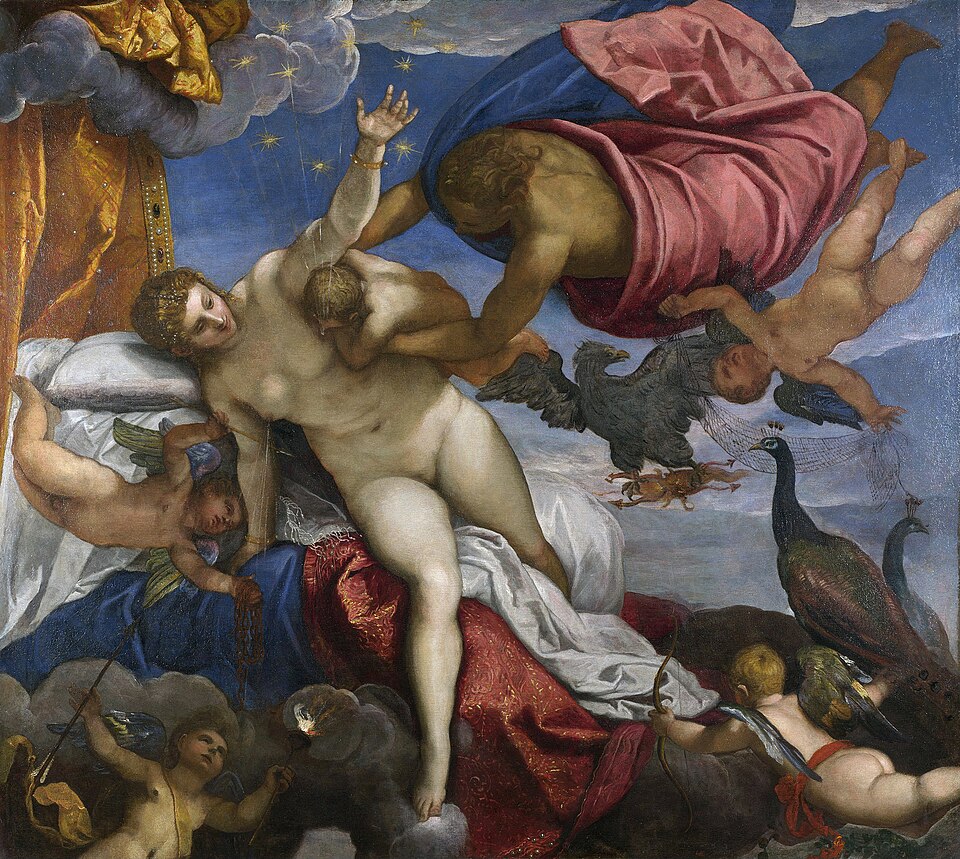
A goddess startles awake, a stolen infant at her breast, and her milk scatters upward into stars. Tintoretto painted the birth of the Milky Way as a burst of motion across the sky.
The story behind the painting
The myth tells how Jupiter wanted to make his son Hercules, born to the mortal Alcmene, immortal by letting him drink the milk of the sleeping goddess Juno. Tintoretto painted it around 1575 to 1580. When the National Gallery X-rayed the canvas in 1972, it found an earlier, rapidly painted version of the same scene beneath. Historians think it may first have been meant for the Venetian physician and astrologer Tommaso Rangone, whose work centred on longevity, and who died in 1577. The painting later certainly belonged to Emperor Rudolf II in Prague, who shared interests in astronomy, alchemy and immortality.
What to look for
Jupiter, dressed in red, swoops down holding the infant to Juno's breast. Juno, waking in her bed, jerks away, and her milk spurts upward to become the stars of the Milky Way, a hazy band behind the eagle. Her peacocks wait beside her, while Jupiter's eagle clutches his lightning bolt in its talons. Putti fly about carrying objects tied to the story. The dynamic poses and repeating curves are typical of Mannerism, and the colours are vivid and layered. The bottom third, which showed milk falling to earth and becoming white lilies, was cut away around 1727.
Meaning and intent
Every element serves the tale, but the subject also suited its owners. For Rangone, a doctor devoted to long life, the milk of immortality was a fitting emblem; a similar image appears on a medal he had cast in 1562. The Habsburgs liked to model themselves on Hercules as a just and protective ruler, and Rudolf II was shown with a lion skin and club. The erotic charm of the scene also suited the emperor's taste. Tintoretto likely drew on a passage in Giovanni Battista Giraldi's epic Ercole.
Legacy
The canvas has had a hard life. Two horizontal creases with cracked paint suggest it was folded in half while still fresh, probably for the journey to Prague. Its edges are frayed, and old linings flattened the paint. A pamphlet of 1648 mentions a Tintoretto showing Jupiter holding a little Bacchus to Juno's breast, presumably this work misnamed. It later passed through the Orleans Collection and is now in the National Gallery in London, where it is considered one of Tintoretto's most successful works in the Venetian style.
¿Sabías que…?
- Painted c. 1575-1580; National Gallery, London.
- An earlier version of the scene lies beneath, found by X-ray in 1972.
- The bottom third was cut off around 1727.
- Owned by Emperor Rudolf II, later in the Orleans Collection.
Sobre el artista
Tintoretto (1518-1594)
mujer · niño · pintura mitológica · National Gallery de Londres · escuela veneciana · manierismo · cielo · hombre vestido, mujer desnuda · Colección Orleans · Heracles
Más obras de Tintoretto
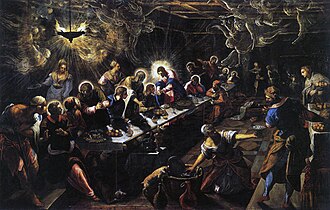 La Última Cena - Jacopo Tintoretto (1563)
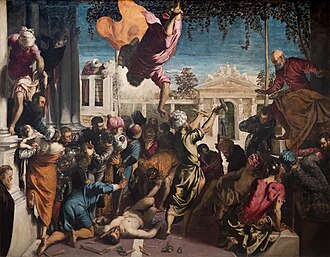 San Marcos liberando al esclavo - Jacopo Tintoretto (1540s)
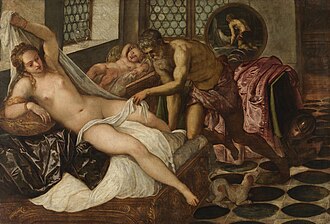 Venus, Vulcano y Marte - Jacopo Tintoretto (1555)
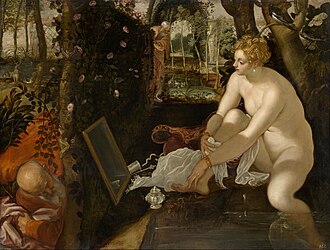 Susana y los viejos - Jacopo Tintoretto (1550s)
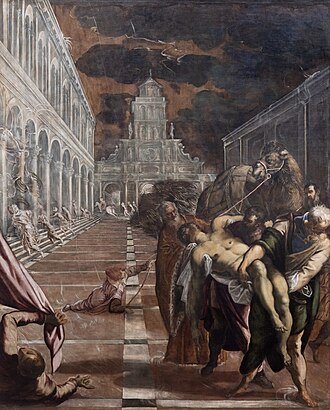 Traslación del cuerpo de San Marcos - Jacopo Tintoretto (1560s)
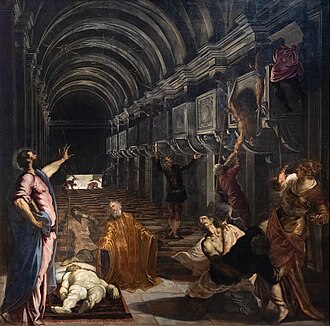 Finding of the body of St Mark - Jacopo Tintoretto (1562)
%20Jacopo%20Tintoretto%20-%20Gloria%20del%20Paradiso%20-%20Sala%20del%20Maggior%20Consiglio.jpg) Paradise - Jacopo Tintoretto
Paradise - Jacopo Tintoretto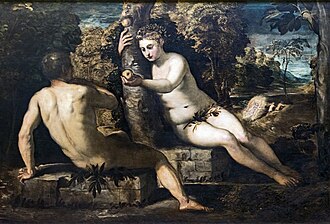 El pecado original - Jacopo Tintoretto (1550s)
Obras de artistas relacionados
.jpg) Venus de Urbino - Titian (1538)
Venus de Urbino - Titian (1538) La Asunción de la Virgen - Titian (1510s)