Portrait of a boy
Camille Pissarro · 1850s
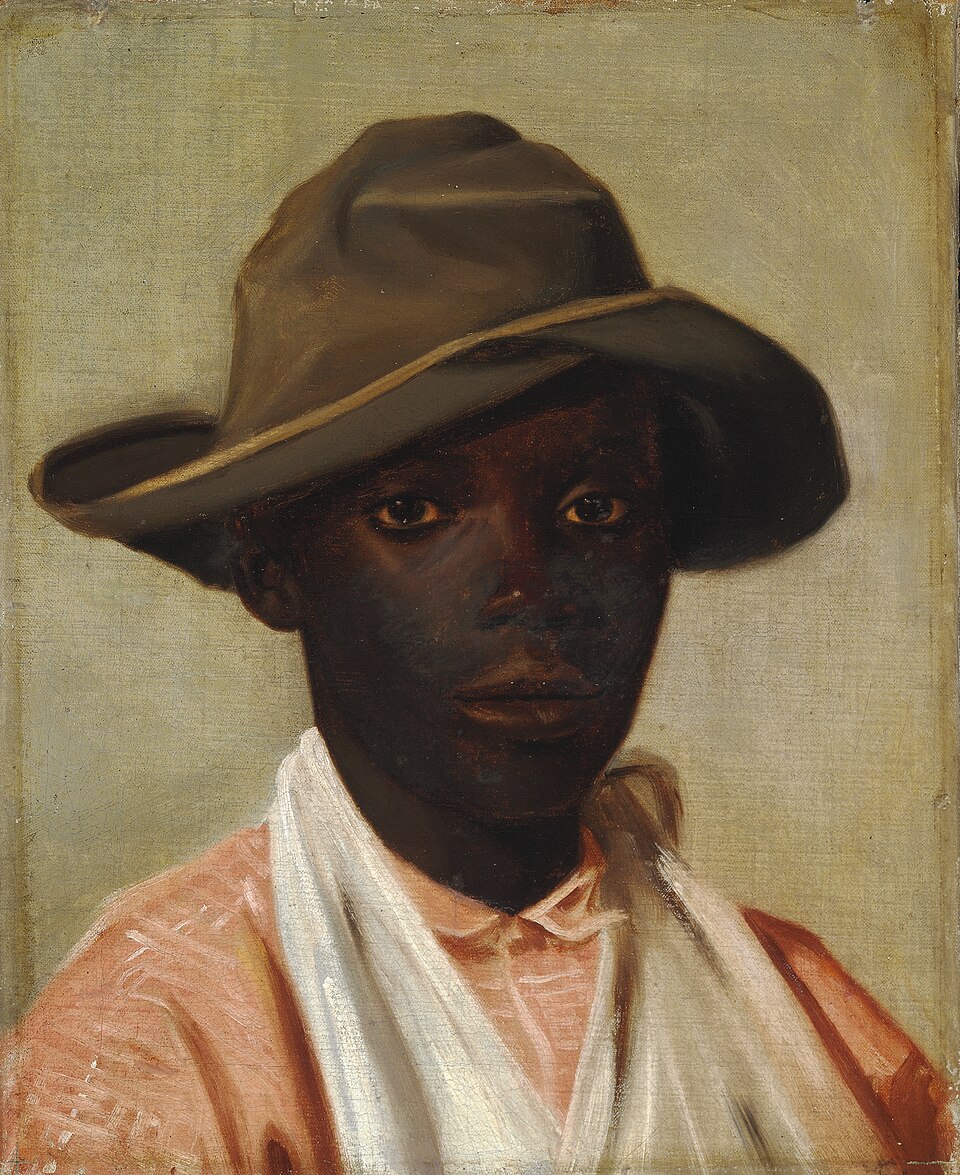
A Black boy in a battered straw hat and an orange shirt, his arm in a white sling, looks straight at us. Painted by the young Pissarro in the Danish West Indies, the picture stayed unseen until 2018.
The story behind the painting
Camille Pissarro painted this portrait between 1852 and 1855 in the Danish West Indies, before he moved to Paris and became one of the leading figures of French Impressionism. Before leaving for Paris in 1855, he gave it to Hermann Meier Hjernøe, a lawyer living on Saint Thomas. It stayed in the family: his son Carl Christian inherited it and took it to Denmark in 1877. The picture was never shown in public until 2018, and was only then reattributed to Pissarro, so it is missing from his 2005 catalogue raisonné.
What to look for
The boy is shown from the shoulders up against a light wall, looking directly at the viewer. His dented hat has a broad brim, and his plain orange shirt is crossed by a sling of white gauze. He is clearly injured, but neither his face nor his clothing tells us more. Pissarro gave the clothes and background only quick strokes, while he painted the skin and expression with care, using small, fine touches. The colours are restrained, the execution simple and almost sketch-like.
Meaning and intent
The work belongs to the late Danish Golden Age school, seen in the viewpoint, the choice of a working-class sitter and the sober execution. Workers and market people were not new subjects, but portraits of people freed from slavery only a few years before were a rarity in Europe, especially as an individual portrait rather than as a decorative figure in a landscape. The boy is thought to have been one of the colony's former enslaved children. That makes the painting unique in its cultural context and important for Pissarro's early development.
Legacy
The Wildenstein Institute in New York examined the picture and declared it a newly found oil painting by Pissarro. It was shown publicly at the Danish Embassy in London on 15 and 16 May 2018, and on 29 May 2018 it was acquired at auction for the Ordrupgaard Museum with funding from the Carlsberg Foundation. Danish authorities ruled it may not be sold abroad, calling it a rare contribution to the history of Denmark as a colonial power. After a loan to the Sorø Art Museum, it is shown at Ordrupgaard.
¿Sabías que…?
- Painted 1852 to 1855 in the Danish West Indies.
- Reattributed to Pissarro only in 2018.
- Danish authorities barred its sale abroad.
- In the Ordrupgaard Museum near Copenhagen.
Sobre el artista
Camille Pissarro (1830-1903)
Más obras de Camille Pissarro
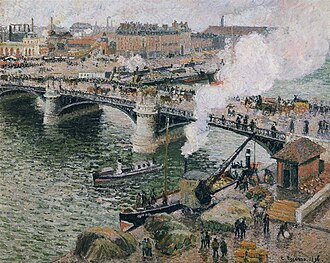 Pont Boieldieu in Rouen, Rainy Weather - Camille Pissarro (1896)
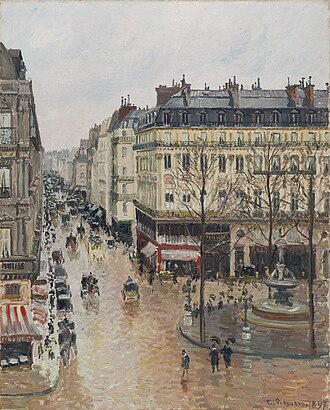 Rue Saint-Honoré por la tarde. Efecto de lluvia. - Camille Pissarro (1897)
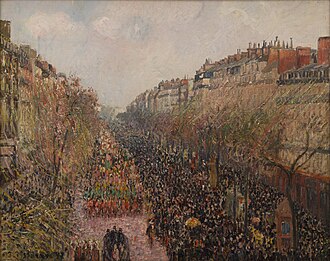 Boulevard Montmartre, Mardi Gras - Camille Pissarro (1897)
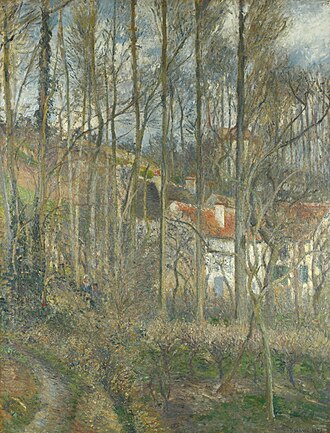 The Côte des Bœufs, Pontoise - Camille Pissarro (1877)
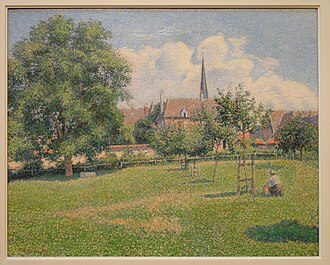 The House of the Deaf Woman and the Belfry at Eragny - Camille Pissarro (1886)
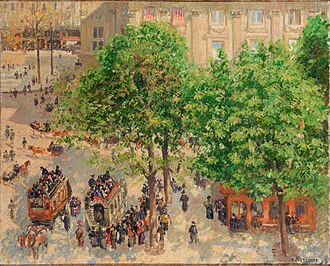 Place du Theatre-Francais in Spring - Camille Pissarro (1898)
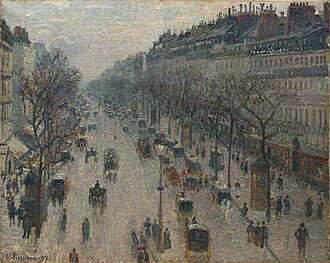 The Boulevard Montmartre on a Winter Morning - Camille Pissarro (1897)
 The Nap, Peasant Woman Lying in the Grass, Pontoise - Camille Pissarro (1882)
Obras de artistas relacionados
 Impresión, sol naciente - Claude Monet (1872)
 Nenúfares - Claude Monet (1906)
 Almuerzo sobre la hierba - Édouard Manet (1863)
 Olympia - Édouard Manet (1863)
 Baile en el Moulin de la Galette - Pierre-Auguste Renoir (1876)
 El almuerzo de los remeros - Pierre-Auguste Renoir (1881)
 La cuna - Berthe Morisot (1872)
 Summer's Day - Berthe Morisot (1879)
 El ajenjo - Edgar Degas (1875)
 Die Bellelli Familie - Edgar Degas (1858)
 El canal del Loing - Alfred Sisley (1892)
 The Watering Pond at Marly with Hoarfrost - Alfred Sisley (1876)