Nuda Veritas
Gustav Klimt · 1899
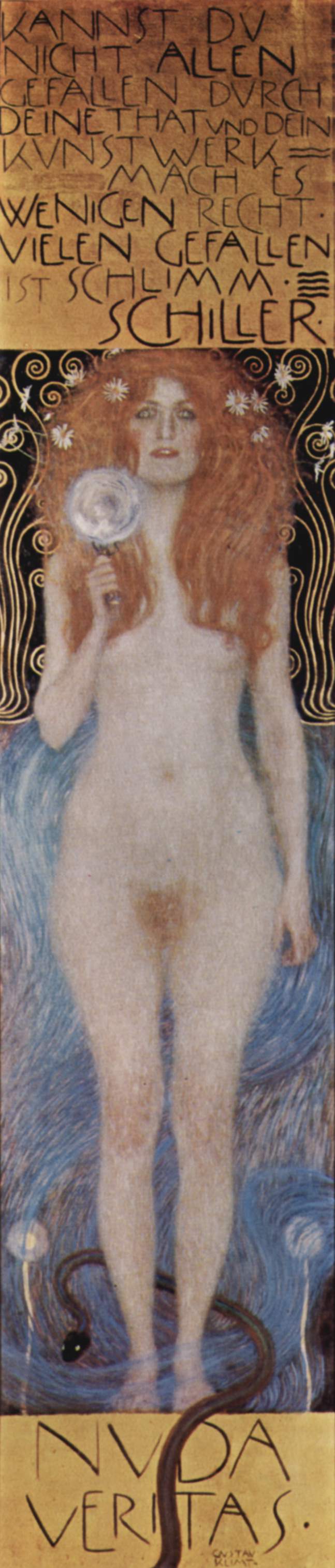
A naked woman faces you, red hair crowned with flowers, holding up a mirror that reflects nothing. A snake coils at her feet. Klimt painted Naked Truth in 1899, and Vienna was offended.
The story behind the painting
At the end of the nineteenth century Vienna lived under a hypocritical, repressive morality, and Klimt's art, with its eroticism and often explicit themes, was frequently rejected. Some artists felt the need for a radical change, and nineteen painters and architects broke away from the Academy of Fine Arts to form the Vienna Secession, with its own building. A first version of Nuda Veritas, a lithograph, appeared in 1898 in Ver Sacrum, the Secession's magazine. The painted version followed in 1899, in oil on canvas. Its first owner, the writer Hermann Bahr, was the only person who defended the work.
What to look for
The canvas is tall and narrow, about 252 by 56 cm, though Wikidata gives the width as 55.2 cm. At the top a quotation from Schiller is written on a gold ground. In the centre the woman stands frontally in complete nakedness, hiding nothing. She has pale skin, red hair and a fixed, stony gaze, and she holds a mirror with no reflection out towards the viewer. Flowers sit in her hair, the background is watery and almost fading, and a snake wraps around her ankles. Two thin long-stemmed flowers link her to the lower part, and at her feet the title Nuda Veritas is written.
Meaning and intent
Compared with the lithograph, Klimt made two important changes. He replaced a quotation by the German writer Leopold Schefer with the gold quotation from Schiller, and he added the snake, which was absent from the first version. The snake is read as truth threatened by lies and envy, its body spilling past the picture frame towards the words Nuda Veritas. In the most accepted reading, the woman turns the mirror towards us to urge us to flee from lies. The work is seen as a statement of the absolute freedom of art, which must tell the truth as the expression of its time.
Legacy
The public rebelled against the painting for the demonic, fatal character typical of Klimt's women, and the critic Hevesi called Veritas a Secessionist Isis. The frank realism of the nude was far from the idealised nudes the public knew, and it offended Viennese conformity in a period when Sigmund Freud's work had made sexuality an uncomfortable subject of study. The painting shows key traits of Klimt's art: his mastery of drawing, flat colour, gold, and techniques borrowed from the decorative arts. It is kept today at the Austrian Theatre Museum in Vienna.
¿Sabías que…?
- Oil on canvas, 1899, after a lithograph of 1898 in Ver Sacrum.
- The snake and the Schiller quotation were added in the painted version.
- Its first owner, Hermann Bahr, was its only defender.
- Now in the Austrian Theatre Museum, Vienna.
Sobre el artista
Gustav Klimt (1862-1918)
mujer · desnudo · desnudo · melena · de pie · alegoría · pelirrojo · ombligo
Más obras de Gustav Klimt
 El beso - Gustav Klimt (1907-1908)
 Retrato de Adele Bloch-Bauer I - Gustav Klimt (1907)
 Dánae - Gustav Klimt (1907)
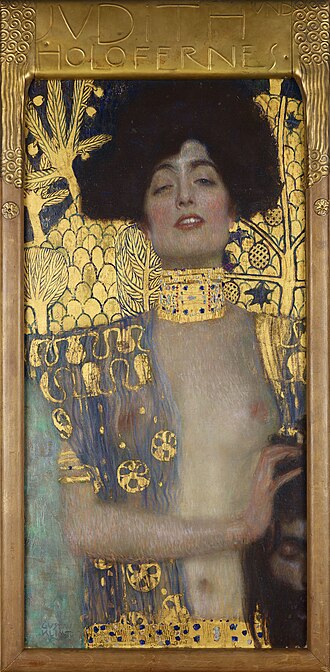 Judit I - Gustav Klimt (1901)
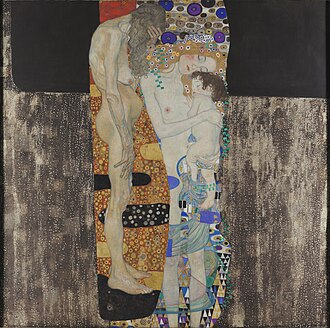 Las tres edades de la mujer - Gustav Klimt (1905)
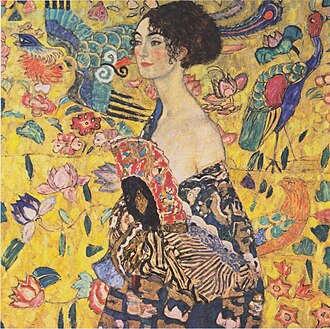 Dama con abanico - Gustav Klimt (1917)
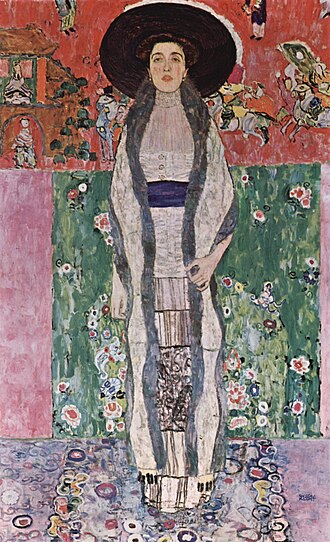 Retrato de Adele Bloch-Bauer II - Gustav Klimt (1912)
 Retrato de una dama - Gustav Klimt (1910s)