Virgen del rosal
Sandro Botticelli · 1469
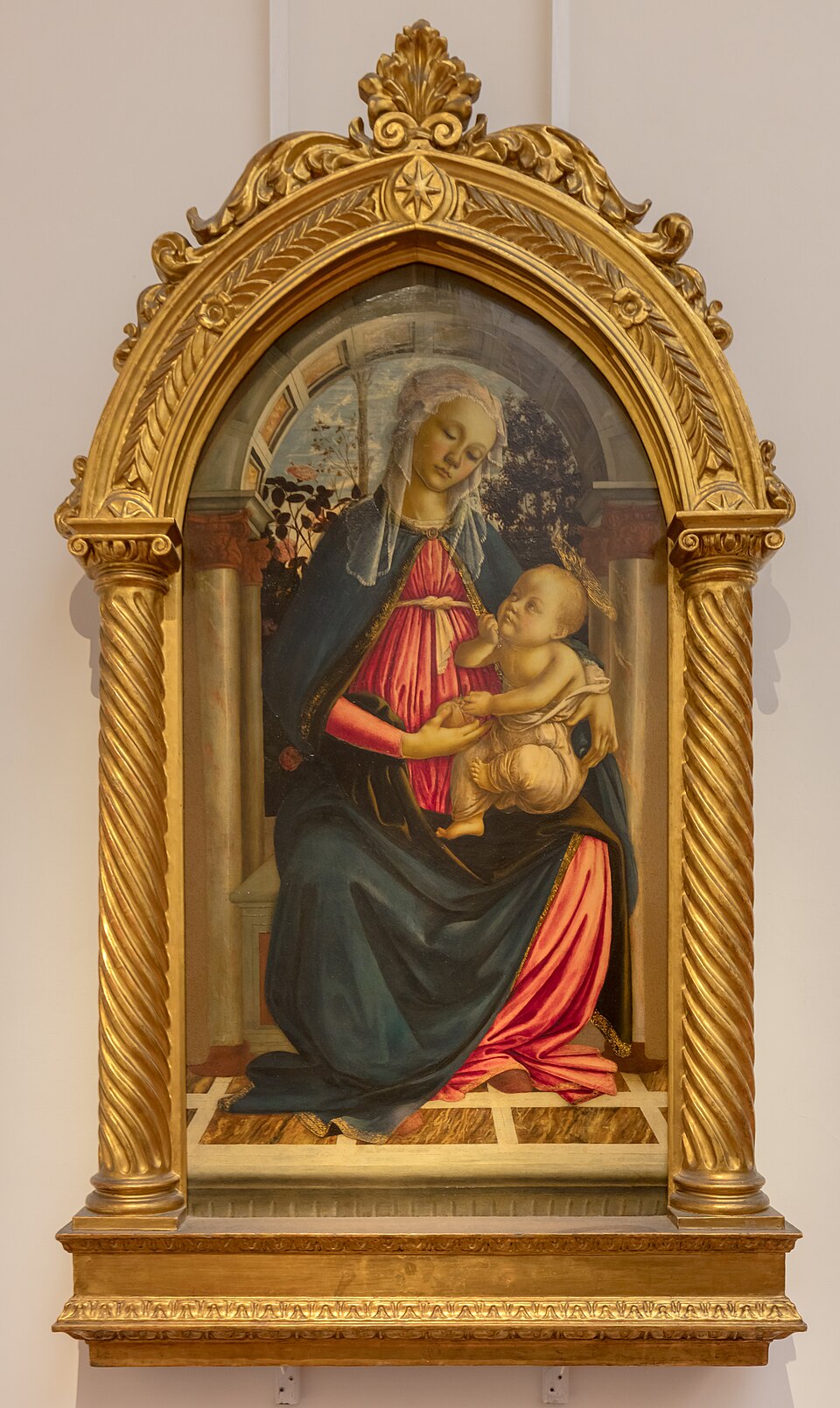
A pensive young Mary sits under an arch with pink roses behind her while her baby tastes a pomegranate. It is one of Botticelli's very first paintings, made when he was still learning from Verrocchio.
The story behind the painting
The Madonna of the Rose Garden is a tempera painting on panel made by Sandro Botticelli between 1469 and 1470, one of his earliest works. It is now in the Uffizi in Florence. The panel was once in the Chamber of Commerce of Florence, which has led to the hypothesis that, like his earlier Madonna della Loggia, it was commissioned by the Wool Guild or the Tribunale della Mercanzia, the merchants' court. Wilhelm von Bode was the first to date it to the artist's youth, in his Verrocchio period of 1469 to 1470, and other scholars have since confirmed that date.
What to look for
The Wikipedia article gives the size as 124 by 64 cm, while Wikidata gives 124 by 65 cm. Mary, pensive, holds the Christ Child on her knees beneath a loggia whose columns carry a round arch with a coffered ceiling. The arch frames her head and follows the curved top of the panel. Behind her stretches a garden, with pink roses dominating. Beneath her is a floor of framed marble tiles that shows the painter's skill in perspective. Look at the Child: a large oval head and a joyful, lively face, the same type as in Verrocchio's sculpture Putto with Dolphin from the same years.
Meaning and intent
The roses stand for one of Mary's titles, the Mystical Rose. The pomegranate that Mary holds and the Child is tasting symbolises fertility and royalty, and with its red colour, the blood of the Passion of Jesus. So in a peaceful, almost domestic garden scene, the future suffering is already present in a child's snack. The thoughtful mood of Mary fits that double meaning. The commission for a guild or a merchants' court, if the hypothesis is right, would mean that this tender image was meant to watch over the working life of the city's institutions.
Legacy
The painting also shows a young artist still finding his way. Its sharp contrasts of light and shadow recall Verrocchio, in whose workshop Botticelli may have trained. Mary's figure is long and loosely posed, more so than in the works of Filippo Lippi, another of his early models. There are some uncertainties in the space: the architecture behind is too small compared with Mary and with the flowers of the garden. Together with the Madonna in Glory with Seraphim, also in the Uffizi, it shows the large, seated, monumental Madonnas with which Botticelli began his career.
¿Sabías que…?
- Tempera on panel, 1469-1470, one of Botticelli's earliest works.
- Possibly made for the Wool Guild or the merchants' court.
- Roses stand for Mary as the Mystical Rose.
- Size given as 124 x 64 cm (Wikipedia) or 124 x 65 cm (Wikidata).
Sobre el artista
Sandro Botticelli (1445-1510)
arte religioso · mujer · Virgen María · Niño Jesús · niño · Primer Renacimiento · madre · Galería Uffizi
Más obras de Sandro Botticelli
 El nacimiento de Venus - Sandro Botticelli (c. 1485)
 La primavera - Sandro Botticelli (1480s)
 Venus y Marte - Sandro Botticelli (1485)
 Adoración de los Magos - Sandro Botticelli (1470s)
 Virgen del Magnificat - Sandro Botticelli (1481)
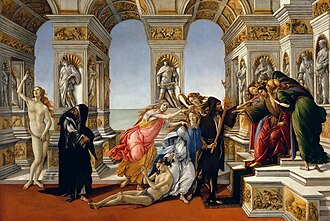 La Calumnia de Apeles - Sandro Botticelli (1490s)
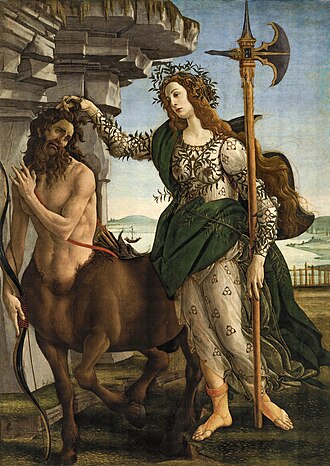 Palas y el Centauro - Sandro Botticelli (1482)
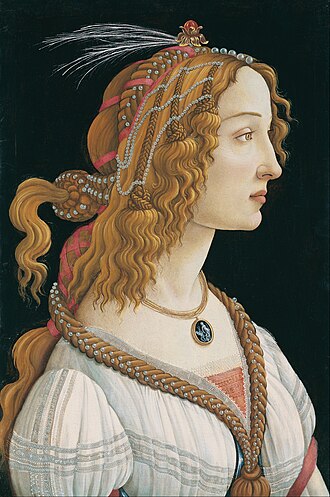 Retrato de una joven - Sandro Botticelli (1480)
Obras de artistas relacionados
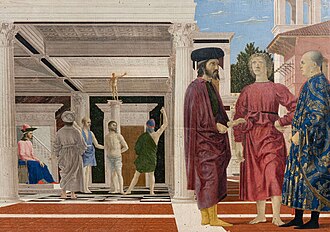 La flagelación - Piero della Francesca (1450s)
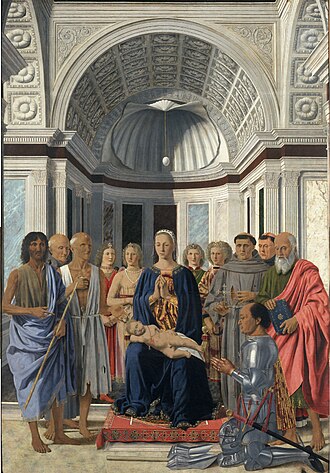 Sacra Conversación - Piero della Francesca (1472)
 La Gioconda - Leonardo da Vinci (1503-1519)
 La dama del armiño - Leonardo da Vinci (1490)
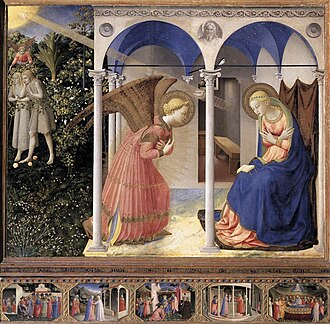 La Anunciación - Fra Angelico (1425)
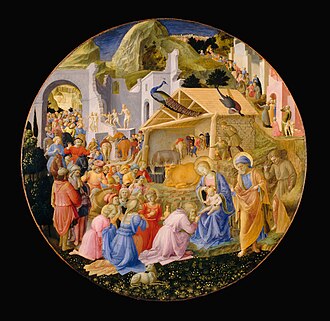 Adoración de los Reyes Magos - Fra Angelico (1430)
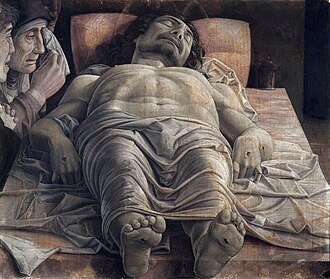 Lamentación sobre Cristo muerto - Andrea Mantegna (1483)
 Madonna de la Victoria - Andrea Mantegna