Madonna and Child with Saint John the Baptist and Two Angels
Sandro Botticelli · 1470
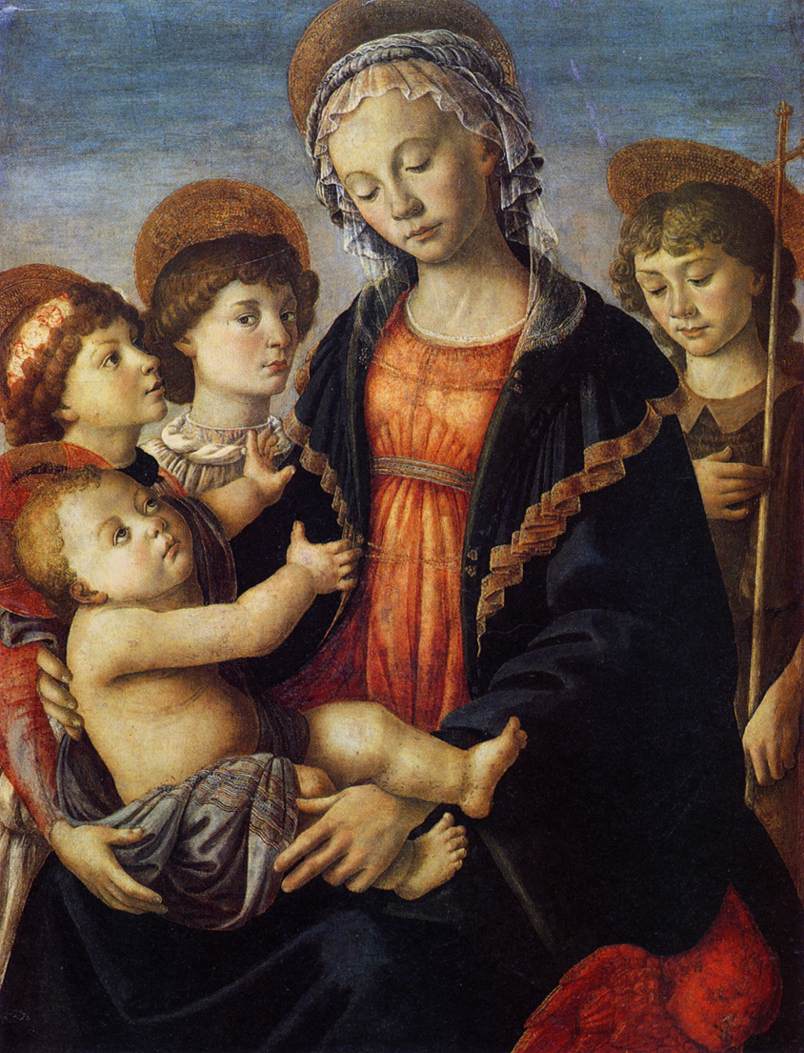
One angel holds the Child up to his mother. The other turns and looks straight at you, as if inviting you into the scene. Botticelli painted this around 1470.
The story behind the painting
This religious painting, dating from around 1470, came from the hospital of Santa Maria Nuova in Florence. It appears in the inventory of the Florentine museums of 1890 under number 3166. It is generally attributed to Sandro Botticelli, but Herbert Horne and Adolfo Venturi disputed this and called it a workshop piece, because of certain simplifications in the angels' faces. The early date, and its closeness to the Madonna and Child with Two Angels and the Madonna of the Rose Garden, add to these doubts.
What to look for
The Virgin, in her traditional red and blue, sits on a throne with a red seraph carved low on the seat. She turns three-quarters to the left and with her left hand lightly holds the Child, who stretches his arms towards her. One angel supports him at the small of his back while looking at Mary. The second angel stares intensely at the viewer. Behind on the right stands the young John the Baptist with camel skin and a cross-shaped reed. The background is a sky shading to blue. Gold festoons and pearls decorate the clothes and haloes. The panel measures 85 by 62 cm.
Meaning and intent
The angel who looks at us plays the role of the festaiolo, the figure in Renaissance sacred plays who made contact with the audience and explained the scenes. Here John the Baptist is a youth, not a small child as he often is. The dreamy, detached Virgin, the strong outline and the vibrant drapery come from Fra Filippo Lippi's Lippina, but the forms are softer and the poses more complex. The vivid contrasts and bronze tones come from Pollaiuolo, the Child's face is now typically Botticelli's, and the mood is melancholy and contemplative.
Legacy
The Virgin's head, with its pointed chin, appears again in Botticelli's Madonna of the Eucharist, the Madonna of the Loggia and his allegory of Fortitude, all from the same years. That family resemblance is part of why most scholars keep the painting in his own hand, even as the question raised by Horne and Venturi remains. The painting is kept at the Galleria dell'Accademia in Florence and is shown in the Sala del Colosso.
¿Sabías que…?
- Painted around 1470, from the hospital of Santa Maria Nuova.
- Generally attributed to Botticelli; some called it a workshop work.
- 85 x 62 cm.
- In the Galleria dell'Accademia, Florence, Sala del Colosso.
Sobre el artista
Sandro Botticelli (1445-1510)
arte religioso · Virgen María · Niño Jesús · Primer Renacimiento · ángel · Virgen con Niño · San Juan niño
Más obras de Sandro Botticelli
 El nacimiento de Venus - Sandro Botticelli (c. 1485)
 La primavera - Sandro Botticelli (1480s)
 Venus y Marte - Sandro Botticelli (1485)
 Adoración de los Magos - Sandro Botticelli (1470s)
 Virgen del Magnificat - Sandro Botticelli (1481)
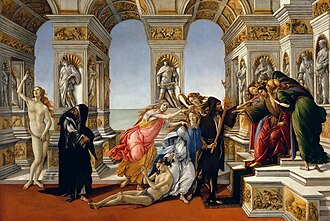 La Calumnia de Apeles - Sandro Botticelli (1490s)
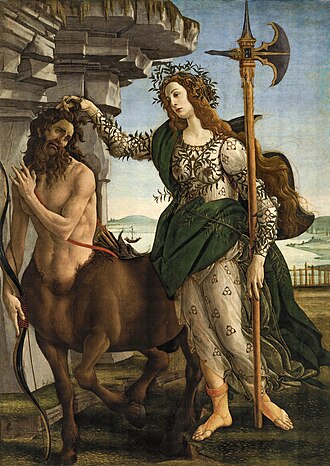 Palas y el Centauro - Sandro Botticelli (1482)
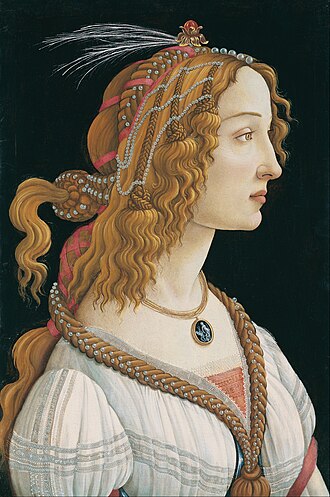 Retrato de una joven - Sandro Botticelli (1480)
Obras de artistas relacionados
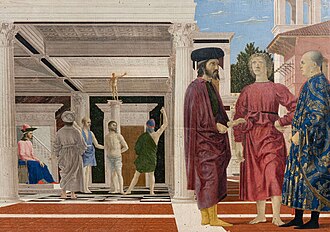 La flagelación - Piero della Francesca (1450s)
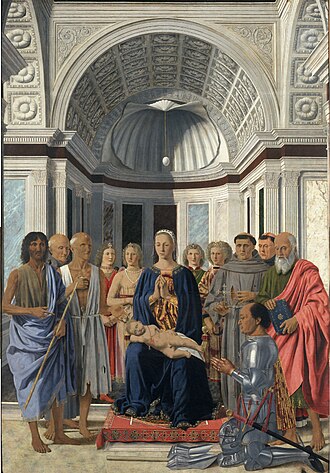 Sacra Conversación - Piero della Francesca (1472)
 La Gioconda - Leonardo da Vinci (1503-1519)
 La dama del armiño - Leonardo da Vinci (1490)
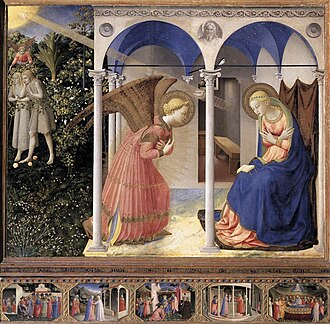 La Anunciación - Fra Angelico (1425)
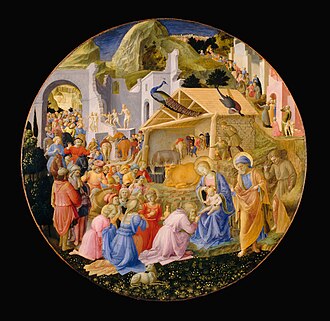 Adoración de los Reyes Magos - Fra Angelico (1430)
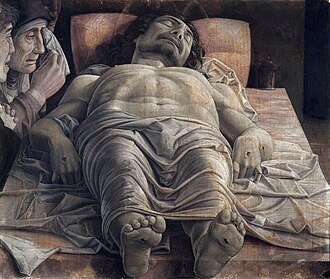 Lamentación sobre Cristo muerto - Andrea Mantegna (1483)
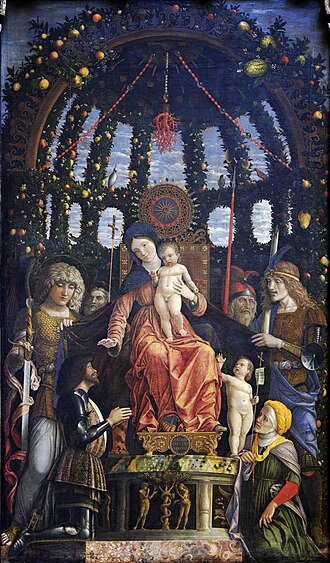 Madonna de la Victoria - Andrea Mantegna