Esperanza II
Gustav Klimt · 1907
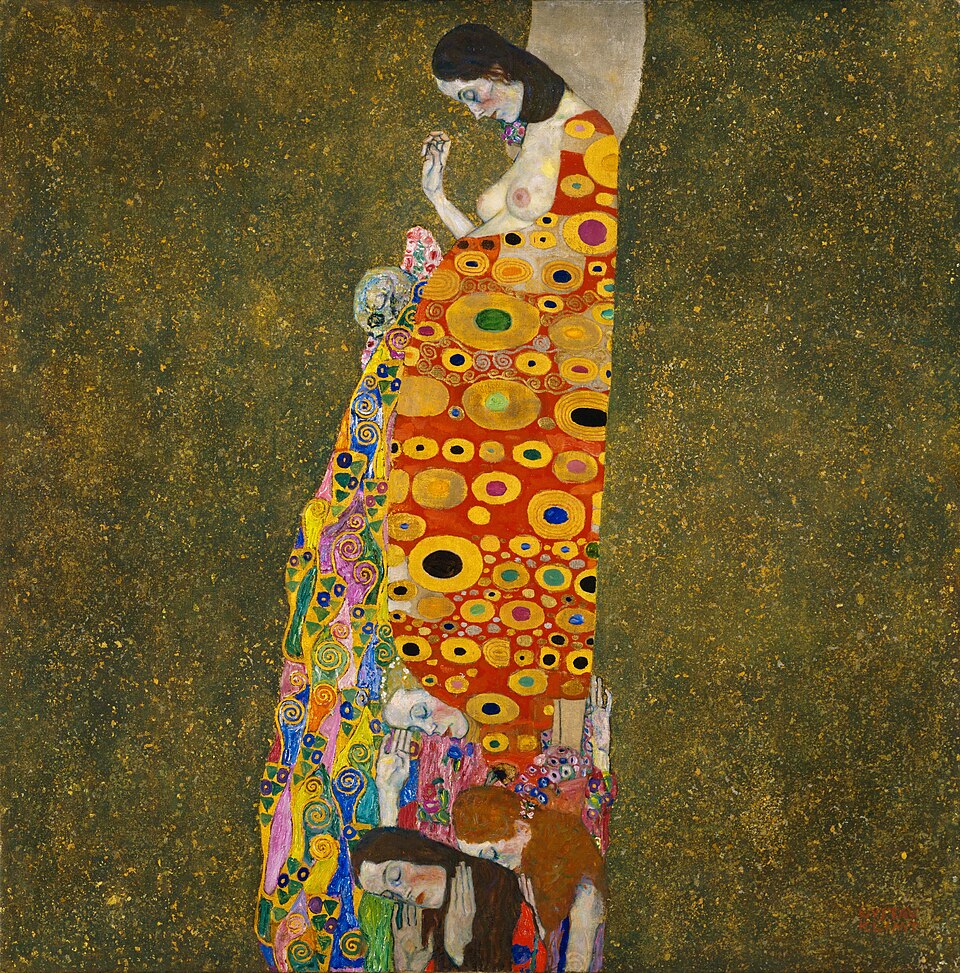
A pregnant woman bows her head, eyes closed, wrapped in a robe of gold and jewel-like patterns. From behind her belly a skull peers out, and at her feet three women bow as if in prayer. Klimt first called it Vision.
The story behind the painting
Hope II was painted in 1907 to 1908, in oil with gold and platinum on canvas; Wikidata gives 1907. It was Klimt's second painting of a pregnant woman, and both show Herma, one of his favourite models. In the first, Hope I of 1903, she stands naked, and contemporaries found it outrageous. This time she is clothed, so the picture was less provocative. Klimt painted it at the same time as The Kiss, and the two are close in composition and colour. He called it Vision; the title Hope II came later, after the earlier work.
What to look for
The canvas is square, 110.5 cm on each side. The women fill the central third, with a darker gold-flecked background on either side. The mother wears a long robe covered in geometric shapes and gold leaf, richly coloured and patterned like a Byzantine work but flat like an Orthodox icon. Against it, her face and bare skin are painted softly and with real volume: long brown hair, closed eyes, head bowed toward her breasts and growing belly. At the bottom, three more women bow their heads, praying or perhaps mourning.
Meaning and intent
A human skull appears from behind her stomach. It may point to the dangers of childbirth, or act as a memento mori, a reminder of death in the midst of new life, as the skull and deathlike figures do in Hope I. The skull was not there at first. At some point between 1909 and 1914 Klimt painted over a halo above the woman's head and added the skull above her belly, turning a gentler image of expectant motherhood into something more uneasy, where hope and fear are held together.
Legacy
Hope II was shown at the 1908 Kunstschau with The Kiss and Danaë, and in 1909 at the International Art Exhibition in Vienna under the name Vision. The sources disagree about Hope I: this article says it was rejected from a 1901 Secession show, while the Hope I article dates that painting to 1903. Eugenie Primavesi owned Hope II before December 1914. It was sold in the late 1930s by the Neue Galerie of Otto Kallir or his successor, stayed in private hands, and in 1978 was acquired by the Museum of Modern Art in New York.
¿Sabías que…?
- Painted 1907-1908 in oil with gold and platinum.
- Klimt's original title was Vision.
- The skull was added between 1909 and 1914, over a halo.
- Acquired by the Museum of Modern Art, New York, in 1978.
Sobre el artista
Gustav Klimt (1862-1918)
alegoría · Museo de Arte Moderno
Más obras de Gustav Klimt
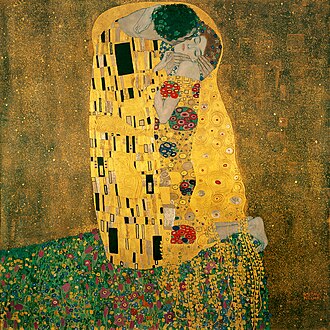 El beso - Gustav Klimt (1907-1908)
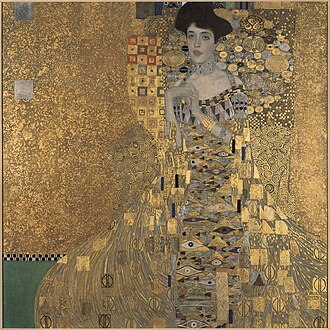 Retrato de Adele Bloch-Bauer I - Gustav Klimt (1907)
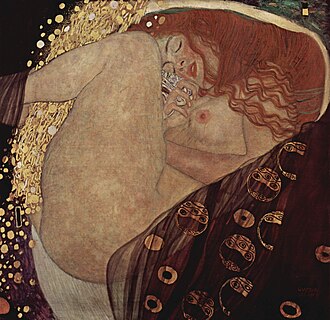 Dánae - Gustav Klimt (1907)
.jpg) Judit I - Gustav Klimt (1901)
Judit I - Gustav Klimt (1901)%20Google%20Art%20Project.jpg) Las tres edades de la mujer - Gustav Klimt (1905)
Las tres edades de la mujer - Gustav Klimt (1905)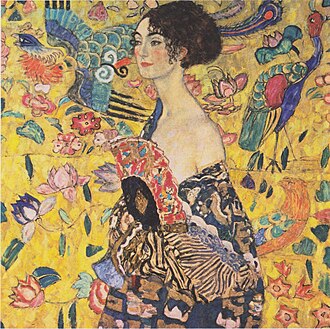 Dama con abanico - Gustav Klimt (1917)
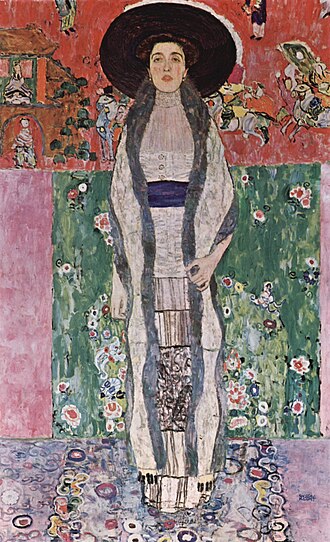 Retrato de Adele Bloch-Bauer II - Gustav Klimt (1912)
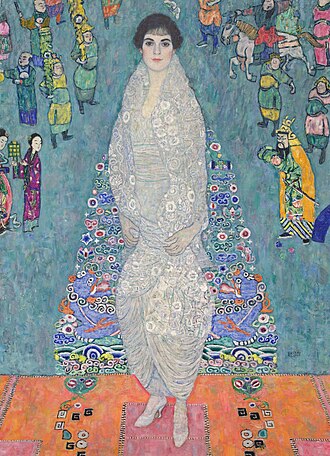 Retrato de Elisabeth Lederer - Gustav Klimt (1910s)