Grupa valenciana
Joaquín Sorolla · 1906
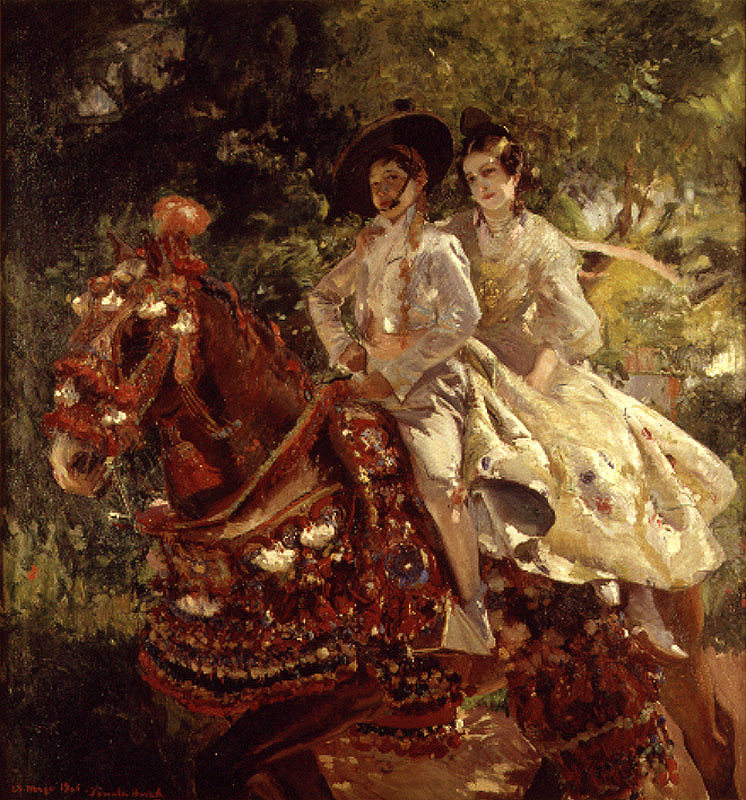
Two children in festive Valencian costume ride one chestnut horse, the sun blazing on silk and flowers. Sorolla painted his own family this way in 1906, for the biggest show of his life in Paris.
The story behind the painting
Sorolla signed and dated this canvas on 28 May 1906, when he already had a European reputation. He painted it for his first large solo exhibition in Paris, at the Galerie Georges Petit, an innovative step for a Spanish painter then, where some 500 of his works were shown. It was one of the last pictures made for that show. Though inspired by his native Valencia, it was painted in the garden of the family home in Madrid. It served as a first version of the scene that became My Daughters Maria and Elena Dressed as Valencians, now in the National Art Museum of Catalonia in Barcelona.
What to look for
The canvas is almost square, about 200 by 187 cm, yet the composition feels horizontal. A chestnut horse, seen at an angle, wears a decorated cloth with tassels on which the two riders sit. The younger rider in front holds the reins with both hands and wears the traditional male costume of Torrent: light blue silk jacket and breeches, white shirt, waistcoat, white stockings and a pink hat with pompoms. The figure behind wears a Valencian farm woman's dress of flowered silk, with hair dressed high with combs. Sorolla shades the costumes with complementary colours and leaves half the scene in shadow, against a strong blaze of sun on the right.
Meaning and intent
The title refers to riding a la grupa, a festive tradition in which a man sits in front holding the reins and a woman sits behind on the horse's rump, both legs to one side, holding on to him. Horse and riders are richly dressed in 18th-century style. This way of riding appeared in festive parades in Valencia and elsewhere in Spain. Sorolla turned it into a family portrait, but the sources disagree on the sitters: one passage names his children Joaquim and Maria Clotilde, while the analysis identifies his daughters Elena and Maria, with Elena, the youngest, in the male costume.
Legacy
At the Paris show, the work was bought along with all the others through the account of Antonio Hereen. During the Spanish Civil War it was moved to the convent of the Descalzas Reales, owned by his son Augusto, and briefly to the Prado after a fire. Later the collector Fèlix Fernández-Valdés acquired it, and in 1981 the Ministry of Culture bought it for the Museum of Fine Arts of Valencia. It is praised as a masterpiece of light and colour, its wide range of tones drawn from the bright costumes of the Valencian tradition.
¿Sabías que…?
- Signed and dated 28 May 1906.
- Painted for Sorolla's 1906 solo show at the Galerie Georges Petit, Paris.
- Shows the festive Valencian way of riding two on one horse.
- In the Museum of Fine Arts of Valencia since 1981.
Sobre el artista
Joaquín Sorolla (1863-1923)
Museo de Bellas Artes de Valencia
Más obras de Joaquín Sorolla
 Paseo a orillas del mar - Joaquín Sorolla (1909)
 Triste herencia - Joaquín Sorolla (1898)
 Chicos en la playa - Joaquín Sorolla (1910)
 Trata de blancas - Joaquín Sorolla (1894)
 Y aún dicen que el pescado es caro - Joaquín Sorolla (1894)
 El regreso de la pesca: remolcando el barco - Joaquín Sorolla (1894)
 Saltando a la comba, La Granja - Joaquín Sorolla (1911)
 Saliendo del baño - Joaquín Sorolla (1915)
Obras de artistas relacionados
 La noche estrellada - Vincent van Gogh (1889)
 Terraza de café por la noche - Vincent van Gogh (1888)
 ¿De dónde venimos? ¿Qué somos? ¿Adónde vamos? - Paul Gauguin (1897-1898)
 El Cristo amarillo - Paul Gauguin (1889)
 Las grandes bañistas - Paul Cézanne (1900s)
 The Boy in the Red Vest - Paul Cézanne
 Baile en el Moulin de la Galette - Pierre-Auguste Renoir (1876)
 El almuerzo de los remeros - Pierre-Auguste Renoir (1881)
 En el Moulin Rouge - Henri de Toulouse-Lautrec (1892)
 La toilette - Henri de Toulouse-Lautrec (1896)