Götz von Berlichingen
Lovis Corinth · 1917
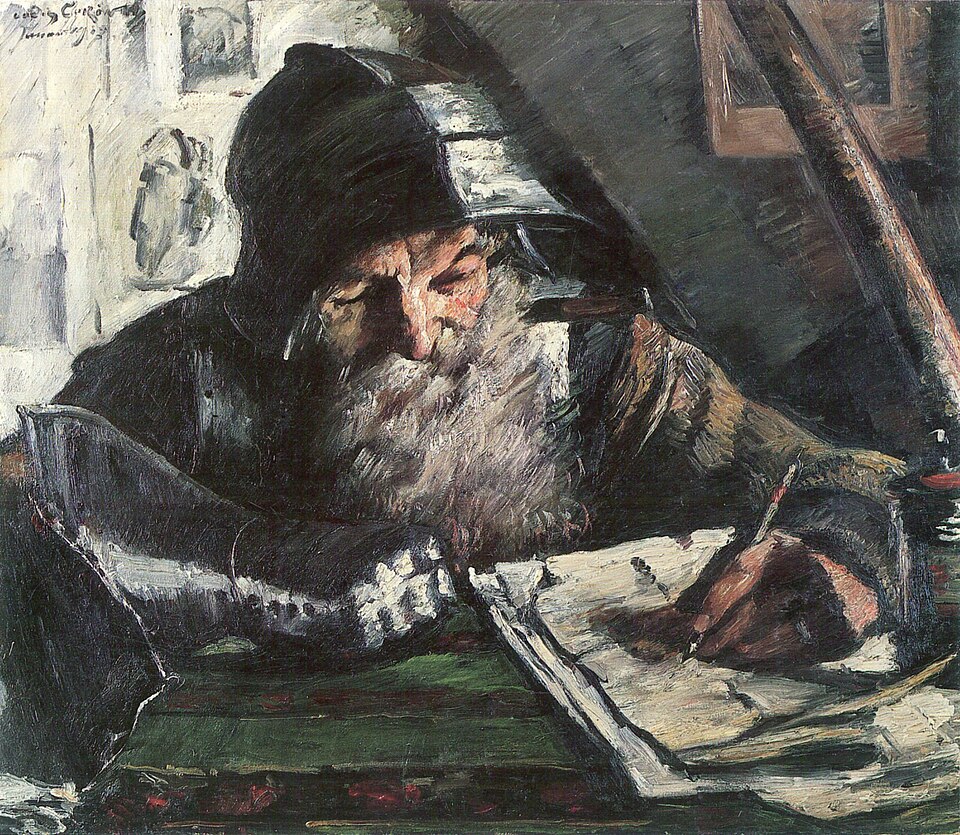
An old knight in a helmet, his iron hand resting on the table, bends over a pile of paper and writes his memoirs. Lovis Corinth painted him in 1917, and put his own steel pen in the knight's fingers.
The story behind the painting
Lovis Corinth painted this canvas, about 85 by 100 cm, in his Berlin studio in 1917. The real Götz von Berlichingen, who lived from 1480 to 1562, mattered less to him than the literary figure he knew from Goethe's drama. Corinth also knew, through Gerhart Hauptmann's play Florian Geyer, of the knight's doubtful conduct during the German Peasants' War, and he had painted the actor Rudolf Rittner as Florian Geyer in 1906. The picture was shown at the Berlin Secession the same year it was made.
What to look for
The old knight sits at a table in armour, cut off at chest height by the green tabletop, leaning slightly forward. His iron right hand rests on the table, while the fingers of his left hand guide a pen over a stack of sheets; no words can be read. His face is framed by an iron helmet and a full grey beard, his half-closed eyes on the paper. Behind him is a grey wall with several drawings, and over his left shoulder a staircase with a railing before a grey-green wall where a painting hangs.
Meaning and intent
According to Lothar Brauner, the pen in the knight's hand is Corinth's own steel pen, and the armour, helmet and iron hand are only attributes to make the figure recognisable. Brauner suggests that, because of the knight's dubious role, Corinth showed him not as a commander but writing the memoirs that inspired Goethe's drama. Charlotte Berend-Corinth, in her catalogue of his paintings, described it simply as the knight with a large grey beard, writing his memoirs. Corinth often drew on theatre, and armour appears in many of his pictures, including self-portraits from 1911 and 1914.
Legacy
After the 1917 Secession show the painting belonged to R. Beyer, and around 1925 it was sold through the dealer Alfred Flechtheim to the Museum für Kunst und Kulturgeschichte in Dortmund. In 1957 it passed to the Museum am Ostwall, today's Museum Ostwall. It appeared in the 1958 exhibitions marking the hundredth anniversary of Corinth's birth, in Wolfsburg and Munich, then in Linz, Cologne and Essen, and in 1996 to 1997 in a touring show at the Haus der Kunst in Munich, the Nationalgalerie in Berlin, the Saint Louis Art Museum and the Tate Gallery.
¿Sabías que…?
- Painted by Lovis Corinth in Berlin in 1917, about 85 x 100 cm.
- Shows the knight writing his memoirs, the source of Goethe's drama.
- The pen is said to be Corinth's own steel pen.
- In the Museum Ostwall, Dortmund, since 1957.
Sobre el artista
Lovis Corinth (1858-1925)
Más obras de Lovis Corinth
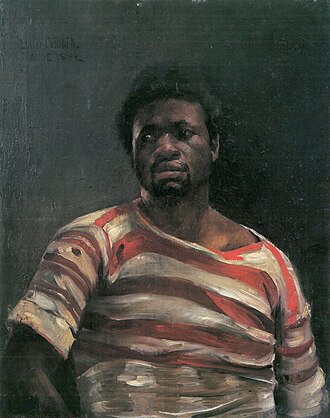 Un Otelo - Lovis Corinth (1884)
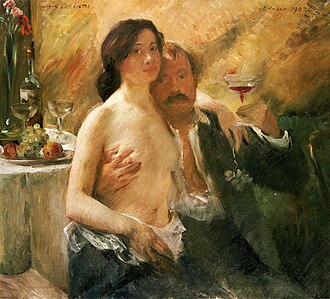 Autorretrato con Charlotte Berend y una copa de champán - Lovis Corinth (1902)
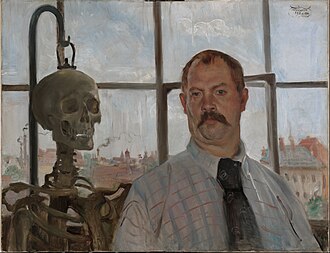 Autorretrato con esqueleto - Lovis Corinth (1896)
 Innocentia - Lovis Corinth (1890)
 Susanna im Bade, segunda versión - Lovis Corinth (1890)
 The Red Christ - Lovis Corinth (1922)
 Reading Woman - Lovis Corinth (1911)
 Carmencita - Lovis Corinth (1924)