Un Otelo
Lovis Corinth · 1884
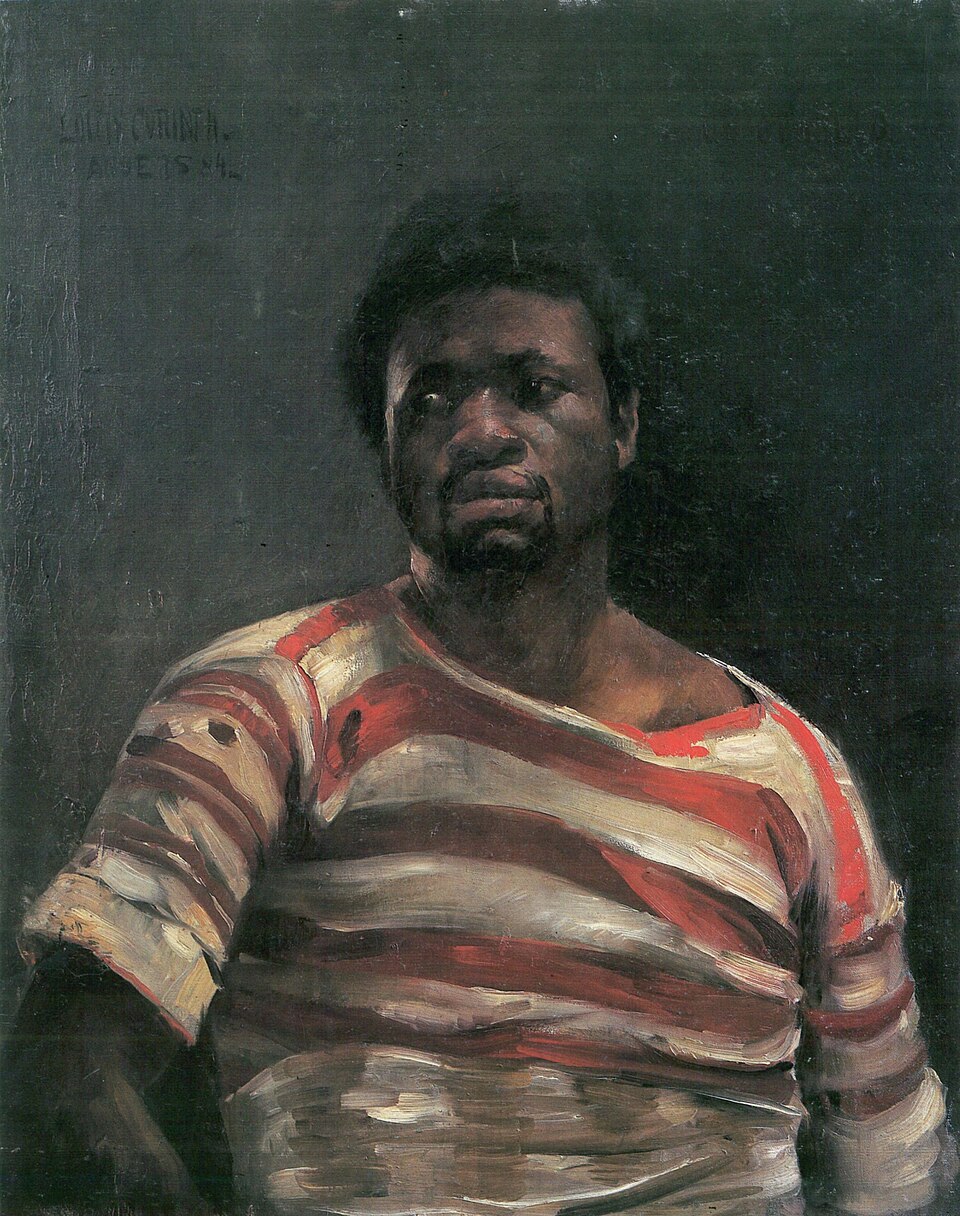
A dock worker or sailor from Antwerp, in a torn striped shirt, lit harshly against a dark grey ground. The young Lovis Corinth wrote two words in the corner, Un Othello, and turned an unnamed man into Shakespeare's hero.
The story behind the painting
This is an early work. In 1884 Lovis Corinth spent three months in Antwerp studying under the Belgian painter Paul Eugène Gorge, and in Gorge's studio he made this canvas, as well as a portrait of Gorge himself. The model was a dock worker or a sailor from the port of Antwerp, whose name is not recorded. Corinth signed the painting at upper left and wrote its title at upper right: Un Othello. The painting is also known as Sailor.
What to look for
The man is shown as a bust, his upper body slightly turned to the left and his face towards the viewer. He wears a holey wool shirt with red and white horizontal stripes and a wide collar, painted very roughly; the shirt ends just before the elbow. Against the black-grey background his hair seems to melt into the dark, and his features are not fully legible. Strong light makes the face uneasy. He has a small beard and looks to the left with an apparent sense of unease.
Meaning and intent
The title compares the anonymous model with the hero of Shakespeare's Othello, as if he were a modern counterpart, probably to stress his strength and pride rather than any rank. The historian Friedrich Gross contrasts it with Gérôme's Bashi-Bazouk: Gérôme's soldier shows calm and pride with fine, restrained light, while Corinth dissolves the image into patches of colour and violent brushstrokes. Gross places the work in a humanist tradition of psychologically deep portraits of Black men, from Rembrandt and Frans Hals to Géricault. Lothar Brauner links it to Frans Hals, though Corinth probably did not know his paintings then.
Legacy
The painting was first owned by R. Brackl in Munich, then passed through three owners, the last being Jean and Ida Baer, a Jewish couple in Berlin. It later came to the collector Wolfgang Gurlitt, who acquired it in 1953 for the Neue Galerie der Stadt Linz, today the Lentos Art Museum. In 2015 the museum restituted it to the heirs of Jean and Ida Baer, it was auctioned in London that year, and it is now in a private collection.
¿Sabías que…?
- Painted in Antwerp in 1884.
- Made in the studio of Paul Eugène Gorge.
- Inscribed Un Othello at upper right.
- Restituted by the Lentos Art Museum in 2015 to the heirs of Jean and Ida Baer.
Sobre el artista
Lovis Corinth (1858-1925)
Más obras de Lovis Corinth
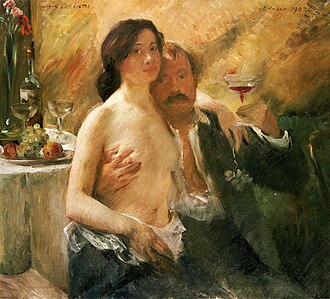 Autorretrato con Charlotte Berend y una copa de champán - Lovis Corinth (1902)
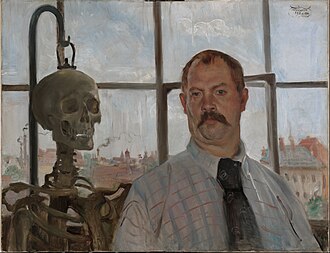 Autorretrato con esqueleto - Lovis Corinth (1896)
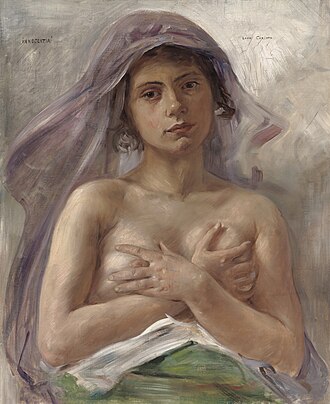 Innocentia - Lovis Corinth (1890)
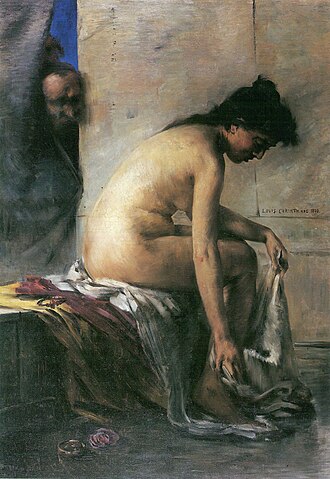 Susanna im Bade, segunda versión - Lovis Corinth (1890)
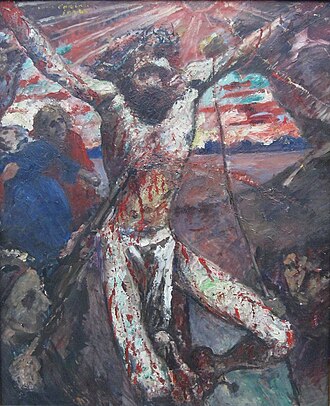 The Red Christ - Lovis Corinth (1922)
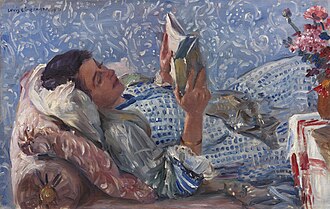 Reading Woman - Lovis Corinth (1911)
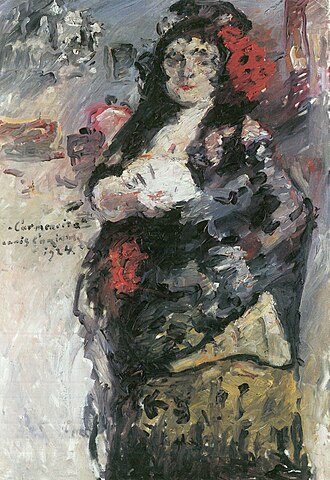 Carmencita - Lovis Corinth (1924)
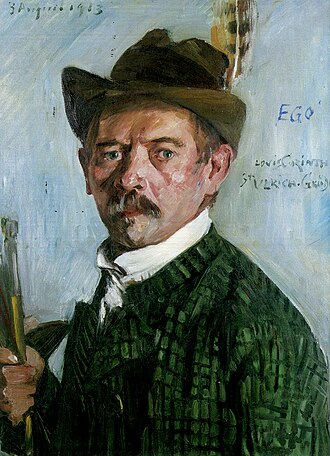 Self-portrait with a Tyroler hat - Lovis Corinth (1913)