Extreme Unction
Nicolas Poussin · 1638
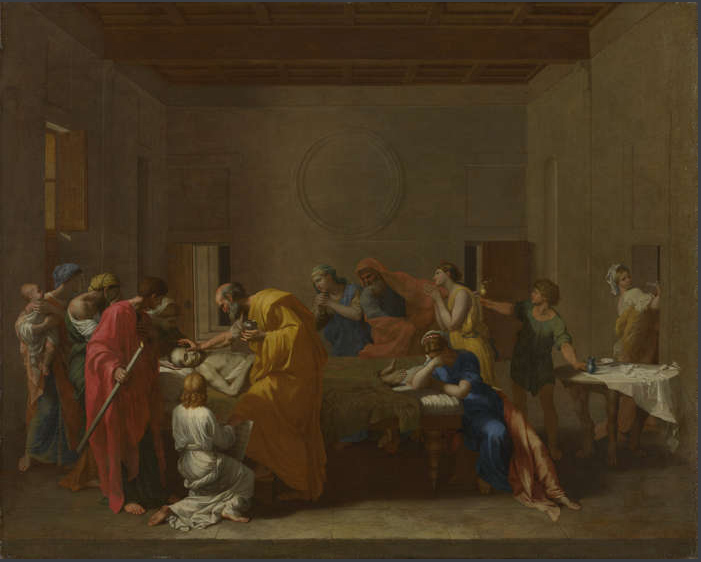
A dying man lies surrounded by family as a priest anoints him with oil. Poussin painted this quiet, grave scene as one of his Seven Sacraments, facing death with measured lines and unexpectedly radiant colour.
The story behind the painting
Extreme Unction, or Final Anointing, is one of a set of seven scenes representing the sacraments of the Catholic Church, painted by Nicolas Poussin between 1638 and 1640. The set was commissioned in Rome by the renowned connoisseur Cassiano dal Pozzo. In choosing a deathbed, Poussin was at his most ambitious: he consciously measured himself against the ancient Greek painter Apelles, who, as Poussin wrote, was much pleased to represent scenes of death. Wikidata gives 1638 as the date, the start of the period in which the series was painted.
What to look for
The scene shows a dying man being anointed with oil according to the rites of the early Roman church. Poussin drew on his long study of classical art and artefacts to reproduce costumes, setting and composition, and he set the figures in frieze like poses, as on an ancient relief, which heightens the realism of the scene. Follow the stark, lyrical line that runs through the group, and the controlled play of light and shadow. Then look for the passages of resplendent, even joyous colour that keep this sombre moment from turning heavy.
Meaning and intent
Poussin's sobriety can seem difficult or remote today, but here subject and style are perfectly aligned, and the restraint brings out the full depth of emotion in this momentous scene. Death remains one of the last great taboos in much of the developed world, and the painting addresses human mortality with potency and directness. Through the rhythmic beauty of its line and its colour, it invites us to contemplate the most natural and inevitable event of human life. This classicising approach went on to influence painters from Jacques-Louis David and Ingres to Cézanne and Picasso.
Legacy
By the 18th century collectors across Europe wanted Poussin's pictures. In 1785 the Duke of Rutland bought the Seven Sacraments, then among his most important works in Rome; the purchase caused a sensation in England, and King George III himself visited the series at the Royal Academy. The set is no longer complete: Penance was destroyed by fire in 1816, Baptism is now in the National Gallery of Art in Washington, and Ordination went to the Kimbell Art Museum in Texas in 2011. Extreme Unction then entered the Fitzwilliam Museum in Cambridge, whose acquisition was described as the most important Old Master to arrive there for almost a century.
¿Sabías que…?
- One of Poussin's Seven Sacraments, painted 1638-1640.
- Commissioned in Rome by Cassiano dal Pozzo.
- Bought with the series by the Duke of Rutland in 1785.
- Now in the Fitzwilliam Museum, Cambridge.
Sobre el artista
Nicolas Poussin (1594-1665)
Más obras de Nicolas Poussin
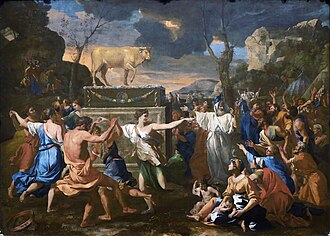 La adoración del becerro de oro - Nicolas Poussin (1634)
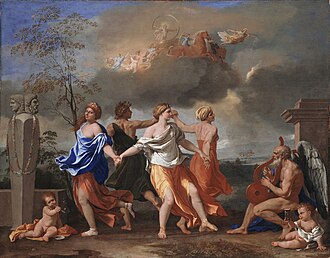 La danza de la vida humana - Nicolas Poussin (1630s)
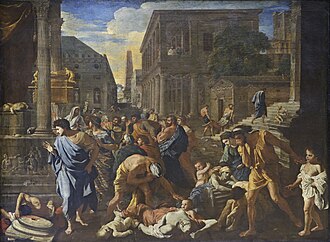 The Plague at Ashdod - Nicolas Poussin (1630)
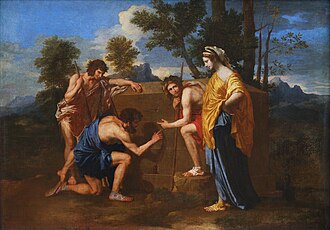 Et in Arcadia ego - Nicolas Poussin (1638)
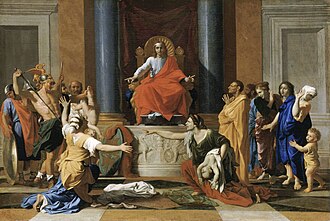 El juicio de Salomón - Nicolas Poussin (1649)
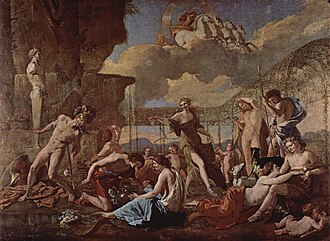 The Empire of Flora - Nicolas Poussin (1631)
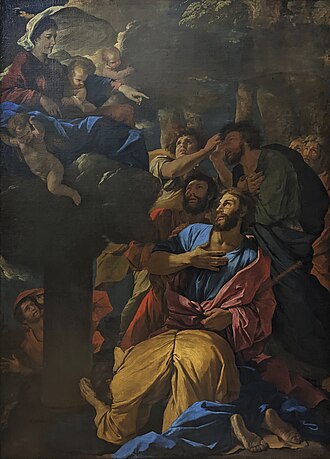 Aparición de la Virgen María a Santiago el Mayor - Nicolas Poussin (1620s)
 The Martyrdom of Saint Erasmus - Nicolas Poussin (1628)