The Empire of Flora
Nicolas Poussin · 1631
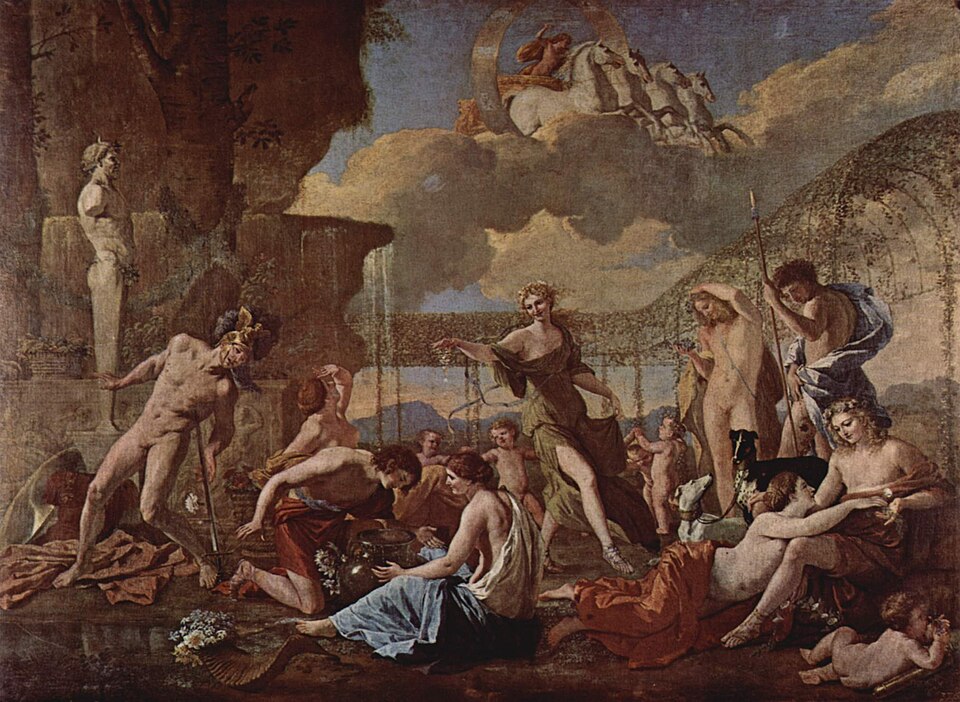
Flora dances through a garden, scattering flowers over young lovers who are about to become flowers themselves. Poussin gathers a whole book of Ovid's metamorphoses into a single bright afternoon.
The story behind the painting
The Empire of Flora, also called The Realm of Flora, is dated to about 1630 or 1631; Wikidata gives 1631. Its first owner is uncertain. Some have argued that it was painted for Cardinal Omodei. However, as the scholar Emily A. Beeny states, its patron is believed to have been Fabrizio Valguarnera, an art merchant who was also a jewel thief. The composition became widely known through an engraving by Audran. The canvas measures about 131 by 181 cm.
What to look for
In the centre, Narcissus bends over a vase of water, sighing for his own reflection, while Echo sits beside him gazing with loving eyes. Beyond them, Clytie watches in rapture as the sun god drives his shining chariot across the sky. On the left, Ajax falls on his own sword. On the other side, Smilax lies in the lap of Crocus. A little further back stands the young hunter Adonis with a spear and two dogs, and further still the beautiful Hyacinthus. Behind Flora, cupids dance hand in hand, and one lies in front holding a bunch of flowers.
Meaning and intent
Every figure here comes from the stories of people transformed into flowers, and Poussin shows each one at the moment just before the change. That gives the picture its strange sweetness: Flora dances in triumph, scattering blossoms over lovers who are pining, wounded or dying, because their sorrow is about to bloom. Love, loss and the cycle of nature become one garden scene, a parterre surrounded by bowers, where grief and beauty are the same thing seen at different moments.
Legacy
The painting is now in the Gemäldegalerie Alte Meister in Dresden, part of the Staatliche Kunstsammlungen Dresden. Its German title is Das Reich der Flora. Through Audran's engraving, its cast of mythological lovers reached a wide audience. For a viewer today, the pleasure lies in reading it slowly, finding each figure in turn and remembering the flower that will grow from them: narcissus, hyacinth, crocus and the rest of Flora's kingdom.
¿Sabías que…?
- Dated about 1630 or 1631.
- Each figure is a mythological lover later changed into a flower.
- Its patron may have been the art merchant Fabrizio Valguarnera.
- Now in the Gemäldegalerie Alte Meister, Dresden.
Sobre el artista
Nicolas Poussin (1594-1665)
pintura mitológica · Staatliche Kunstsammlungen Dresden
Más obras de Nicolas Poussin
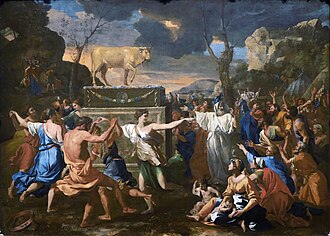 La adoración del becerro de oro - Nicolas Poussin (1634)
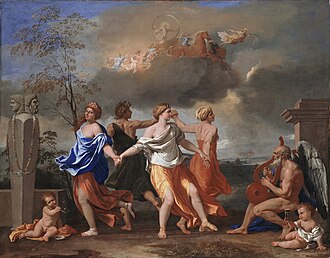 La danza de la vida humana - Nicolas Poussin (1630s)
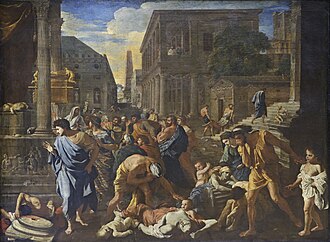 The Plague at Ashdod - Nicolas Poussin (1630)
.jpg) El juicio de Salomón - Nicolas Poussin (1649)
El juicio de Salomón - Nicolas Poussin (1649) Aparición de la Virgen María a Santiago el Mayor - Nicolas Poussin (1620s)
 The Martyrdom of Saint Erasmus - Nicolas Poussin (1628)
 A Bacchanalian Revel Before a Term - Nicolas Poussin (1630s)
 Midas ante Baco - Nicolas Poussin (1630)