El Conde-Duque de Olivares a caballo
Diego Velázquez · 1636
.jpg)
The king's chief minister rides a rearing horse toward a distant battle, turning back to make sure we are watching. On horseback, an honour usually kept for kings, Velázquez made a heavy man look slender and triumphant.
The story behind the painting
Gaspar de Guzmán, Count-Duke of Olivares, was the valido, the right hand of Philip IV, and the most powerful man at court after the king. He had also supported Velázquez in his early years in Madrid. The painting is not dated. Wikipedia places it around 1636 but also suggests it was probably painted just after the Hall of Realms series, around 1638, possibly after the Battle of Fuenterrabía, a success credited to Olivares though he did not take part. Wikidata gives 1636.
What to look for
Olivares wears a wide-brimmed feathered hat, armour and the sash of State, and holds a marshal's baton pointing toward the battle. His armour may survive in the Liria Palace in Madrid. Seen from a low viewpoint, his torso twisted back, he looks slimmer than the massive, rather clumsy man of Velázquez's earlier portraits. The horse rears in a levade, and a diagonal from the hills gives the picture an energy that recalls Rubens. The battle is a few small spots of paint; the hills fade into green and blue.
Meaning and intent
Being shown on horseback, normally reserved for monarchs, declared the power Olivares had reached. The aim was to validate that power, and the design and colour are more vigorous and showy than Velázquez's usual sober portraits. The portrait was likely suggested by Olivares himself, and Velázquez had to take particular care with so important a patron. Some think the battle is not a specific one; the landscape may be schematic because the painter did not know Hondarribia.
Legacy
It was not made for the Hall of Realms and only entered the royal collection about a century later. It has been in the Museo del Prado since the museum opened in 1819. Its rich colour and treatment of light still give the scene great vitality. Set beside the royal equestrian portraits, it shows how close to the throne Velázquez placed his patron, and how a painter could turn a minister's ambition into an image of the king's own kind of glory.
¿Sabías que…?
- Shows the Count-Duke of Olivares, chief minister of Philip IV.
- Dated around 1636, or possibly about 1638.
- An equestrian portrait, an honour usually reserved for kings.
- In the Prado since 1819.
Sobre el artista
Diego Velázquez (1599-1660)
varón · Museo del Prado · caballo · equitación · retrato ecuestre · río
Más obras de Diego Velázquez
 Las meninas - Diego Velázquez (1656)
 La rendición de Breda - Diego Velázquez (1635)
 Venus del espejo - Diego Velázquez (1644)
 Las Hilanderas - Diego Velázquez
.jpg) Inocencio X - Diego Velázquez
Inocencio X - Diego Velázquez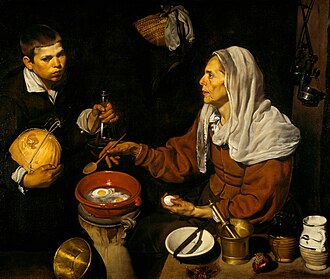 Vieja friendo huevos - Diego Velázquez (1618)
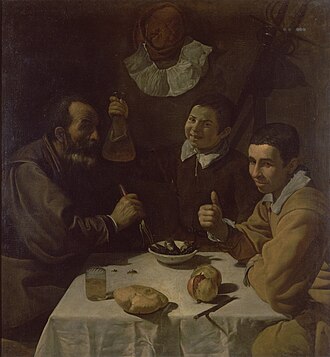 El almuerzo - Diego Velázquez (1617)
.jpg) El triunfo de Baco - Diego Velázquez (1628)
El triunfo de Baco - Diego Velázquez (1628)
Obras de artistas relacionados
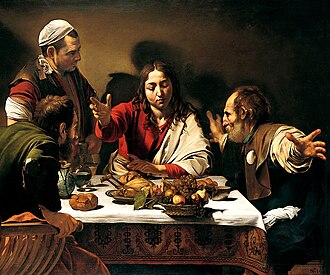 La cena de Emaús - Caravaggio (1601)
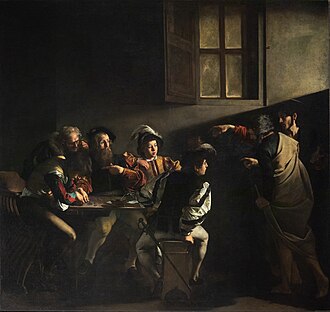 La vocación de San Mateo - Caravaggio (1609)
.jpg) La elevación de la cruz - Peter Paul Rubens (1609)
La elevación de la cruz - Peter Paul Rubens (1609) Rapto de las hijas de Leucipo - Peter Paul Rubens (1618)
%20-%20Google%20Art%20Project.jpg) Triple retrato de Carlos I - Anthony van Dyck (1635)
Triple retrato de Carlos I - Anthony van Dyck (1635)%20with%20M.%20de%20St%20Antoine%20-%20Google%20Art%20Project.jpg) Charles I (1600-1649) with M. de St Antoine - Anthony van Dyck (1636)
Charles I (1600-1649) with M. de St Antoine - Anthony van Dyck (1636) La ronda de noche - Rembrandt van Rijn (1642)
 Autorretrato - Rembrandt van Rijn (1659)
 La joven de la perla - Johannes Vermeer (1665)
 La lechera - Johannes Vermeer (c. 1658)