La madre muerta y su hija
Edvard Munch · 1899
%2C%20Kunsthalle%20Bremen.jpg)
A little girl stands with her back to her dead mother, hands pressed to her ears, eyes wide open toward us. Munch, who lost his own mother at five, painted the silence of that moment again and again.
The story behind the painting
Munch lost his mother to tuberculosis when he was five, and nine years later his sister Sophie died of the same disease. The motif of a child at a mother's deathbed draws on that family history. The earliest sketch dates from 1889, which is why the English Wikipedia article calls the composition one of 1889, while Wikidata dates this Bremen canvas to 1899. Munch first painted the scene between 1897 and 1899 in a wide version, now in the Munch Museum in Oslo, with his family in the background. The Bremen painting came after it, stripped down to the essential.
What to look for
Seen from above, a small blonde girl stands on the left, facing us, her back turned to the bed. Her arms are raised, her hands seem pressed to her ears, her blue eyes wide. She wears a white top, a pale purple dress, black stockings and dark boots. Her shadow runs diagonally back toward the bed, tying her to the gaunt, dark-haired woman lying with closed eyes on a white pillow. The woman's skin barely differs from the pillowcase. Look at the dull orange of the floor returning beside the pillow like bloodstains. The paint is thin, the face drawn with oil pastel.
Meaning and intent
Ulrich Bischoff saw the change from the first version to this one as typical of Munch's radicalisation. The family and the sickroom disappear, and only the child and her mother remain. The girl rises from the reddish floor into the dark blue zone of death, joining life and death in one figure. Her healthy skin and tense body stand against the worn-out figure behind her, as if she were trying to hold off death itself. One commentator called the child's silent horror a variant of The Scream. The picture does not explain grief. It makes us feel it.
Legacy
In 1918 the Kunsthalle Bremen bought the painting, the first Munch acquired by a German museum. Much later, a request from the Munch Museum led to X-rays, which revealed a second Munch painting of the same size hidden underneath: Girl and Three Male Heads, from around 1895 to 1898. Why it was there is unclear. The curator Dorothee Hansen suggested it may have served as a support, perhaps for lack of material. Many fingerprints on the edges suggest Munch handled the canvas while the paint was wet over a long time. Both works were shown together in Bremen in 2011 and 2012. Munch also made an etching of the motif in 1901.
¿Sabías que…?
- The motif recalls the death of Munch's mother when he was five.
- Wikipedia dates the composition 1889 (first sketch); Wikidata dates the canvas 1899.
- The first Munch painting bought by a German museum, in 1918.
- X-rays revealed a hidden painting underneath.
Sobre el artista
Edvard Munch (1863-1944)
Más obras de Edvard Munch
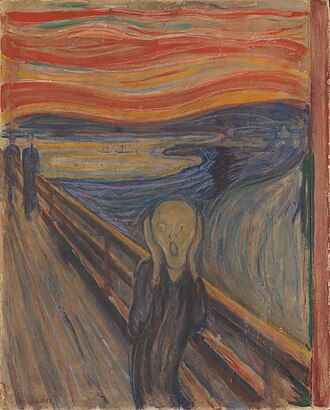 El grito - Edvard Munch (1893)
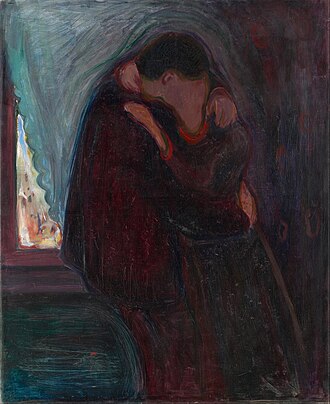 El Beso - Edvard Munch (1897)
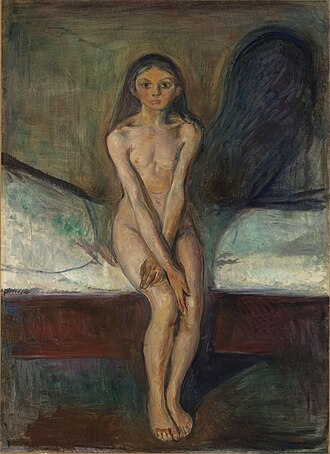 Pubertad - Edvard Munch (1895)
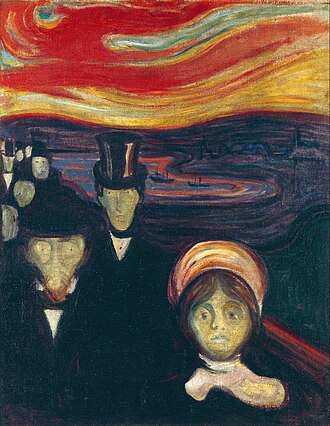 Ansiedad - Edvard Munch (1894)
.jpg) Inger en la playa - Edvard Munch (1889)
Inger en la playa - Edvard Munch (1889).jpg) Tarde en Karl Johan - Edvard Munch (1892)
Tarde en Karl Johan - Edvard Munch (1892)%2C%20NG.M.01111.jpg) Noche en Saint-Cloud - Edvard Munch (1890)
Noche en Saint-Cloud - Edvard Munch (1890) Autorretrato con cigarrillo - Edvard Munch (1895)