San Roque siendo nombrado por Cristo patrón de los enfermos de peste
Pedro Pablo Rubens · 1619
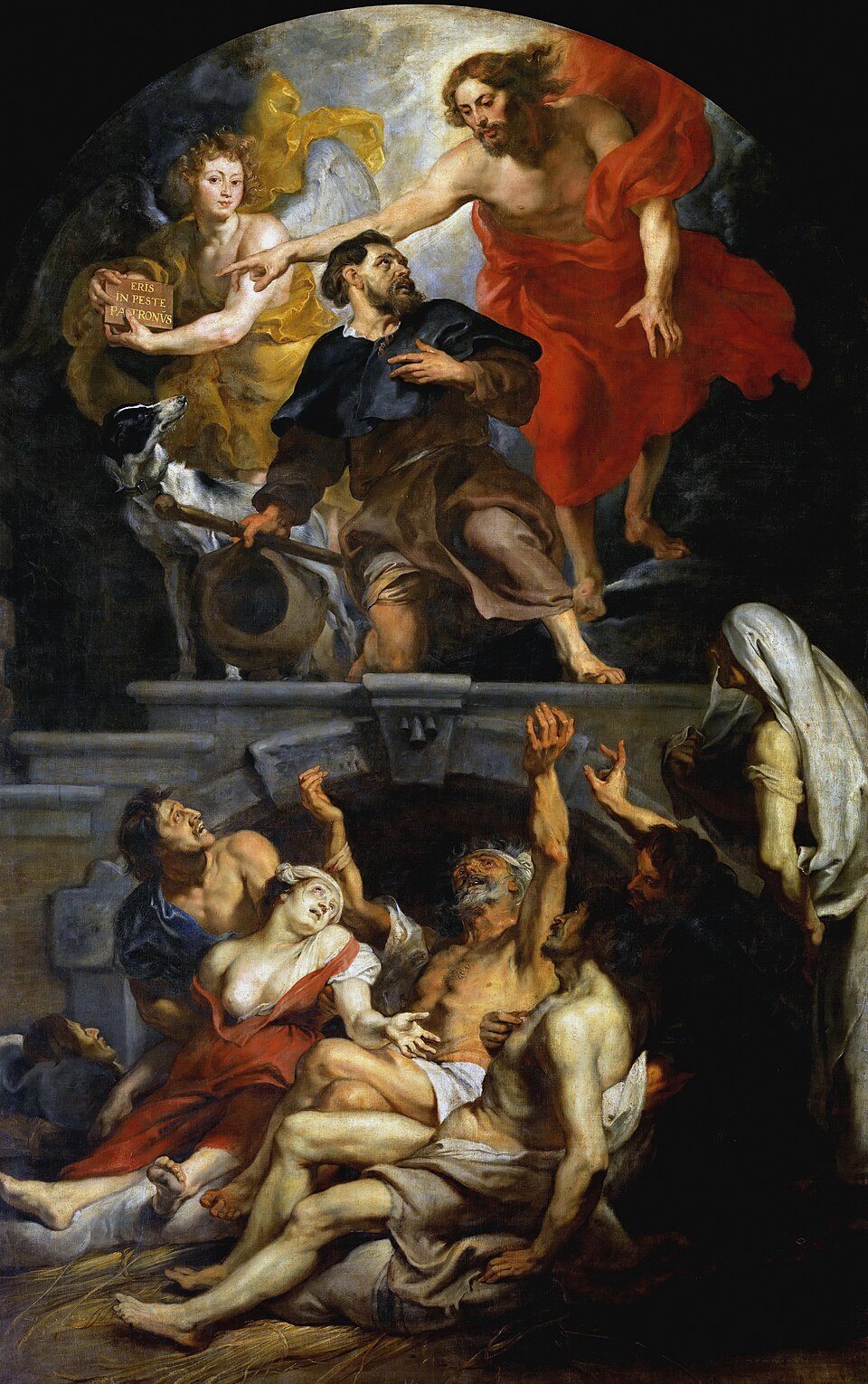
Light bursts into a prison cell, Christ appears, and below him the sick and even the dead lift their hopes. Rubens painted this towering altarpiece for a brotherhood in Aalst that prayed for protection against the plague.
The story behind the painting
Devastating plague epidemics had swept through Europe since the sixteenth century, and the lay Brotherhood of Saint Roch commissioned Rubens to paint an altarpiece for the Church of St Martin in Aalst, Belgium, where they were installing an altar to their saint. Roch, who lived in the fourteenth century, was the patron of invalids and was specially invoked against the plague. Wikipedia dates the altarpiece to 1623 to 1626, while Wikidata gives 1619, so the exact date differs between the two sources.
What to look for
The altarpiece is 412 by 258 cm with an arched top, and it is built in two groups. Above, Saint Roch prays in prison for those suffering from the plague. Light bursts in, a divine messenger appears, and Christ himself comes. With his left hand Christ gestures towards the afflicted, and with his right he points to a golden inscription, Eris in peste patronus, Thou shalt be the patron in the plague. Below, the sick look up, aware of the miracle, and even a shrouded figure on the right seems to hope to rise.
Meaning and intent
Legend says Roch worked many cures by the sign of the cross, the touch of his hand and prayer, then fell ill himself at Piacenza and was cast out, recovering in the forest. He is often shown as a pilgrim with hat and staff, a bubo on his thigh, and the dog that brought him bread and licked his wounds. Rubens ties heaven and earth together with diagonals, a Baroque device: figures above lean and gesture down, while the outstretched arms and gazes below carry the eye back up.
Legacy
In 1794 Napoleonic troops took the painting, with its two predella panels, to the Louvre in Paris. It was returned to Aalst in 1814 and remains in St Martin's Church. The work is sometimes compared with Saint Roch Interceding with the Virgin for the Plague-Stricken, painted in 1780 by Jacques-Louis David. The contrast is striking: in Rubens's picture the victims are full of hope that relief is about to come, while in David's they appear forlorn, apathetic and despairing. Rubens chose to paint the moment when hope arrives.
¿Sabías que…?
- Commissioned by the Brotherhood of Saint Roch for St Martin's Church in Aalst.
- Dated 1623-1626 by Wikipedia, 1619 by Wikidata.
- Taken to the Louvre in 1794 and returned in 1814.
- The inscription reads Eris in peste patronus.
Sobre el artista
Pedro Pablo Rubens (1577-1640)
arte religioso · Jesús de Nazaret · ángel · perro
Más obras de Pedro Pablo Rubens
.jpg) La elevación de la cruz - Peter Paul Rubens (1609)
La elevación de la cruz - Peter Paul Rubens (1609)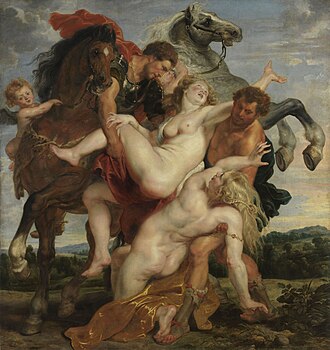 Rapto de las hijas de Leucipo - Peter Paul Rubens (1618)
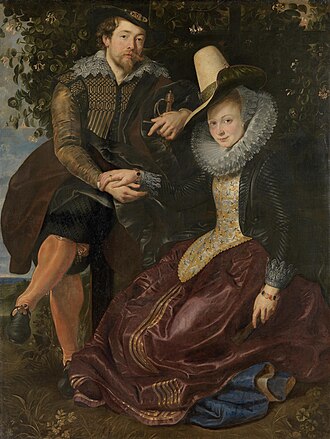 Autorretrato con su esposa Isabel Brant - Peter Paul Rubens (1600s)
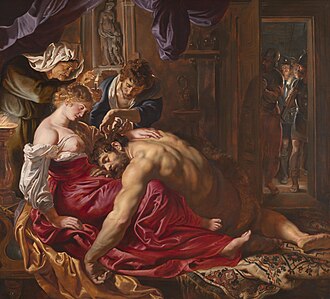 Sansón y Dalila - Peter Paul Rubens (1600s)
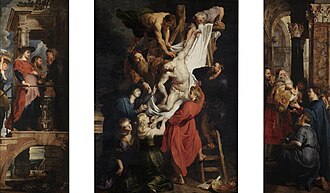 Descendimiento de Cristian - Peter Paul Rubens (1611)
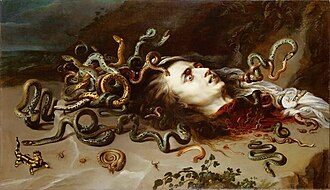 Head of Medusa - Peter Paul Rubens (1618)
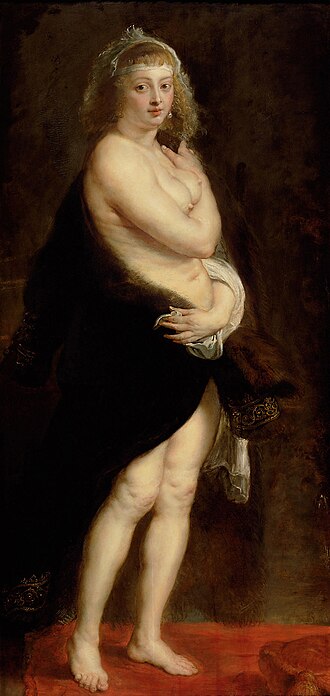 Helena Fourment saliendo del baño - Peter Paul Rubens (1638)
.jpg) El jardín del amor - Peter Paul Rubens (1632)
El jardín del amor - Peter Paul Rubens (1632)
Obras de artistas relacionados
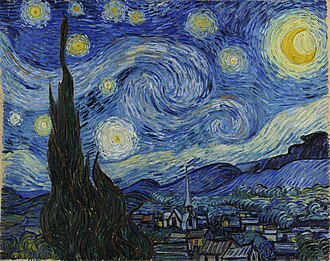 La noche estrellada - Vincent van Gogh (1889)
.jpg) Terraza de café por la noche - Vincent van Gogh (1888)
Terraza de café por la noche - Vincent van Gogh (1888)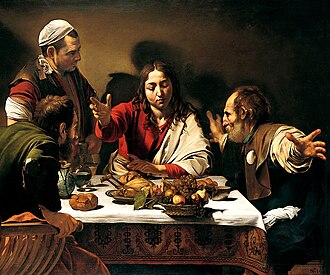 La cena de Emaús - Caravaggio (1601)
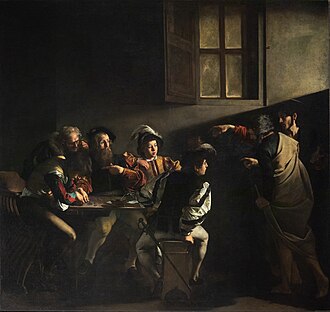 La vocación de San Mateo - Caravaggio (1609)
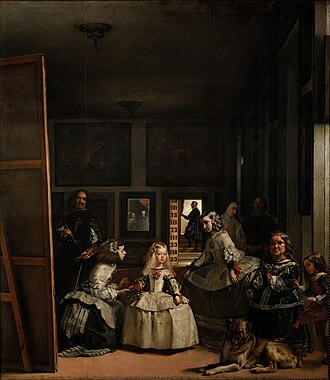 Las meninas - Diego Velázquez (1656)
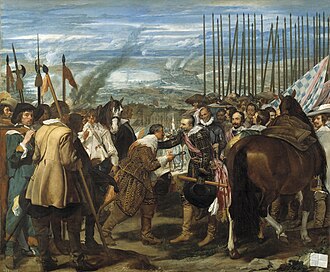 La rendición de Breda - Diego Velázquez (1635)
%20-%20Google%20Art%20Project.jpg) Triple retrato de Carlos I - Anthony van Dyck (1635)
Triple retrato de Carlos I - Anthony van Dyck (1635)%20with%20M.%20de%20St%20Antoine%20-%20Google%20Art%20Project.jpg) Charles I (1600-1649) with M. de St Antoine - Anthony van Dyck (1636)
Charles I (1600-1649) with M. de St Antoine - Anthony van Dyck (1636)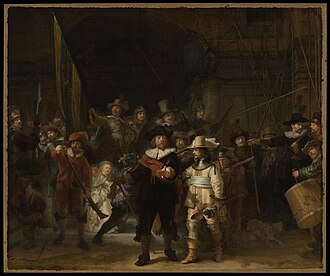 La ronda de noche - Rembrandt van Rijn (1642)
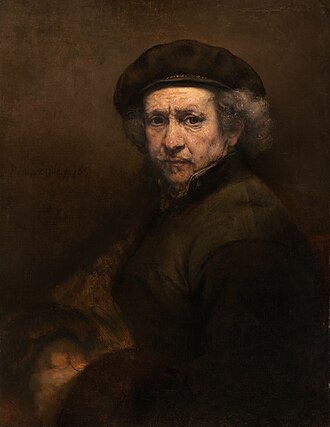 Autorretrato - Rembrandt van Rijn (1659)
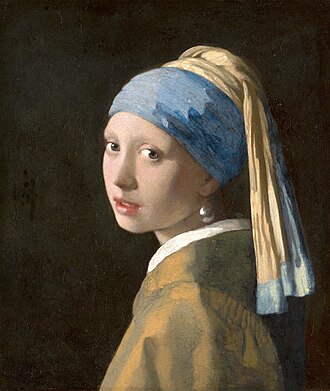 La joven de la perla - Johannes Vermeer (1665)
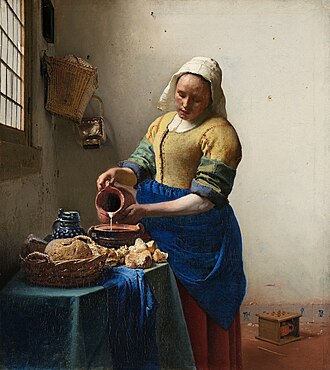 La lechera - Johannes Vermeer (c. 1658)