Joshua Reynolds
1723-1792
Sir Joshua Reynolds, the schoolmaster's son from Devon with an ear trumpet, became the first president of the Royal Academy and the leading portraitist of his age. In his hands the faces of Enlightenment Britain gained dignity, warmth and daring.
Origins
Reynolds was born in Plympton, Devon, on 16 July 1723, the third son of the Reverend Samuel Reynolds, master of the town's grammar school. His father had been a fellow of Balliol College, Oxford, but sent none of his sons to the university. His sister Mary Palmer, seven years older and later the author of Devonshire Dialogue, loved drawing, and her fondness is said to have shaped Joshua as a boy; she also helped pay for his training. As a boy he came under the influence of Zachariah Mudge, whose Platonistic philosophy stayed with him all his life. He filled a commonplace book with extracts from writers such as Ovid, Shakespeare and Milton, and the work that influenced him most was Jonathan Richardson's An Essay on the Theory of Painting.
Life and turning points
In 1740 he was apprenticed to the London portrait painter Thomas Hudson, also from Devon, but stayed only until 1743. In 1749 Commodore Augustus Keppel invited him on a voyage to the Mediterranean, and he went on to Rome, where he spent two years studying the Old Masters and acquiring a taste for the "Grand Style". There a severe cold left him partially deaf. Back in England in 1752, he settled in London and achieved success rapidly, receiving five or six sitters a day at the height of the season. He helped found the Society of Artists, became the first president of the Royal Academy of Arts in 1768 and held the post until his death, and was knighted by George III in 1769. In 1784 he became Principal Painter in Ordinary to the King. He died on 23 February 1792.
Style and technique
Reynolds promoted the Grand Style, which depended on the idealisation of the imperfect. His studio was famously prolific and produced over 2,000 paintings during his lifetime. The clothing of his sitters was usually painted by pupils, his assistant Giuseppe Marchi or the drapery specialist Peter Toms, with lay figures used to model the clothes, while his own work remained, in his pupil James Northcote's words, slight and masterly. He often adapted poses from earlier artists. He was also known for portraits of children, stressing their innocence and natural grace, as in Age of Innocence of 1788, whose sitter is still unknown. In his Discourses, delivered at the Academy from 1769 to 1790, he argued that invention is little more than a new combination of images gathered in memory.
Stories and anecdotes
His borrowing of poses did not go unnoticed. In 1775 Nathaniel Hone submitted The Conjuror to the Royal Academy, showing a figure representing Reynolds seated before a cascade of the prints he had borrowed from. In Rome, Lord Edgcumbe suggested he study with Pompeo Batoni, but Reynolds replied that he had nothing to learn from him. He brought together The Club in 1764, which met every Monday evening at the Turks Head in Gerrard Street with friends such as Samuel Johnson, Edmund Burke, Oliver Goldsmith and David Garrick. When Keppel was acquitted at his court-martial in 1779, Reynolds painted his hand on his sword. Becoming the king's painter did not make him happy; he wrote to Boswell that it was a shabby, miserable place.
Legacy
The critic John Russell called Reynolds one of the major European painters of the 18th century, and he has been described as the master who revolutionised British art. Simon Schama called his Portrait of Omai one of the greatest things British art has ever produced, and Thomas Lawrence rated Sarah Siddons as the Tragic Muse as the finest female portrait in the world. Not everyone agreed: William Blake published vitriolic annotations to his Discourses. But J. M. W. Turner asked to be laid to rest at his side, and Northcote wrote that he knew all his faults and yet almost worshipped him. As a teacher and the head of the Academy, he raised the status of art and artists in Britain, and his portraits still feel alive with the daring of their age.
¿Sabías que…?
- After his illness in Rome he carried the small ear trumpet with which he is often pictured.
- His annotated copy of Richardson's essay was lost for nearly two hundred years until it turned up in a Cambridge bookshop.
- He exchanged portraits with the painter Angelica Kauffman.
- He was only the second English artist to be knighted.
Artistas relacionados
J. M. W. Turner · Jean-Léon Gérôme · Édouard Manet · Gustave Courbet · John Singer Sargent · Eugène Delacroix · Jacques-Louis David · Gustave Moreau
Obras de Joshua Reynolds
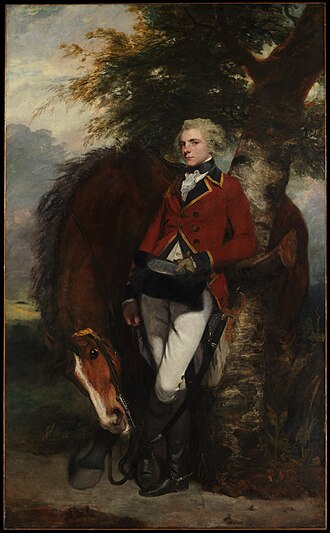 Capitán George K. H. Coussmaker - Joshua Reynolds (1782)
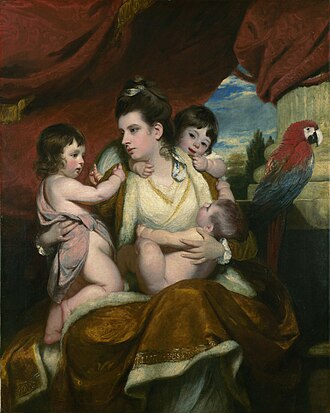 Retrato de Lady Cockburn con sus tres hijos - Joshua Reynolds (1773)
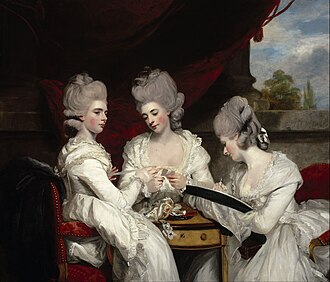 Las hermanas Waldgrave - Joshua Reynolds (1780)
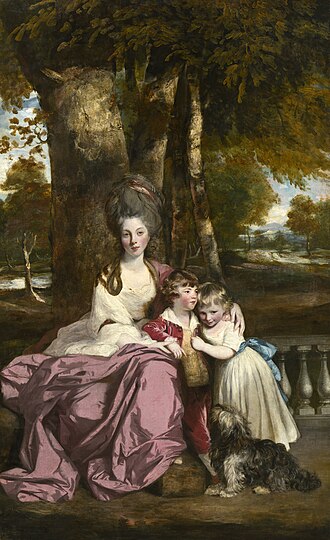 Lady Elizabeth Delmé and Her Children - Joshua Reynolds (1770s)
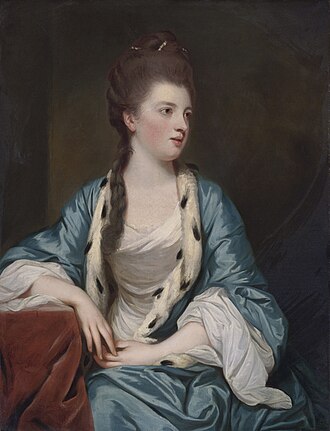 Elizabeth Kerr, marquesa de Lothian - Joshua Reynolds (1769)
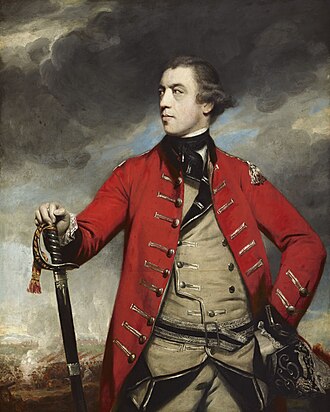 General John Burgoyne - Joshua Reynolds (1766)
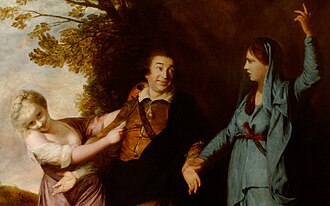 David Garrick Between Tragedy and Comedy - Joshua Reynolds (1761)
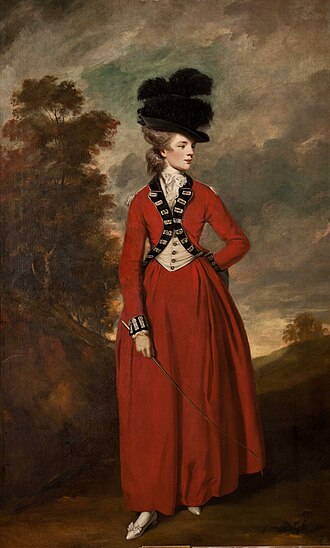 Lady Worsley - Joshua Reynolds (1779)
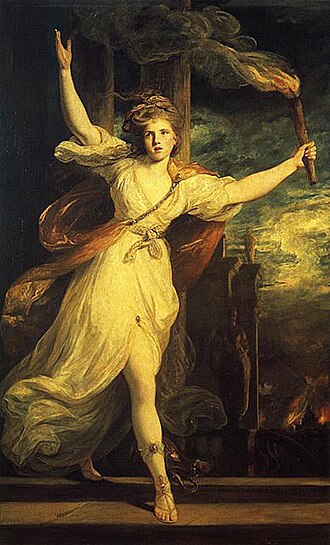 Thaïs - Joshua Reynolds (1781)
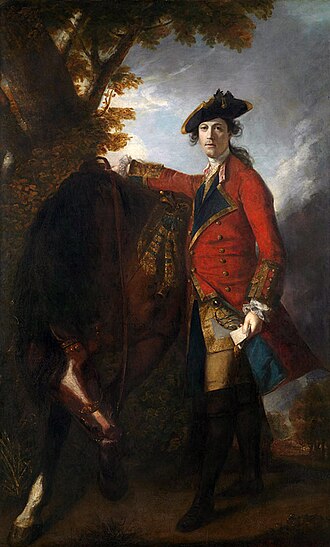 Captain Robert Orme - Joshua Reynolds (1756)
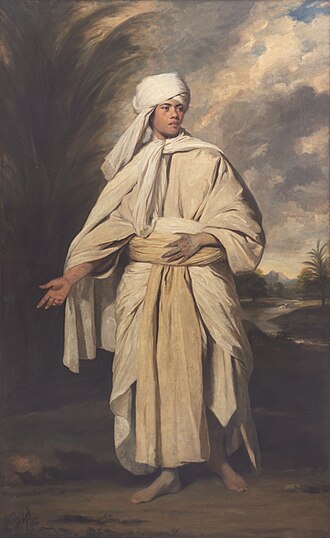 Portrait of Omai - Joshua Reynolds (1776)
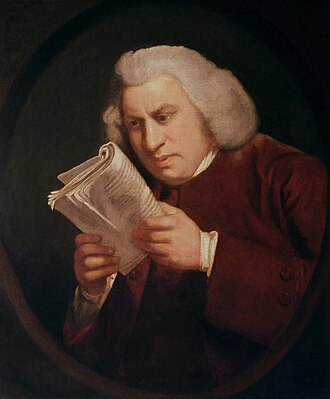 Portrait of Samuel Johnson - Joshua Reynolds (1770s)