Dante Gabriel Rossetti
1828-1882
Dante Gabriel Rossetti was a poet who painted and a painter who wrote poems. Co-founder of the Pre-Raphaelite Brotherhood, he filled his canvases with medieval dreams and later with glowing, solitary women whose faces still hold viewers spellbound.
Origins
Gabriel Charles Dante Rossetti was born on 12 May 1828 at 38 Charlotte Street in London. His father was the exiled Italian scholar Gabriele Rossetti, and his mother, Frances Polidori, was the daughter of a Tuscan scholar; the writer John William Polidori was his uncle. Family and friends called him Gabriel, but in print he preferred Dante. His siblings were the poet Christina Rossetti, the critic William Michael Rossetti and the author Maria Francesca Rossetti. The household was bohemian, visited by Italian artists, scholars and revolutionaries, and their mother taught the children Dante and Petrarch at home. Like all his siblings he wanted to be a poet, but he also longed to paint, drawn to medieval Italian art.
Life and turning points
Rossetti studied at Henry Sass' Drawing Academy and the Royal Academy's Antique School, then under Ford Madox Brown. In 1848 he founded the Pre-Raphaelite Brotherhood with William Holman Hunt and John Everett Millais, aiming to return to the detail and intense colour of early Italian and Flemish art. Stung by criticism of Ecce Ancilla Domini in 1850, he turned to watercolours and rarely exhibited again. Around 1849 or 1850 he met Elizabeth Siddal, his muse and pupil; they married in 1860, and she died of a laudanum overdose in 1862. He then lived for twenty years at 16 Cheyne Walk in Chelsea. Wikipedia gives his death date as 9 April 1882 in its opening and as Easter Sunday, 10 April, later on; he died at Birchington-on-Sea.
Style and technique
Rossetti's art is marked by sensuality and medieval revivalism. In the 1850s, inspired by Dante and Malory, he developed a way of using watercolour with thick pigments mixed with gum to create rich effects like medieval illumination, and a new technique in pen and ink. Around 1860 he returned to oil, leaving dense medieval scenes for powerful close-up images of women in flat spaces of deep colour, drawing on Titian and Veronese. These works became a major influence on the European Symbolists. He often wrote sonnets to accompany his pictures, from The Girlhood of Mary Virgin of 1849 to Astarte Syriaca of 1877, and he also designed book bindings and illustrations.
Stories and anecdotes
When Siddal was buried at Highgate Cemetery, Rossetti placed most of his unpublished poems in her grave; in 1869 he had them dug up and published them the next year. His translation of a Villon ballad is credited with the first use of the word yesteryear. At Cheyne Walk he kept exotic animals, including two wombats; the first, named Top, was allowed to sleep in the dinner table centrepiece. He spotted the model Alexa Wilding in the Strand in 1865, and when she failed to turn up, he later jumped from his cab to persuade her to come to his studio. She sat for more of his finished works than anyone else.
Legacy
Rossetti inspired Algernon Swinburne, William Morris and Edward Burne-Jones, and his later work influenced the Symbolists and was a major precursor of the Aesthetic movement. Large collections of his work are held at Tate Britain, Birmingham, Manchester, Salford and Wightwick Manor. The painter L. S. Lowry collected him avidly, saying his women fascinated him because they were not real women but dreams. His later paintings are the best known, but his small early works and drawings show most clearly his originality and technical inventiveness. Standing before them, you feel how closely word and image were bound together for him, each one completing the other.
¿Sabías que…?
- In paintings such as Beata Beatrix he idealised Siddal as Dante's Beatrice.
- He was a founding partner of Morris, Marshall, Faulkner and Co. in 1861.
- His grave at Birchington has a tombstone designed by Ford Madox Brown.
- His incomplete painting Found, begun in 1853, was his only major modern life subject.
Artistas relacionados
John Everett Millais · John William Waterhouse
Obras de Dante Gabriel Rossetti
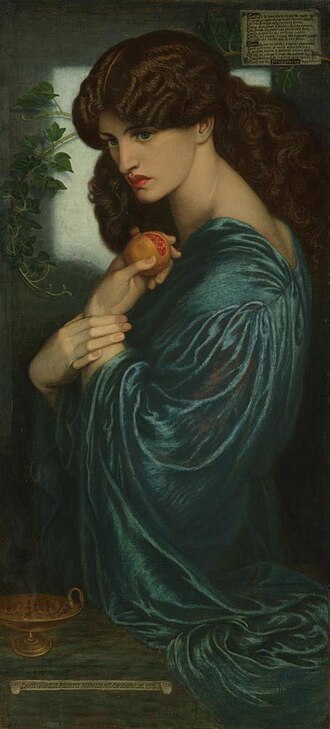 Proserpina - Dante Gabriel Rossetti (1874)
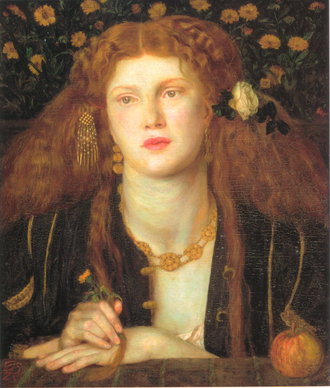 Bocca Baciata - Dante Gabriel Rossetti (1859)
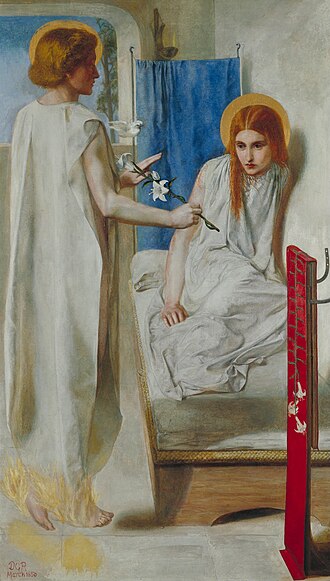 Ecce Ancilla Domini - Dante Gabriel Rossetti (1850)
.jpg) El sueño de Dante ante la muerte de su amada - Dante Gabriel Rossetti (1871)
El sueño de Dante ante la muerte de su amada - Dante Gabriel Rossetti (1871).jpg) Monna Rosa - Dante Gabriel Rossetti (1867)
Monna Rosa - Dante Gabriel Rossetti (1867)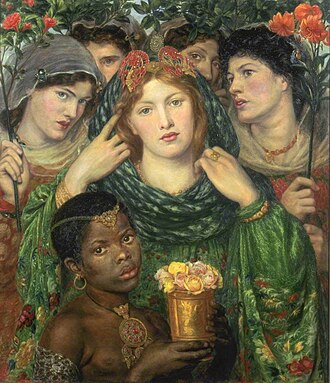 The Beloved - Dante Gabriel Rossetti (1865)
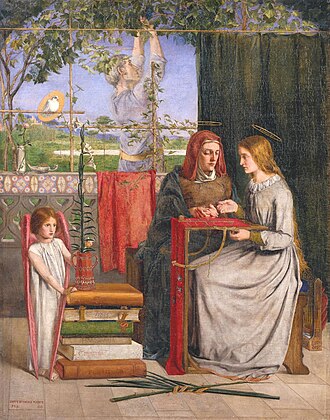 The Girlhood of Mary Virgin - Dante Gabriel Rossetti (1840s)
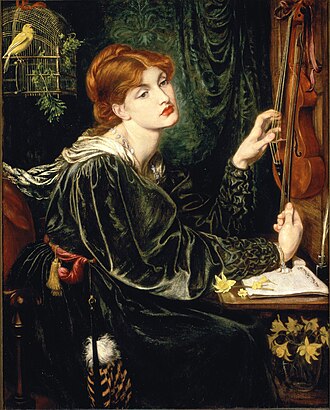 Veronica Veronese - Dante Gabriel Rossetti (1872)
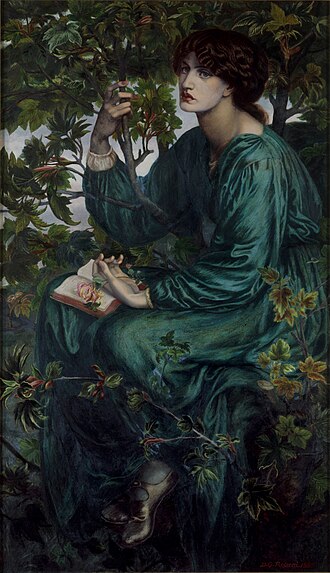 Sueño de día - Dante Gabriel Rossetti (1880)
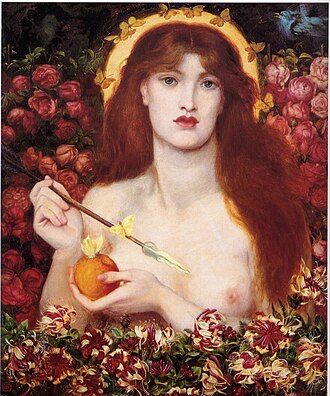 Venus Verticordia - Dante Gabriel Rossetti (1860s)