Two Watermills and an Open Sluice near Singraven
Jacob van Ruisdael · 1650
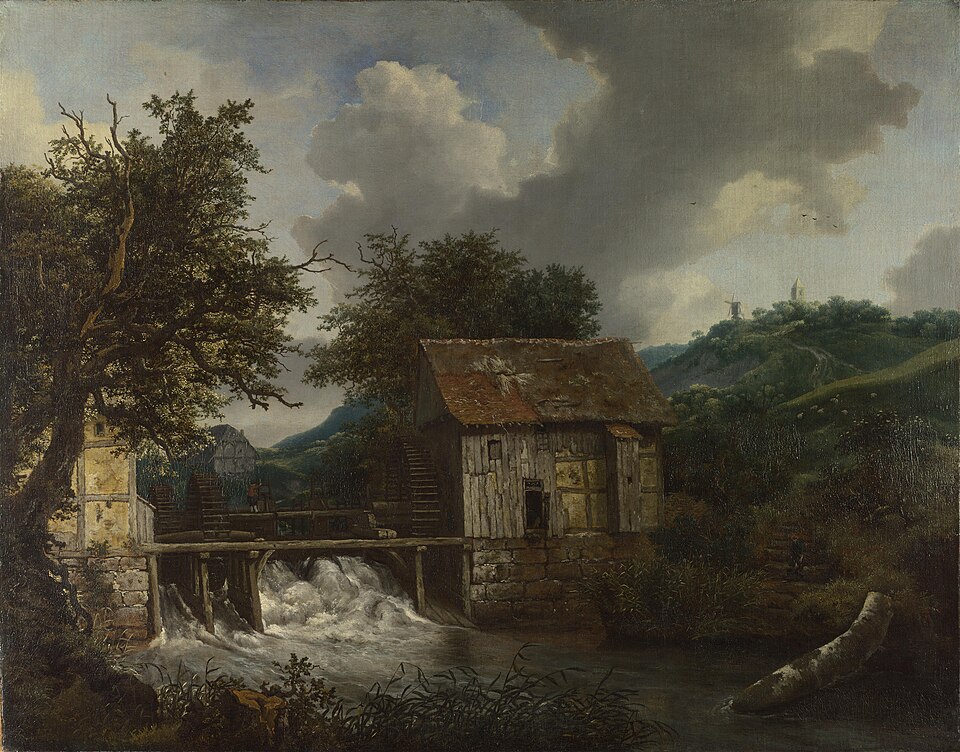
Water rushes through an open sluice between two old mills while a man on the footbridge lifts the gate. Jacob van Ruisdael painted this corner of the eastern Netherlands around 1650, and the scene kept returning in his work.
The story behind the painting
Jacob van Ruisdael painted this oil on canvas around 1650, an example of Dutch Golden Age landscape painting. The place has been identified as Singraven, part of Dinkelland near Ootmarsum in the east of the Netherlands, a spot that appears in more of Ruisdael's paintings. Around this time he made several very similar pictures of watermills. One of them, described by the scholar Hofstede de Groot, shows the same mills from a nearer standpoint, without the landscape on the right and with the right-hand mill in ruins.
What to look for
The canvas, about 87 by 111.5 cm, is signed in full. Following Hofstede de Groot's 1911 description: two watermills stand on either side of a stream flowing toward the right front. The left mill is partly cut off by the frame and hidden by an oak. Between them turn three water wheels, two on the left and one on the right, and in the centre the open sluice gate lets the stream rush down. A man stands on the footbridge above, raising the gate. Reeds grow on the left bank, a tree trunk lies in the water on the right, and steps climb to a path toward a village church and a windmill under a cloudy sky.
Meaning and intent
The painting shows a working landscape rather than a wild one. The mills, the sluice and the man at the gate are all about people harnessing water, and the stream rushing through the opening gives the quiet scene its energy. Ruisdael's views of watermills from this period often served as inspiration for later landscape painters. Seen next to his other versions, this one widens the view to the right, adding the hill, the church and the windmill, so that the mills become part of a whole countryside under a changing sky.
Legacy
The painting's history can be traced through Hofstede de Groot's catalogue entry. It appeared in the sale of Thomas Emmerson in London in 1832, and by 1854 it was in the collection of Wynn Ellis, where the German scholar Waagen recorded it. Wynn Ellis bequeathed it to the National Gallery in London in 1876, and it has remained in the gallery's collection ever since, catalogued as No. 986 in 1906. It stands among the many Dutch landscapes that entered the national collection through that bequest.
Did you know?
- Painted by Jacob van Ruisdael around 1650.
- The site is Singraven, near Ootmarsum in the Netherlands.
- Described by Hofstede de Groot in 1911.
- In the National Gallery, London, since 1876.
About the artist
Jacob van Ruisdael (1628-1682)
landscape painting · National Gallery
More by Jacob van Ruisdael
 The Windmill at Wijk bij Duurstede - Jacob van Ruisdael (1670)
 The Jewish Cemetery - Jacob van Ruisdael (1650s)
 Landscape with Waterfall - Jacob van Ruisdael (1668)
 View of Haarlem with Bleaching Fields - Jacob van Ruisdael (1670)
 Peasant Cottage in a Landscape - Jacob van Ruisdael (1646)
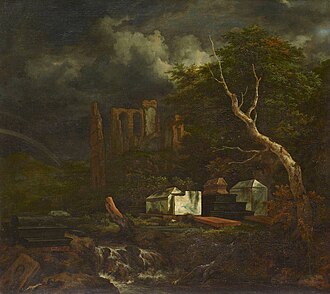 The Jewish Cemetery - Jacob van Ruisdael (1653)
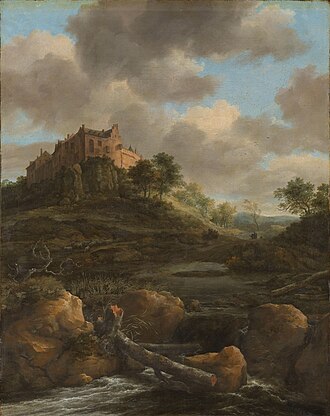 Bentheim Castle - Jacob van Ruisdael (1650s)
View of Egmond aan Zee - Jacob van Ruisdael (1650)
Paintings by related artists
 The Night Watch - Rembrandt van Rijn (1642)
 Self-Portrait - Rembrandt van Rijn (1659)
 Girl with a Pearl Earring - Johannes Vermeer (1665)
 The Milkmaid - Johannes Vermeer (c. 1658)
 The Feast of Saint Nicholas - Jan Steen (1660s)
 Girl eating oysters - Jan Steen (1658)
 A Militiaman Holding a Berkemeyer, Known as the ‘Merry Drinker’ - Frans Hals (1620s)
 Laughing Cavalier - Frans Hals (1624)
 The Courtyard of a House in Delft - Pieter de Hooch (1658)
 A Woman Peeling Apples - Pieter de Hooch (1663)