Tragedy
Gustav Klimt · 1897
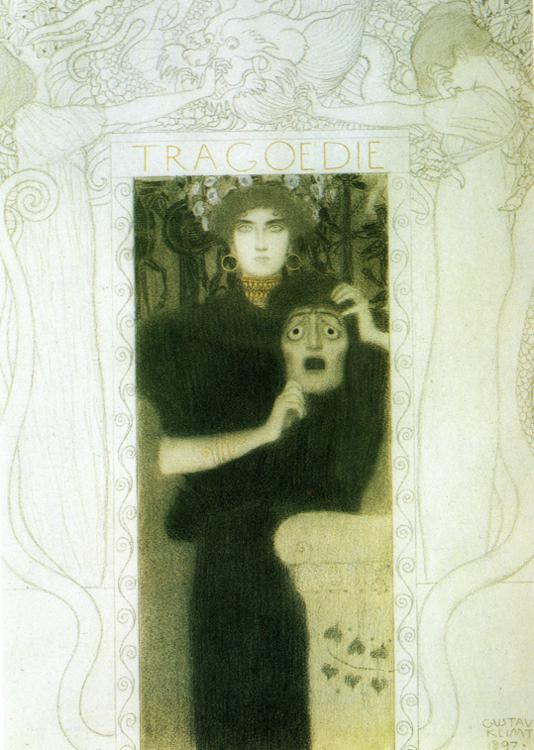
A pale young woman holds a screaming mask and stares straight back at us. In this small drawing from 1897, the year he founded the Vienna Secession, Klimt first shows the gold and the femme fatale that would define him.
The story behind the painting
Tragedy is a small work, 41.9 by 30.8 cm, made by Gustav Klimt in 1897 in charcoal and washed pencil, heightened with gold and white. It belongs to a set of plates commissioned by the publisher Martin Gerlach in 1883 for a three-volume edition called Allegories and Emblems; this was Klimt's third drawing for the second volume, alongside subjects such as Love and Sculpture. The year matters: in 1897 Klimt became the first president of the Vienna Secession, a group of artists who rejected the conservative, academic art of old Vienna.
What to look for
In the central panel stands Melpomene, the muse of tragedy, frontal and rigid, in contemporary clothing. She carries her attributes, a mask, a crown and jewels painted in gold. Compare the two faces: the mask is twisted in drama, while the young woman's face is calm and her gaze challenges the viewer. Around her runs an architectural frame inscribed Tragoedie, drawn in fine, soft lines. In it two classical women face each other, one covering her eyes, the other throwing her head back, while a dragon of Eastern inspiration wraps its tail around the border.
Meaning and intent
The mask stands for the gap between outward appearance and the hidden reality inside. Allegories had always been women, but Klimt draws her as a real woman, without idealisation, in one of his first images of the femme fatale, influenced by the Pre-Raphaelites: threatening and seductive at once, with pale skin, reddish hair and light eyes, the traits of his later women. The gold here is still decorative, but in later works it would gain a deeper, almost spiritual meaning, linked by the source to the medieval metaphysics of light.
Legacy
This drawing is seen as a turning point. Klimt still uses classical elements, but a new language appears in its content, announcing the principles of his mature style, influenced by Dutch and Belgian Symbolism. The contrast between the dark central motif and the white of the paper in the frame creates a kind of silence, and the pale skin and gold jewels act as the main sources of light. The lines thin out as they move outward, and the play with empty space shows his technical mastery. The drawing belongs to the Vienna Museum.
Did you know?
- Drawn in 1897 in charcoal and pencil with gold and white.
- Made for Martin Gerlach's Allegories and Emblems.
- Shows Melpomene, the muse of tragedy, with her mask.
- Kept in the Vienna Museum.
About the artist
Gustav Klimt (1862-1918)
More by Gustav Klimt
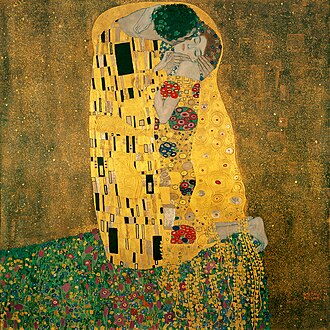 The Kiss - Gustav Klimt (1907-1908)
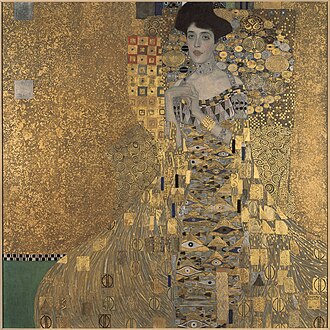 Portrait of Adele Bloch-Bauer I - Gustav Klimt (1907)
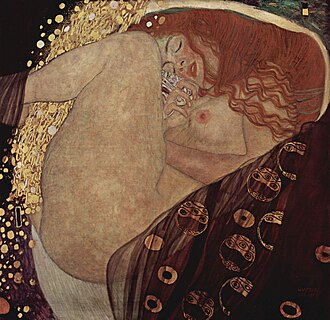 Danaë - Gustav Klimt (1907)
 Judith I - Gustav Klimt (1901)
 The Three Ages of Woman - Gustav Klimt (1905)
 Woman With a Fan - Gustav Klimt (1917)
 Adele Bloch-Bauer II - Gustav Klimt (1912)
 Portrait of a Lady - Gustav Klimt (1910s)