The Races at Longchamp
Édouard Manet · 1866
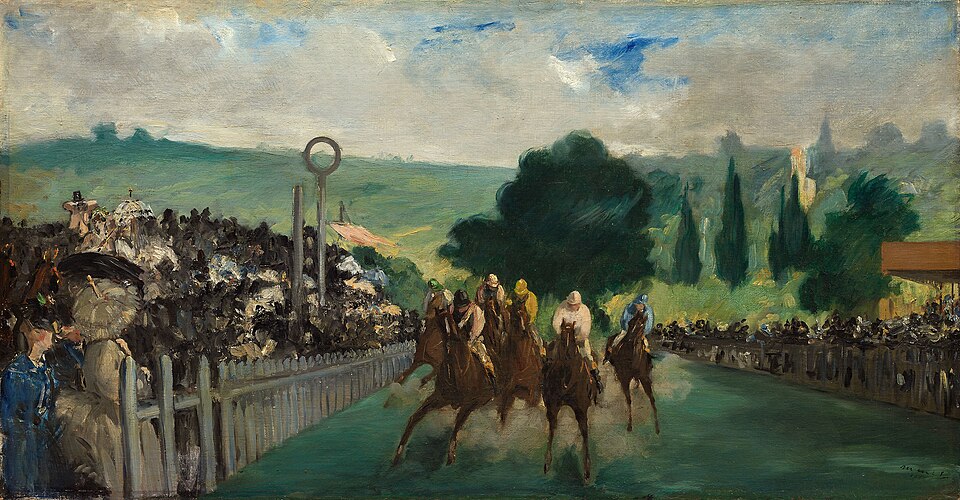
The horses come straight at you, as if bursting out of the trees. Manet's Races at Longchamp is thought to be the first painting to show a race head-on, and you seem to be standing right on the track.
The story behind the painting
On Sunday 5 June 1864, about a hundred thousand Parisians, Manet among them, watched the second Grand Prix de Paris at Longchamp, the racecourse in the Bois de Boulogne opened in 1857 with the backing of the Jockey Club and Napoleon III. The English favourite Blair Athol, winner of that year's Epsom Derby, never led, and the French horse Vermouth won by two lengths. Manet made this race the setting of his picture. He painted the subject four times over four years. The version in Chicago is dated 1866: its smudged inscription was read as 1865 or 1867 until a microscopic examination settled on 1866.
What to look for
The pack of horses charges directly toward the viewer, who faces south toward Saint-Cloud. Before this, races were usually shown from the side. The pole with a circle on top marks the finish line; the art historian Juliet Wilson-Bareau notes how it pins the distant green hills to the foreground, flattening the depth. On the left, look for two women spectators: the one in beige is Manet's wife, Suzanne Leenhoff. Behind them a man with binoculars is borrowed from William Powell Frith's The Derby Day. On the right rises the public grandstand. The brushwork is very loose, horizontal on the track, diagonal in the trees, dabbed in the sky and crowd.
Meaning and intent
Horse racing was a newly fashionable passion in France, brought over from Britain, and most visitors to Longchamp came to socialise rather than follow the race. Manet had sketched racecourse crowds since at least 1855 and knew British racing prints from his notebooks. Here he captures speed itself. Françoise Cachin compared the effect to a photographer zooming toward a subject, so the area in focus grows and the depth shrinks. The crowds on both sides are fully absorbed in the race, and the picture makes you feel the rush of the moment rather than the story of who won.
Legacy
The Longchamp theme has a tangled history. Manet's original 1864 oil was probably sent to an 1865 exhibition at Louis Martinet's gallery, although it is unclear whether it was actually shown. He cut that canvas up in 1865, and only two fragments are known to survive. A watercolour of two joined sheets, now in the Fogg Art Museum, may have been a study or a record of the lost picture. The Chicago painting, painted in a more vigorous, sketchy style, is the best-known version, and Theodore Reff argued it cannot be part of the large original. Manet returned to a side view in 1872.
Did you know?
- Shows the Grand Prix de Paris of 5 June 1864, won by Vermouth.
- Thought to be the first painting of racehorses running toward the viewer.
- Dated 1866 by microscopic examination of the inscription.
- Manet's wife Suzanne Leenhoff appears among the spectators.
About the artist
Édouard Manet (1832-1883)
genre art · Art Institute of Chicago
More by Édouard Manet
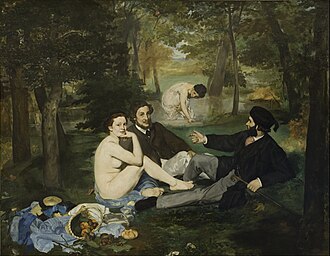 Luncheon on the Grass - Édouard Manet (1863)
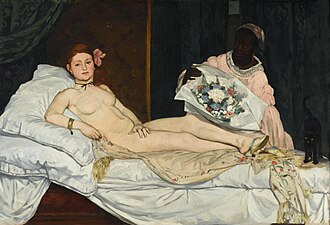 Olympia - Édouard Manet (1863)
%20(33539037428).jpg) A Bar at the Folies-Bergère - Édouard Manet (1882)
A Bar at the Folies-Bergère - Édouard Manet (1882)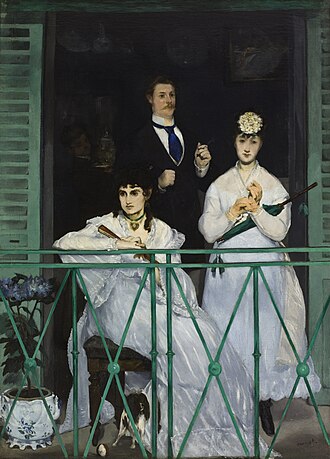 The Balcony - Édouard Manet (1868)
.jpg) Music in the Tuileries - Édouard Manet (1862)
Music in the Tuileries - Édouard Manet (1862).jpg) The Fif - Édouard Manet (1866)
The Fif - Édouard Manet (1866) The Railway - Édouard Manet (1873)
 Berthe Morisot with a Bouquet of Violets - Édouard Manet (1872)
Paintings by related artists
 Impression, Sunrise - Claude Monet (1872)
 Water Lilies - Claude Monet (1906)
 Dance at Le Moulin de la Galette - Pierre-Auguste Renoir (1876)
 Luncheon of the Boating Party - Pierre-Auguste Renoir (1881)
 L'Absinthe - Edgar Degas (1875)
 The Bellelli Family - Edgar Degas (1858)
 The Starry Night - Vincent van Gogh (1889)
.jpg) Café Terrace at Night - Vincent van Gogh (1888)
Café Terrace at Night - Vincent van Gogh (1888) The Fighting Temeraire - J. M. W. Turner (1839)
 Rain, Steam and Speed - The Great Western Railway - J. M. W. Turner (1844)
 Where Do We Come From? What Are We? Where Are We Going? - Paul Gauguin (1897-1898)
%201889.jpg) The Yellow Christ - Paul Gauguin (1889)
The Yellow Christ - Paul Gauguin (1889)