The Balcony
Édouard Manet · 1868
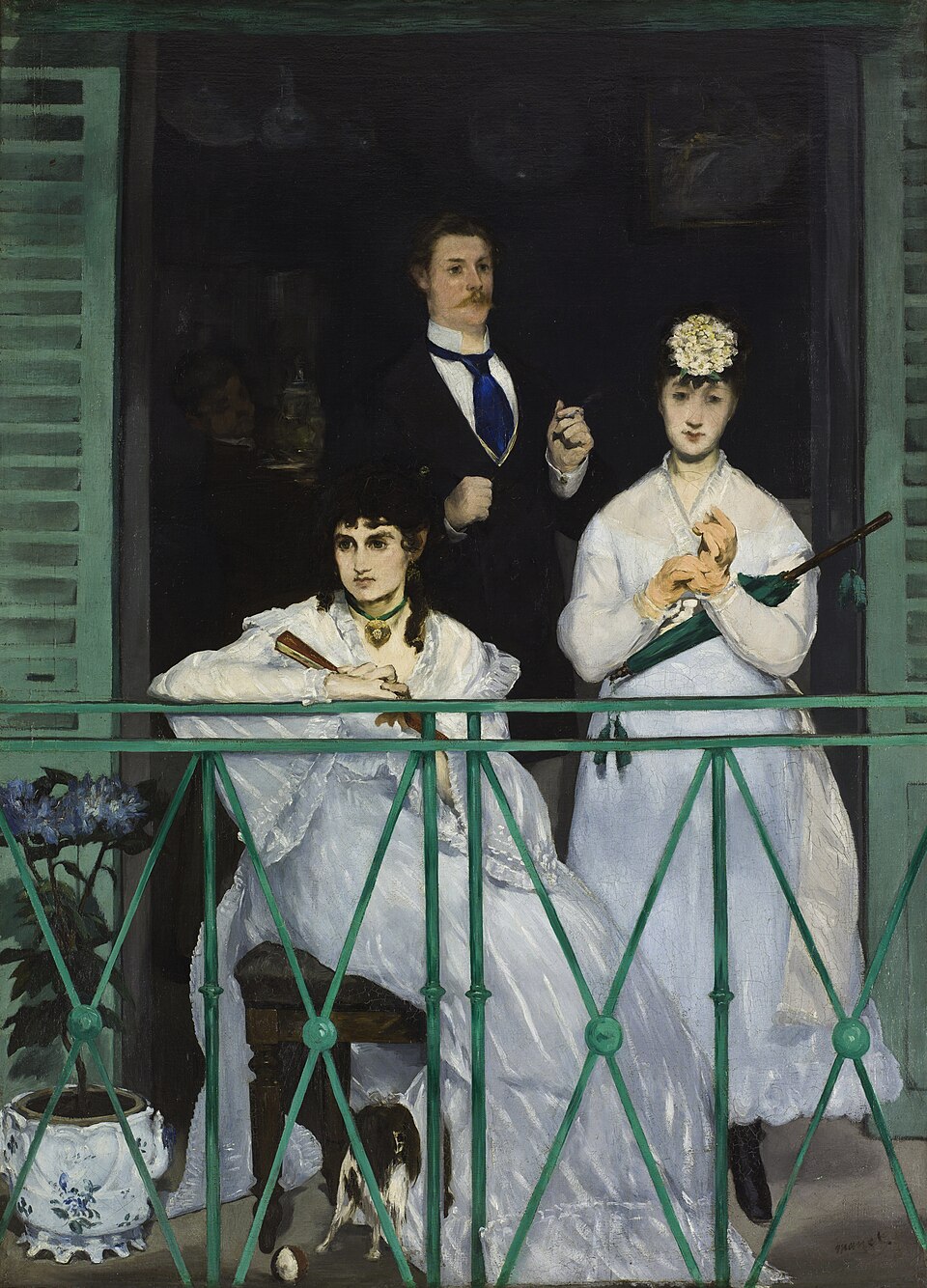
Three friends stand on a green balcony, so close they could touch, yet none of them looks at another. Behind them, the room dissolves into black, and a fourth face hovers in the dark.
The story behind the painting
Édouard Manet painted The Balcony in 1868 and 1869, inspired by Francisco Goya's Majas on the Balcony and created at the same time, and with the same purpose, as his Luncheon in the Studio. All three main figures were his friends. Seated is the painter Berthe Morisot, who married Manet's brother Eugène in 1874; this was Manet's first portrait of her. In the centre stands the painter Antoine Guillemet, and on the right is the violinist Fanny Claus, closest friend of Manet's wife Suzanne Leenhoff. Manet made many preparatory studies, painting each sitter individually again and again, Guillemet as many as fifteen times. One study, an unfinished portrait of Fanny Claus, was painted at Boulogne in 1868.
What to look for
Start with the bold green of the railings and shutters, which frame the group like a stage. The palette is restrained: white, green and black, with two small accents. Find the blue of Guillemet's tie and the red of Morisot's fan. Morisot sits on the left, looking like a romantic, unreachable heroine, while Claus and Guillemet seem indifferent. Notice that no one looks at anyone else. Now look down: just behind the railings sits a hydrangea in a ceramic pot, and below Morisot's chair a dog with a ball. Finally, peer into the black interior, where a boy, probably Manet's son Léon Leenhoff, is half hidden in the shadows.
Meaning and intent
Manet deliberately abandoned any sense of connection between his figures, treating them more like objects in a still life than living people. The stark contrasts, a fully black background against white faces and clothing, blue tie and green railings, help create an atmosphere many have called mysterious. Recent scholarship reads the painting through the idea of the flaneuse, the female counterpart of the flâneur. Placed on a balcony, the women gaze out onto public urban life while remaining close to their domestic world, suggested by the dark space between the green shutters. Watching the city without being part of it is central to the definition of the flâneur, and so the picture raises questions of inclusion and exclusion.
Legacy
Shown at the Paris Salon of 1869, the painting was badly received. The press called it discordant; the caricaturist Cham mockingly asked for the shutters to be closed, and Albert Wolff dismissed it as coarse art. Morisot herself remarked that she looked more strange than ugly, and that some called her a femme fatale. Manet kept it until his death in 1883, hanging it near his Olympia. Gustave Caillebotte bought it in 1884 and left it to the French state in 1894. After stays at the Luxembourg and the Louvre, it entered the Musée d'Orsay in 1986. In 1950 René Magritte replied with Perspective II: Manet's Balcony, placing coffins where the people had been.
Did you know?
- Painted 1868-69; Wikidata gives 1868.
- Exhibited at the Paris Salon of 1869.
- Bequeathed to the French state by Gustave Caillebotte; in the Musée d'Orsay since 1986.
- Size: 170 × 124.5 cm.
About the artist
Édouard Manet (1832-1883)
woman · genre art · man · Musée d'Orsay · dog · group portrait · painter
More by Édouard Manet
 Luncheon on the Grass - Édouard Manet (1863)
 Olympia - Édouard Manet (1863)
%20(33539037428).jpg) A Bar at the Folies-Bergère - Édouard Manet (1882)
A Bar at the Folies-Bergère - Édouard Manet (1882).jpg) Music in the Tuileries - Édouard Manet (1862)
Music in the Tuileries - Édouard Manet (1862).jpg) The Fif - Édouard Manet (1866)
The Fif - Édouard Manet (1866) The Railway - Édouard Manet (1873)
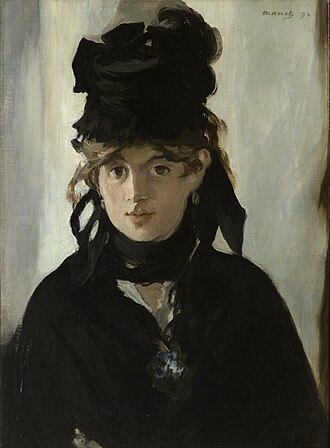 Berthe Morisot with a Bouquet of Violets - Édouard Manet (1872)
 The Spanish Singer - Édouard Manet (1860)
Paintings by related artists
 Impression, Sunrise - Claude Monet (1872)
 Water Lilies - Claude Monet (1906)
 Dance at Le Moulin de la Galette - Pierre-Auguste Renoir (1876)
 Luncheon of the Boating Party - Pierre-Auguste Renoir (1881)
 The Starry Night - Vincent van Gogh (1889)
.jpg) Café Terrace at Night - Vincent van Gogh (1888)
Café Terrace at Night - Vincent van Gogh (1888)