The physician Gian Giacomo Bartolotti da Parma
Titian · 1515
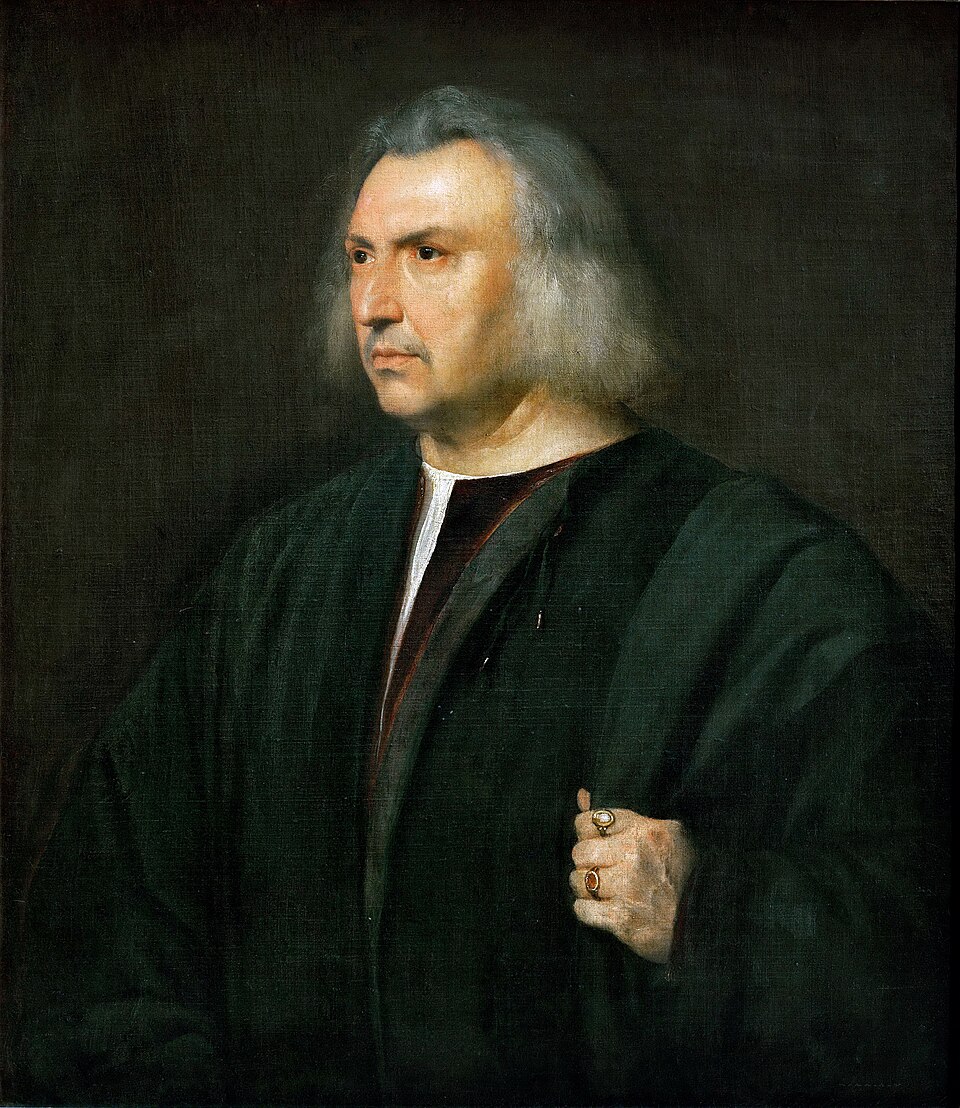
A clean-shaven man with white hair grips a strip of black cloth at his shoulder and looks into the distance. This may be Titian's own doctor, a physician from Parma, painted with a gesture people said could identify him from afar.
The story behind the painting
The portrait is also known simply as Portrait of a Man, and its date is debated. Georg Gronau argued it must date from about 1511, because a head in one of Titian's frescoes in Padua is remarkably similar in style. The Kunsthistorisches Museum in Vienna dates it a little later, to about 1515, and Wikipedia gives about 1515 to 1518. The writer Carlo Ridolfi saw the picture around 1648 in the house of Bartolomeo della Nave in Venice, and in 1660 it was listed as a Titian in the Theatrum Pictorium of Archduke Leopold Wilhelm of Austria.
What to look for
Look at the hands first. The sitter's powerful left hand clasps a strip of black cloth hanging from his shoulder. Gronau called this a habitual gesture by which the great doctor could be recognised from afar. Then the eyes: they are fixed on some distant point with a concentrated look, which Gronau thought hardly less characteristic of the man. Ridolfi described him as clean-shaven, with white hair falling to the middle of his ears. The panel measures 88 by 75 cm, according to Wikidata.
Meaning and intent
The sitter is thought to be Gian Giacomo Bartolotti, a physician from Parma active between 1491 and 1530, said to have been Titian's doctor. The identification rests on Ridolfi, who wrote in 1648 that Titian painted another portrait of his doctor, called the Parma. Gronau observed that in Titian's few early single portraits the hands work as an essential sign of personality. Here a single gesture and a steady gaze become the man's identity, a portrait of character as much as of a face.
Legacy
The painting probably belonged to Bartolomeo della Nave in Venice by 1636. From 1638 to 1649 it was in the collection of James Hamilton, 1st Duke of Hamilton. He kept it for about eleven years. By 1660 it had passed to Archduke Leopold Wilhelm of Austria, whose engraved catalogue, the Theatrum Pictorium, recorded it as a work by Titian. Today the painting belongs to the Kunsthistorisches Museum in Vienna, where visitors can still study that hand and that distant gaze.
Did you know?
- Dated about 1511 by Gronau, about 1515 by the museum.
- Sitter identified as Titian's doctor on the authority of Carlo Ridolfi, 1648.
- Owned by the 1st Duke of Hamilton from 1638 to 1649.
- Now in the Kunsthistorisches Museum, Vienna.
About the artist
Titian (1488-1576)
portrait · High Renaissance · Venetian school · Kunsthistorisches Museum · James Hamilton, 1st Duke of Hamilton collection
More by Titian
 Venus of Urbino - Titian (1538)
 Assumption of the Virgin - Titian (1510s)
 Sacred and Profane Love - Titian (1510s)
 Equestrian Portrait of Charles V - Titian (1548)
 Flora - Titian (1517)
 Allegory of Prudence - Titian (1550)
 Diana and Actaeon - Titian (1550s)
 Bacchus and Ariadne - Titian (1520s)
Paintings by related artists
 Last Supper - Jacopo Tintoretto (1563)
 Miracle of the Slave - Jacopo Tintoretto (1540s)
 The Wedding at Cana - Paolo Veronese (1560s)
 The Feast in the House of Levi - Paolo Veronese (1573)