The Magdalen Reading
Rogier van der Weyden · 1435
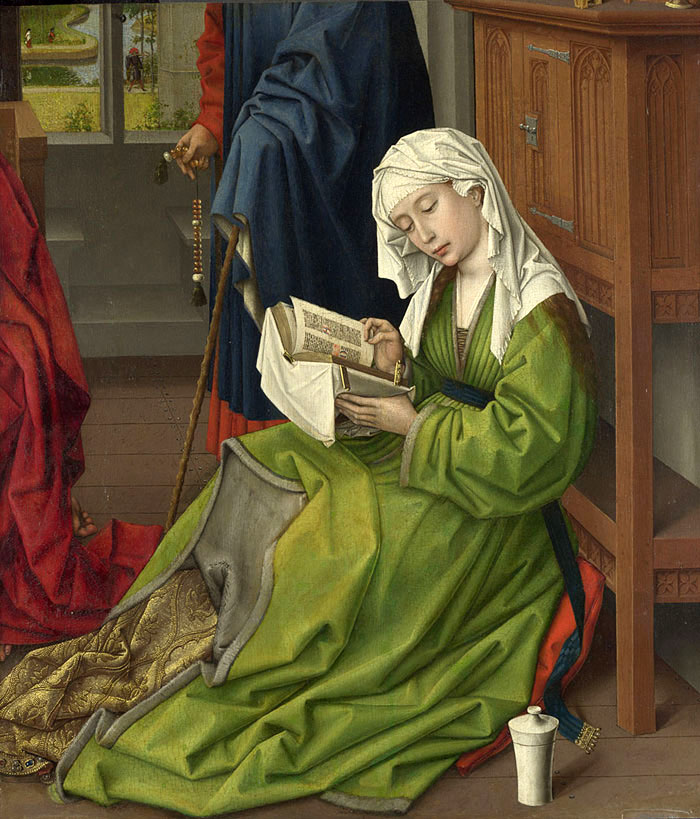
A young woman in green sits on a red cushion, so absorbed in her book that the world around her seems to fall away. She is only a fragment of a lost altarpiece, and for a long time her companions were hidden under brown paint.
The story behind the painting
The Magdalen Reading is one of three surviving fragments of a large oil on oak altarpiece by Rogier van der Weyden, painted some time between 1435 and 1438. At an unknown point before 1811 the altarpiece was broken up. The original was a sacra conversazione, known today only through a drawing, Virgin and Child with Saints, in Stockholm's Nationalmuseum, which shows that the Magdalen sat in the lower right corner. Two smaller fragments in the Calouste Gulbenkian Museum in Lisbon, the head of Saint Joseph and probably Saint Catherine, belong to the same work. The London panel measures 62.2 by 54.4 cm.
What to look for
She is the Magdalen because of the alabaster ointment jar at her feet, her traditional attribute. She leans against a wooden sideboard, head tilted, eyes lowered, reading a holy book wrapped in a white cloth chemise, with four coloured bookmarks tied to a gold bar. Her green robe is held by a blue sash, and her gold brocade underskirt has a jewelled hem. Look closely at the fur lining, painted in greys from almost white to black, and at her lips, mixed from vermilion, white and red. Through the window a canal, an archer on the garden wall and a tiny walking woman reflected in the water appear. Behind her stands a cut-off figure with a crystal rosary.
Meaning and intent
Here the Magdalen is based on Mary of Bethany, who sat at Jesus' feet and listened to his word, and so stands for the contemplative life, repentant and absolved. Her semicircular outline reinforces her quiet detachment. It was rare at the time to show women reading. The critic Charles Darwent noted that the fur and a few loose strands of hair hint at her past as a fallen woman, writing that in her mix of purity and eroticism she feels whole, but she is not. Lorne Campbell called the tiny figure in the window a small miracle of painting, detail that would have been invisible to viewers of the altarpiece in place.
Legacy
Van der Weyden was successful across Europe in his lifetime, but fell from view in the seventeenth century and was rediscovered only in the early nineteenth. The panel is first traced to an 1811 sale, and after passing through dealers in the Netherlands it was bought by the National Gallery in London from a Paris collector in 1860. Its background had been covered with thick brown paint; a cleaning in 1955 and 1956 revealed Joseph behind her, a kneeling figure with a bare foot, and the window view. Campbell calls it one of the great masterpieces of fifteenth century art, though some critics find the floor and cupboard dull and papery.
Did you know?
- Painted between 1435 and 1438 as part of a large altarpiece.
- One of three surviving fragments, two of them in Lisbon.
- In the National Gallery, London, since 1860.
- A 1955 to 1956 cleaning revealed figures hidden under brown overpaint.
About the artist
Rogier van der Weyden (1390s-1464)
religious art · woman · National Gallery · sitting · Early Netherlandish painting · dress · Mary Magdalene · book · reading · veil
More by Rogier van der Weyden
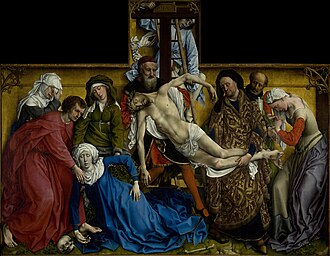 The Descent from the Cross - Rogier van der Weyden (1440s)
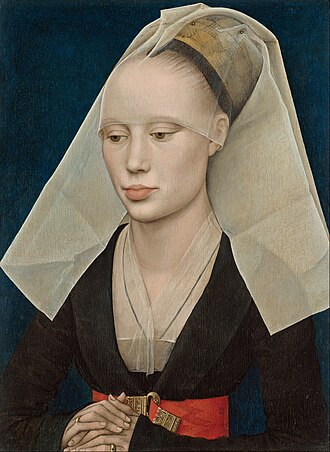 Portrait of a Lady - Rogier van der Weyden (1460)
.jpg) The Last Judgment - Rogier van der Weyden (1443)
The Last Judgment - Rogier van der Weyden (1443)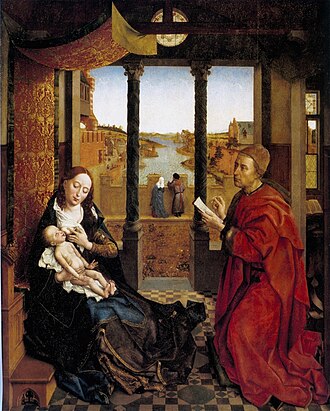 Saint Luke Drawing the Virgin - Rogier van der Weyden (1490)
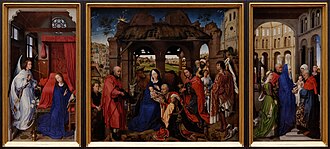 Columba Triptych - Rogier van der Weyden (1450s)
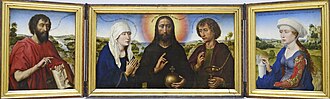 Braque Triptych - Rogier van der Weyden (1452)
%20-%20Prado%20P02722.jpg) Durán Madonna - Rogier van der Weyden (1430s)
Durán Madonna - Rogier van der Weyden (1430s)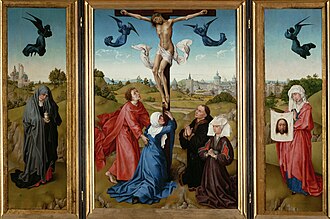 Crucifixion Triptych - Rogier van der Weyden (1440s)
Paintings by related artists
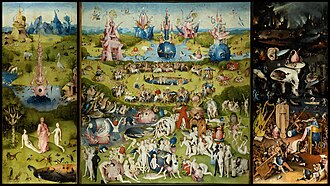 The Garden of Earthly Delights - Hieronymus Bosch
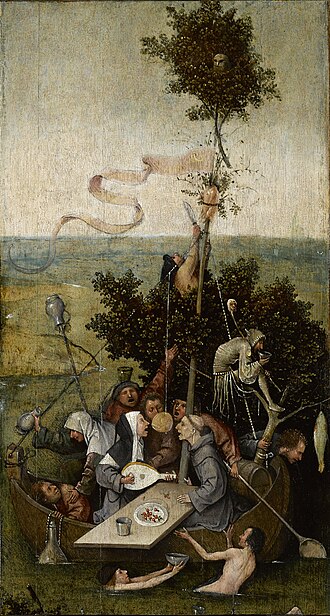 Ship of Fools - Hieronymus Bosch (1500s)
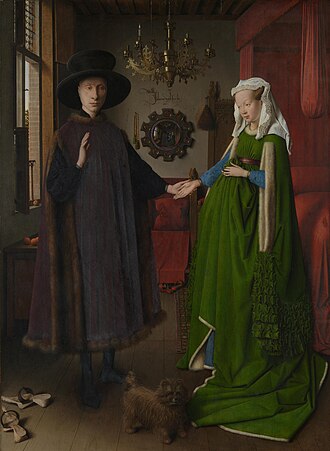 Arnolfini Portrait - Jan van Eyck (1434)
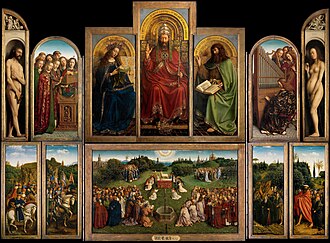 Ghent Altarpiece - Jan van Eyck (1432)
%20-%20Google%20Art%20Project.jpg) The Hunters in the Snow - Pieter Bruegel the Elder (1565)
The Hunters in the Snow - Pieter Bruegel the Elder (1565)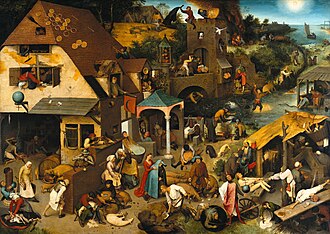 Netherlandish Proverbs - Pieter Bruegel the Elder (1551)