The Gust of Wind
Pierre-Auguste Renoir · 1872
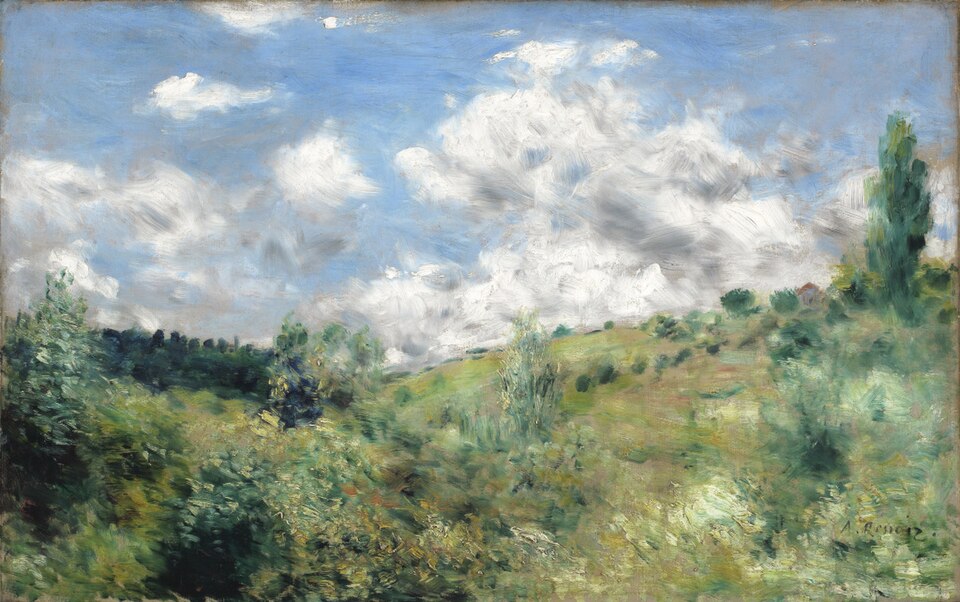
You cannot see wind, yet in this canvas you feel it bending the grass and tossing the trees. Renoir tried to paint the air itself, and when the picture first went to auction the public answered with anger.
The story behind the painting
In the 1860s Renoir trained under Charles Gleyre alongside Claude Monet and Alfred Sisley, and they grew close to Paul Cézanne and Camille Pissarro of the Académie Suisse. The critic Jules-Antoine Castagnary summed up their aim as capturing not the landscape but the sensation it produces. Scholars generally place The Gust of Wind in the summers of 1872 and 1873, a period of classic Impressionism and of Renoir's work with Monet. The exact date and place are still debated: it may show the Saint-Cloud area or the wider Île-de-France. A related work, After the Storm, may have been painted at the same time and place.
What to look for
Wind moves powerfully through the grasses and trees under a blue sky with white clouds, and far off, above the hillside, stands a single house. Renoir often left works of this time in a sketch-like ébauche state with the underpainting visible. He set warm against cool, pairing viridian green with alizarin crimson or with cobalt blue, to build lively shadows. Look at the lower right, below the house on the horizon, where the ecru or biscuit-coloured ground shows through. The blurred foreground feels like a view from a moving train. The canvas is about 52 by 82 cm.
Meaning and intent
Unlike the academic painters before him, Renoir does not turn wind into an allegory. It is a natural phenomenon, a visual effect inside a scene of modern life. The art historian Jane Munro suggests he wanted to catch the elusive nature of air itself, an invisible force made visible through loose brushwork. Malcolm Andrews, a specialist in landscape art, compares the blur to a film camera recording wind on a landscape with a slow shutter speed. The subject is not the hill or the house but the moment the air moves through them.
Legacy
The work was finished just before the first Impressionist exhibition of 1874. On 24 March 1875 it was one of twenty works Renoir offered at the Hôtel Drouot in Paris, listed as Grand Vent (Paysage). The public met the auction with anger and his paintings sold poorly. The artist Auguste de Moulins bought it that year. It later passed through the hands of Paul Durand-Ruel in 1899, Alphonse Kahn in 1908 and Frank Hindley Smith in 1923, and Smith bequeathed it to the Fitzwilliam Museum in Cambridge in 1939, where it remains.
Did you know?
- Usually dated to the summers of 1872 and 1873.
- Offered at the Hôtel Drouot auction of 24 March 1875.
- Shows wind as a natural effect, not an allegory.
- Bequeathed to the Fitzwilliam Museum, Cambridge, in 1939.
About the artist
Pierre-Auguste Renoir (1841-1919)
landscape painting · wind · Fitzwilliam Museum
More by Pierre-Auguste Renoir
 Dance at Le Moulin de la Galette - Pierre-Auguste Renoir (1876)
 Luncheon of the Boating Party - Pierre-Auguste Renoir (1881)
 La Balançoire - Pierre-Auguste Renoir (1876)
 The Great Bathers - Pierre-Auguste Renoir (1884)
 Girls at the Piano - Pierre-Auguste Renoir (1892)
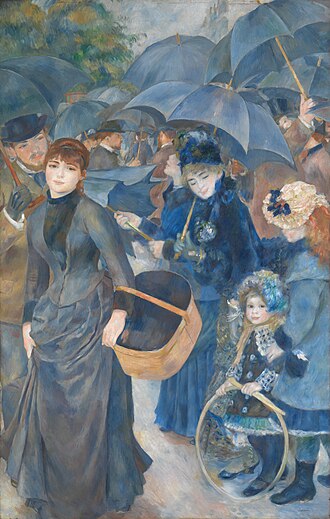 The Umbrellas - Pierre-Auguste Renoir (1880s)
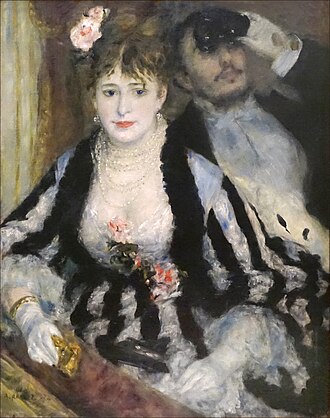 La loge - Pierre-Auguste Renoir (1874)
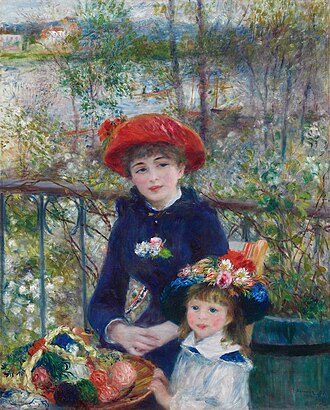 Two Sisters - Pierre-Auguste Renoir (1881)
Paintings by related artists
 Impression, Sunrise - Claude Monet (1872)
 Water Lilies - Claude Monet (1906)
 Luncheon on the Grass - Édouard Manet (1863)
 Olympia - Édouard Manet (1863)
 The Cradle - Berthe Morisot (1872)
 Summer's Day - Berthe Morisot (1879)
 L'Absinthe - Edgar Degas (1875)
 The Bellelli Family - Edgar Degas (1858)
 The Canal du Loing at Moret - Alfred Sisley (1892)
 The Watering Pond at Marly with Hoarfrost - Alfred Sisley (1876)
 Paris Street; Rainy Day - Gustave Caillebotte (1877)
 Les raboteurs de parquet - Gustave Caillebotte (1875)