The Gulf Stream
Winslow Homer · 1899
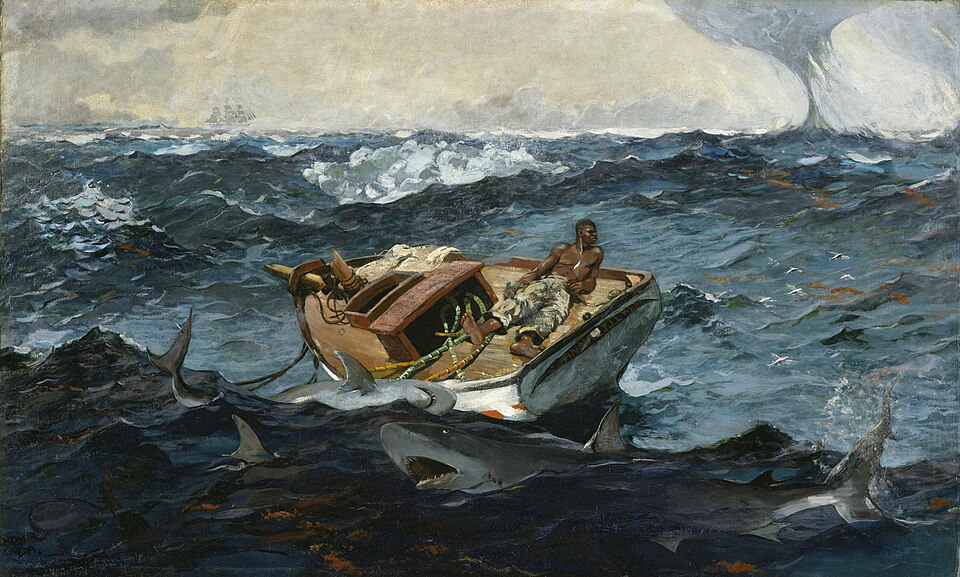
A man lies on the deck of a broken boat, sharks circling, a waterspout rising behind him. Asked what would happen to him, Winslow Homer replied that he would be rescued and live happily ever after.
The story behind the painting
Homer crossed the Gulf Stream many times. His first trip to the Caribbean in 1885 led to a pencil drawing of a dismasted boat and watercolours such as The Derelict (Sharks), and an 1889 watercolour already shows a sailor in the disabled boat with a shark. He also kept an account of a Bahamian tale about a Captain McCabe, caught in a storm in a small boat in 1814. After a winter in Nassau and Florida, Homer began the oil by September 1899, writing that he had commenced arranging a picture from some of the studies. It was painted the year after his father's death, and has been read as showing his own sense of vulnerability.
What to look for
The small fishing boat has lost its mast and rudder and lies in a trough between waves. The man, barely clothed, half reclines across the deck and seems to ignore everything: the sharks around the hull, the waterspout behind, the tiny ship on the far left horizon. Look closely at the black cross on the bow, the open hatch, the ropes, the broken mast and torn sail, all read as funeral symbols. After a first exhibition Homer broke the gunwale, added the sail, a red dash of colour, the legible name Anna, Key West, and the distant ship.
Meaning and intent
Homer disliked explaining it. He wrote that he regretted painting a picture that needed description, that he had crossed the Gulf Stream ten times, and that the boat and sharks were outside matters of very little consequence. Critics read far more into it. Robert Hughes contrasted it with Copley's Watson and the Shark, where rescue is near; here the open sea suggests abandonment. Nicolai Cikovsky saw echoes of Delacroix, Turner and Thomas Cole. Sidney Kaplan called it a masterpiece of the Black image, and Peter H. Wood read it as an allegory of Black Americans during and after the slave trade. John Updike found it on the edge of the absurd.
Legacy
Homer first showed the painting at the Pennsylvania Academy of the Fine Arts in 1900, then reworked it. At the National Academy of Design in 1906, every member of the jury petitioned the Metropolitan Museum of Art to buy it, and the museum did so that year. Reviews were mixed: one Philadelphia writer mocked it as Smiling Sharks, another found its interest diffused. Later, Homer's biographer Albert Ten Eyck Gardner called it his greatest painting, and Sadakichi Hartmann one of the greatest pictures painted in America. Derek Walcott brought it into his poem Omeros, calling the painter another Homer.
Did you know?
- Painted in 1899 after a winter in Nassau and Florida.
- Homer reworked it after its first exhibition in 1900.
- Bought by the Metropolitan Museum of Art in 1906.
- Referenced in Derek Walcott's poem Omeros.
About the artist
Winslow Homer (1836-1910)
man · Metropolitan Museum of Art · marine art · boat · sea · Black people · wind wave
More by Winslow Homer
 Breezing Up - Winslow Homer (1873)
 The Fog Warning - Winslow Homer (1885)
 Fox Hunt - Winslow Homer (1893)
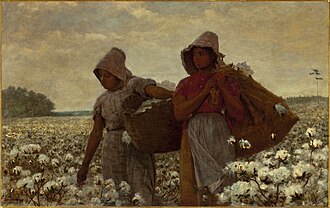 The Cotton Pickers - Winslow Homer (1876)
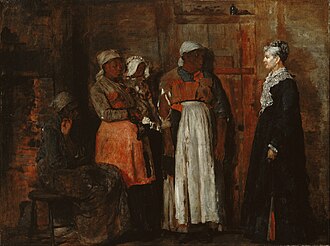 A Visit from the Old Mistress - Winslow Homer (1876)
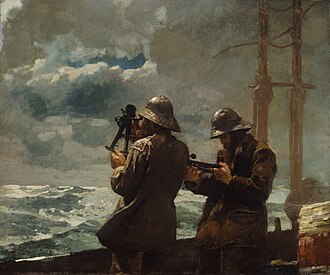 Eight Bells - Winslow Homer (1886)
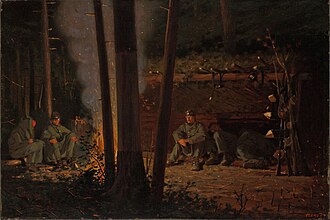 In Front of Yorktown - Winslow Homer (1860s)
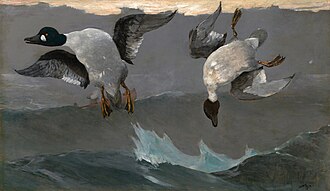 Right and Left - Winslow Homer (1909)
Paintings by related artists
 L'Origine du monde - Gustave Courbet (1866)
 A Burial at Ornans - Gustave Courbet (2020)
 Luncheon on the Grass - Édouard Manet (1863)
 Olympia - Édouard Manet (1863)
 The Starry Night - Vincent van Gogh (1889)
 Café Terrace at Night - Vincent van Gogh (1888)