A Visit from the Old Mistress
Winslow Homer · 1876
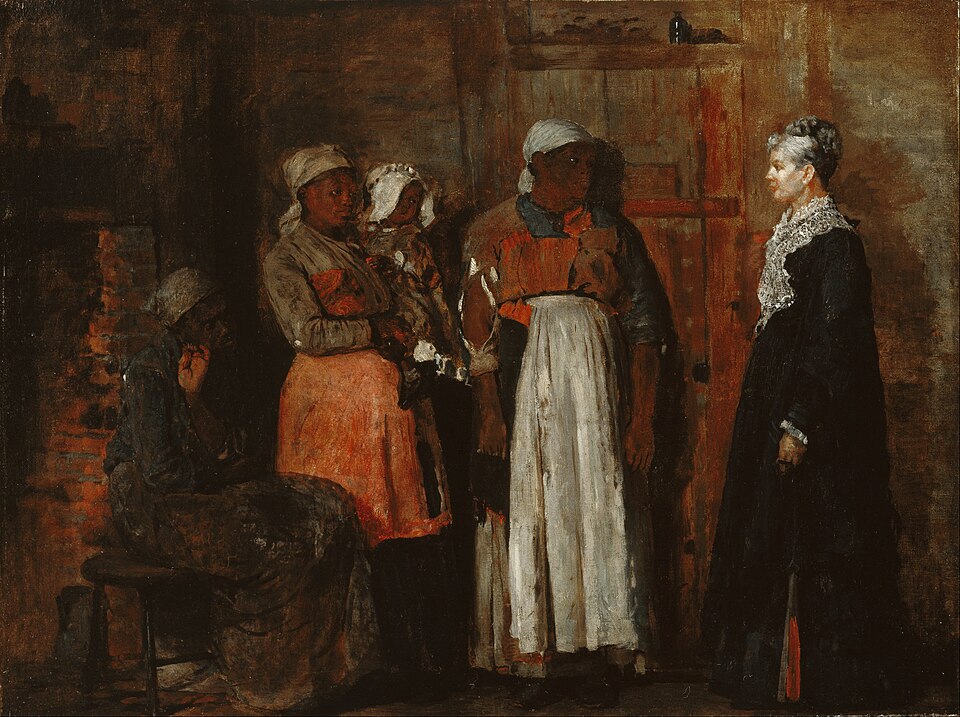
Three freed women face the white widow who once owned them, in a bare cabin where nobody bows. Winslow Homer painted the meeting in 1876, and what its silence means is still argued.
The story behind the painting
Winslow Homer painted A Visit from the Old Mistress in 1876, one of several works thought to come from a mid-1870s visit to Virginia, where he had served as a Union war correspondent in the Civil War. The sources are unsure about these trips: his biographer William Howe Downes knew only of a southern journey in 1877, while some scholars believe Homer went in 1875 and 1876 too. Whether he saw such a scene, worked from wartime memories or used studio sets is speculation. The small canvas, about 45.7 by 61 cm, takes its composition from his earlier Prisoners from the Front.
What to look for
On the left are three Black women in torn clothes: one sits, one stands holding a baby, and one stands in the middle. They face an old white woman in a widow's black dress with a white lace collar, upright and looking evenly at them. The scene is set in the women's own cabin, though an alternate title places it in the mistress's kitchen. Notice who stands and who refuses to. The same room appears in Homer's Sunday Morning in Virginia, so the interiors were probably composed together.
Meaning and intent
The title is double: a visit from the former mistress, meaning they are now free, or from the mistress who is old, meaning she still holds power. Early writers saw humour; Downes found a blend of pathos and humour. Jo-Ann Morgan argues Homer's ragged figures reassured white viewers that old hierarchies remained. Sidney Kaplan sees instead the matriarch's glance as rejection, her family showing dignity, scorn and restraint, and a silent tension between two communities seeking their future. As in Prisoners from the Front, many read it as a confrontation in which the mistress no longer holds her former power.
Legacy
A contemporary critic praised Homer as one of the few who painted Black subjects without caricature, and the work is seen as part of his turn toward realism. It was one of five paintings Homer showed at the Paris Universal Exposition of 1878. The New York collector Thomas B. Clarke bought it; after his collection was sold in 1899, William T. Evans acquired it and gave it to the National Gallery of Art in Washington, where it was shown as The Visit of the Mistress. It later moved to the Smithsonian American Art Museum, where it remains on display.
Did you know?
- Painted in 1876, linked to Homer's visits to post-war Virginia.
- Composition taken from his Prisoners from the Front.
- Its title can mean the former mistress or the old one.
- Shown at the 1878 Paris Universal Exposition; now at the Smithsonian.
About the artist
Winslow Homer (1836-1910)
woman · dress · child · group portrait · Black people
More by Winslow Homer
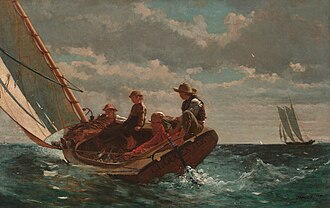 Breezing Up - Winslow Homer (1873)
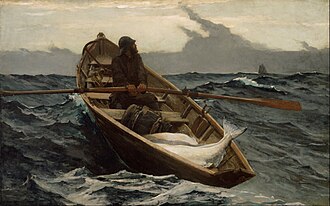 The Fog Warning - Winslow Homer (1885)
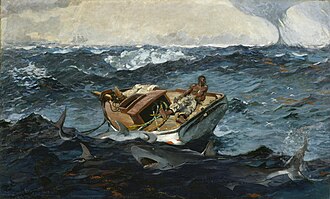 The Gulf Stream - Winslow Homer (1899)
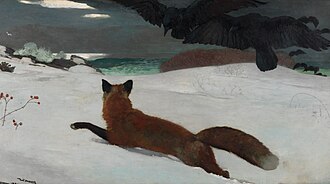 Fox Hunt - Winslow Homer (1893)
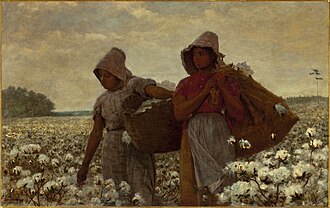 The Cotton Pickers - Winslow Homer (1876)
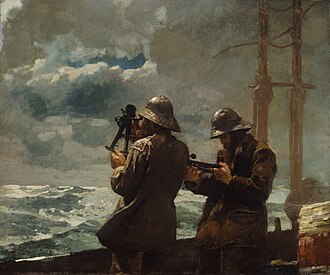 Eight Bells - Winslow Homer (1886)
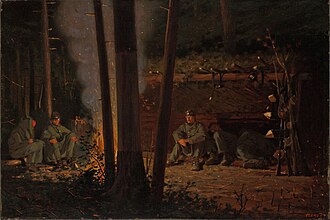 In Front of Yorktown - Winslow Homer (1860s)
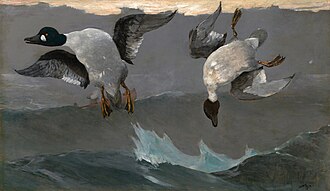 Right and Left - Winslow Homer (1909)
Paintings by related artists
 L'Origine du monde - Gustave Courbet (1866)
 A Burial at Ornans - Gustave Courbet (2020)
 Luncheon on the Grass - Édouard Manet (1863)
 Olympia - Édouard Manet (1863)
 The Starry Night - Vincent van Gogh (1889)
 Café Terrace at Night - Vincent van Gogh (1888)