The Bathers
Gustave Courbet · 1853
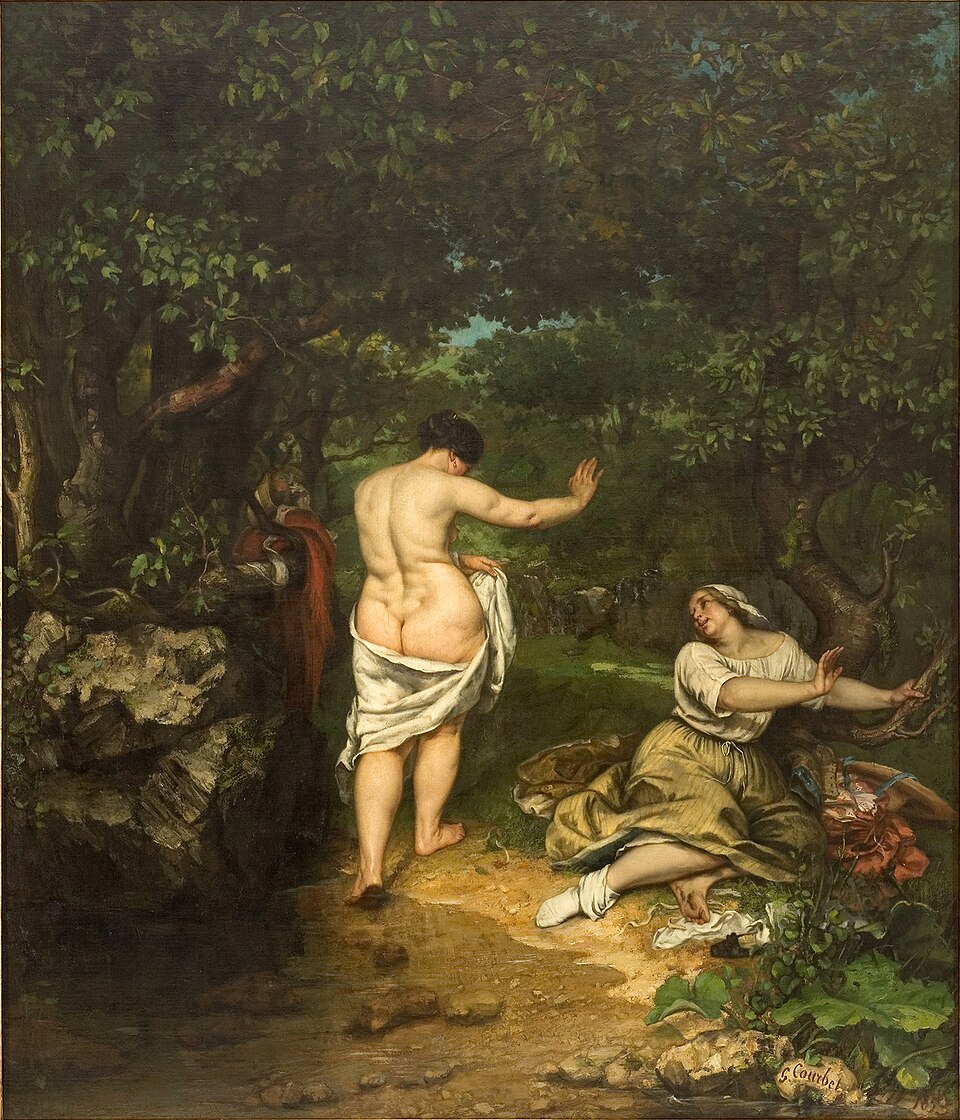
A large, ordinary woman steps out of a stream in the Franche-Comté and turns her back to us. At the Salon of 1853 the critics attacked her unanimously, and Courbet got exactly the noise he had hoped for.
The story behind the painting
By 1852 Courbet had his first successes in France, Belgium and Germany, had won a medal and was showing again at the Paris Salon. That summer he returned to the female nude. On 13 May 1853 he wrote to his parents that the jury now accepted his paintings without objection, that he was gaining ground every day, and that all Paris was waiting to hear the noise they would make. The Bathers, he admitted, was a bit scary, but he had added a cloth over the buttocks. The landscape, he thought, was generally successful.
What to look for
The canvas is large, about 227 by 193 cm, a size usually reserved for religious and mythological scenes or portraits of princes. A big nude woman, seen from behind, rises from the water with the cloth Courbet added over her buttocks. The landscape around them is sketchy, which critics also attacked. Look for the signature and date on a small rock in the bottom right corner. X-rays revealed earlier pictures beneath: a nude pointing at a figure on the right, then a scene of a hallucinating man throwing himself off a cliff, which Courbet abandoned in 1846.
Meaning and intent
Courbet set aside the models of Titian and Rubens and broke the hierarchy of genres, putting a naked ordinary woman into a real landscape to make a scene of everyday life. The female nude did not fit the ideals of Romantic and Neoclassical painting or the polished style of Ingres. Théophile Gautier wrote in La Presse that he saw a kind of Hottentot Venus turning a monstrous rump to the spectator, contrasting a civilised classical Venus with what he called savagery. Proudhon defended the work as art that could show vice as well as virtue, a reading the source calls a misunderstanding of Courbet.
Legacy
The scandal at the Salon of 15 May 1853 was huge, and Cham caricatured the picture in Le Charivari. Yet the collector Alfred Bruyas, soon Courbet's friend, bought it, and this purchase allowed the artist to become financially and artistically independent. Champfleury later used the painting to provoke George Sand in a public letter of 1855. The Bathers has been in the Musée Fabre in Montpellier since 1868, and it remains one of the clearest moments when Courbet chose to paint what he saw rather than what was expected.
Did you know?
- First shown at the Paris Salon of 1853, where it caused a scandal.
- Bought by Alfred Bruyas, which made Courbet independent.
- X-rays show two earlier compositions beneath the paint.
- In the Musée Fabre, Montpellier, since 1868.
About the artist
Gustave Courbet (1819-1877)
woman · genre art · nudity · tree
More by Gustave Courbet
 L'Origine du monde - Gustave Courbet (1866)
 A Burial at Ornans - Gustave Courbet (2020)
 The Sleepers - Gustave Courbet (1866)
 The Painter's Studio - Gustave Courbet (1855)
 Woman with a Parrot - Gustave Courbet (1866)
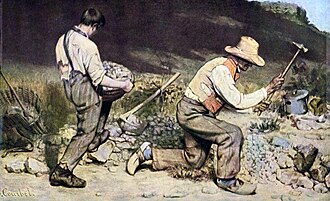 The Stone Breakers - Gustave Courbet (1850)
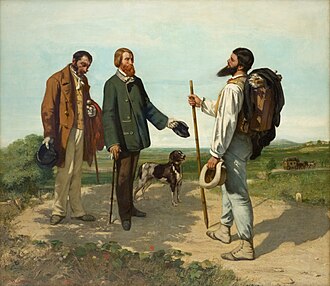 The Meeting, or Bonjour, Monsieur Courbet! - Gustave Courbet (1854)
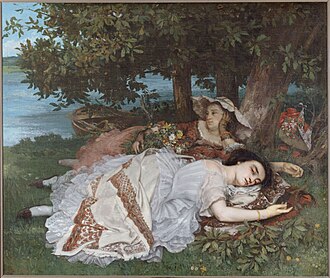 Young Ladies Beside the Seine - Gustave Courbet (1857)
Paintings by related artists
 Impression, Sunrise - Claude Monet (1872)
 Water Lilies - Claude Monet (1906)
 Luncheon on the Grass - Édouard Manet (1863)
 Olympia - Édouard Manet (1863)
 Breezing Up - Winslow Homer (1873)
 The Fog Warning - Winslow Homer (1885)
 The Starry Night - Vincent van Gogh (1889)
 Café Terrace at Night - Vincent van Gogh (1888)