Spring Day on Karl Johan
Edvard Munch · 1890
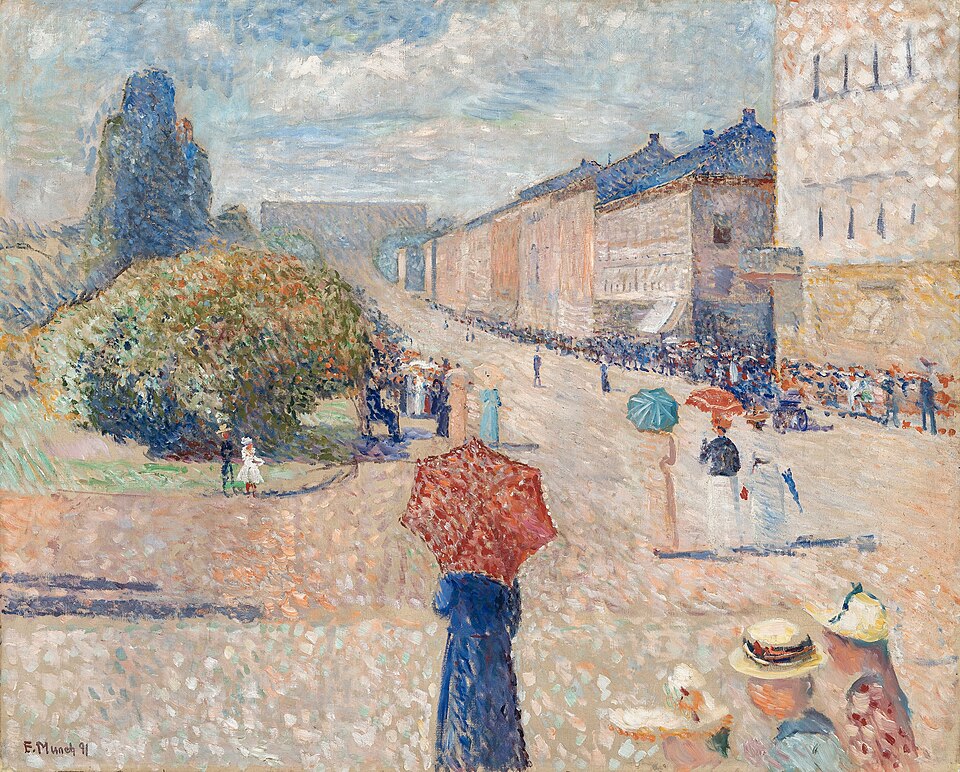
Kristiania's grand avenue flooded with spring sun, strollers with parasols, and in the middle a woman in blue who does not move. Munch tried Impressionist light here, and still slipped in a mystery.
The story behind the painting
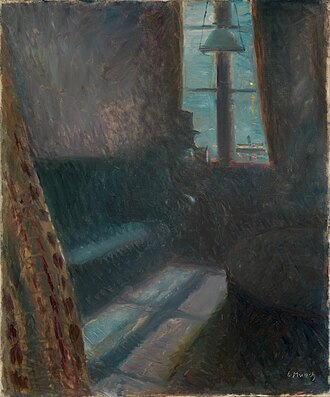
Munch painted this street scene of Karl Johans gate in Kristiania, today's Oslo, in 1890, one of several views of the avenue from different directions and in different weather in his early work. Reinhold Heller contrasts its festive mood with gloomy pictures of the same period such as Night in Saint-Cloud, and links it to Munch's longing, after overcoming thoughts of suicide, for summer days full of sun. Munch wrote that he loved life, sunlit days, the noise of carriages and people strolling on the pavements. The picture is signed and dated E. Munch 91, but Arne Eggum and the 2008 catalogue raisonné by Gerd Woll date it to 1890; Franziska Müller suggests Munch added the wrong date only in 1927.
What to look for
The view runs from the Grand Hotel on the right to the trees of Løvebakken Park on the left, with the pale blue royal palace at the vanishing point. A colourful crowd strolls on both sides and a horse carriage drives down the road. Girls in sun hats are cut off by the right edge like a snapshot; three women with parasols repeat the motif further up; two shadows reach in from the left without their owners. Munch painted on unprimed canvas that shows through in places, experimenting with pointillism but breaking its system, with dissolving strokes and a sky in broad horizontal bands.
Meaning and intent
At the centre, in strong contrasting colours, a woman in blue with a red parasol is seen from behind, rigid amid the movement around her. For Müller she falls out of the composition and gives this Impressionist study a Symbolist character, in line with Munch's saying that he painted not what he saw but what he had seen. Some have tried to link her to his former lover Milly Thaulow or to his mother. Ulrich Bischoff sees two principles in balance: cheerful snapshot genre painting and fixed, symbolic elements.
Legacy
The painting, 80 by 100 cm in oil on canvas, is shown at KODE, the art museum in Bergen. It stands as Munch's engagement with Impressionism, a picture so bright, in Müller's words, that the viewer seems dazzled by the glaring spring sun. It belongs to a group of early views of the same avenue seen from different directions and in different weather. Its bright pointillist surface makes it stand apart from the darker pictures Munch was painting at the same time.
Did you know?
- Painted in 1890, though signed and dated 1891.
- Shows Karl Johans gate in Kristiania, now Oslo.
- Painted on unprimed canvas with pointillist touches.
- Held by KODE in Bergen.
About the artist
Edvard Munch (1863-1944)
KODE Art museums and composer homes
More by Edvard Munch
 The Scream - Edvard Munch (1893)
 Dance of Life - Edvard Munch
 The Kiss - Edvard Munch (1897)
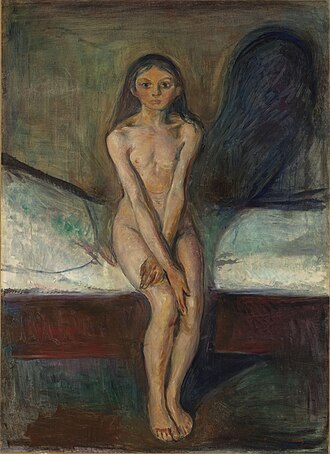 Puberty - Edvard Munch (1895)
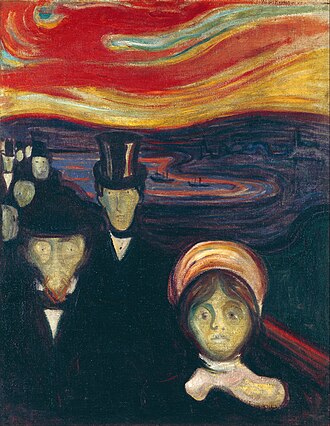 Anxiety - Edvard Munch (1894)
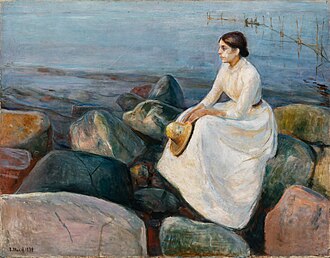 Inger on the Beach - Edvard Munch (1889)
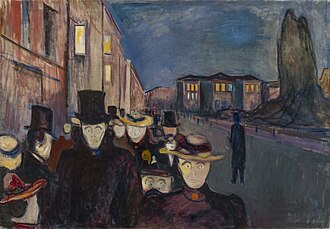 Evening on Karl Johan - Edvard Munch (1892)
 Night in Saint-Cloud - Edvard Munch (1890)