Evening on Karl Johan
Edvard Munch · 1892
.jpg)
A crowd walks straight at you down Kristiania's main street at dusk, faces pale as masks, eyes wide open. One dark figure walks the other way. A year before The Scream, Munch was already painting fear.
The story behind the painting
In his literary diary of 1889 Munch described walking among passers-by who all seemed to stare at him, faces in the evening light, until his head felt empty, his body shook and sweat ran down his face. He recorded a similar feeling on the Boulevard des Italiens in Paris, among a thousand ghostly faces in the electric light. In the summer of 1892, back in Kristiania and Åsgårdstrand and still full of Paris, he turned that experience into this painting. Arne Eggum called it perhaps the most idiosyncratic painting of that summer.
What to look for
This is Karl Johans Gate, Kristiania's main boulevard, at night. On the right, in the distance, stand the Storting building and two towering poplars; on the left, a row of houses with lit windows. A tightly packed crowd comes toward you, men in top hats, women in light straw hats with ribbons. Their faces are frozen, expressionless, eyes staring, painted in bright yellow and green against a blue-red sky. On the right side of the street a single black shadow walks the opposite way, alone.
Meaning and intent
Critics see menace in how directly the crowd faces us, as if we were looking into an abyss or our own reflection. Reinhold Heller describes a threat to the individual from the advancing anonymous crowd; Franziska Müller sees the lone figure as a likeness of Munch himself. The picture reverses his Impressionist Spring Day on Karl Johan of 1890, and Jean Selz saw it as the start of a new expressive style. Here the fear is not shouted, as in The Scream the next year, but stays silent, and all the more terrifying.
Legacy
Munch first showed the painting in September 1892 at his exhibition at Tostrupgården in Kristiania. The newspaper Morgenbladet called it a downright insane painting, and the public denounced both picture and painter as sick. Munch valued it so highly that he made it part of his Frieze of Life, his cycle on life, love and death. The mask-like faces return in Anxiety of 1894. In 1909 the collector Rasmus Meyer bought it for his collection in Bergen, opened to the public in 1924, and it remains with the KODE art museums in Bergen.
Did you know?
- Painted in 1892, a year before the first version of The Scream.
- First shown in Kristiania in September 1892, called insane by critics.
- Part of Munch's Frieze of Life.
- In the Rasmus Meyer collection, KODE, Bergen.
About the artist
Edvard Munch (1863-1944)
More by Edvard Munch
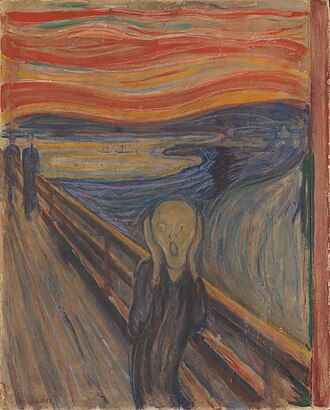 The Scream - Edvard Munch (1893)
 The Kiss - Edvard Munch (1897)
 Puberty - Edvard Munch (1895)
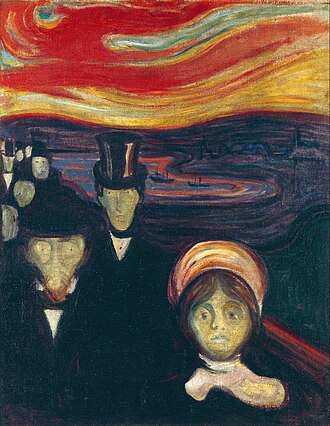 Anxiety - Edvard Munch (1894)
.jpg) Inger on the Beach - Edvard Munch (1889)
Inger on the Beach - Edvard Munch (1889)%2C%20NG.M.01111.jpg) Night in Saint-Cloud - Edvard Munch (1890)
Night in Saint-Cloud - Edvard Munch (1890) Self-Portrait with Cigarette - Edvard Munch (1895)
%2C%20Kunsthalle%20Bremen.jpg) Death and the Child - Edvard Munch (1899)
Death and the Child - Edvard Munch (1899)
Paintings by related artists
 The Kiss - Gustav Klimt (1907-1908)
 Portrait of Adele Bloch-Bauer I - Gustav Klimt (1907)