Santa en oración
Joaquín Sorolla · 1888
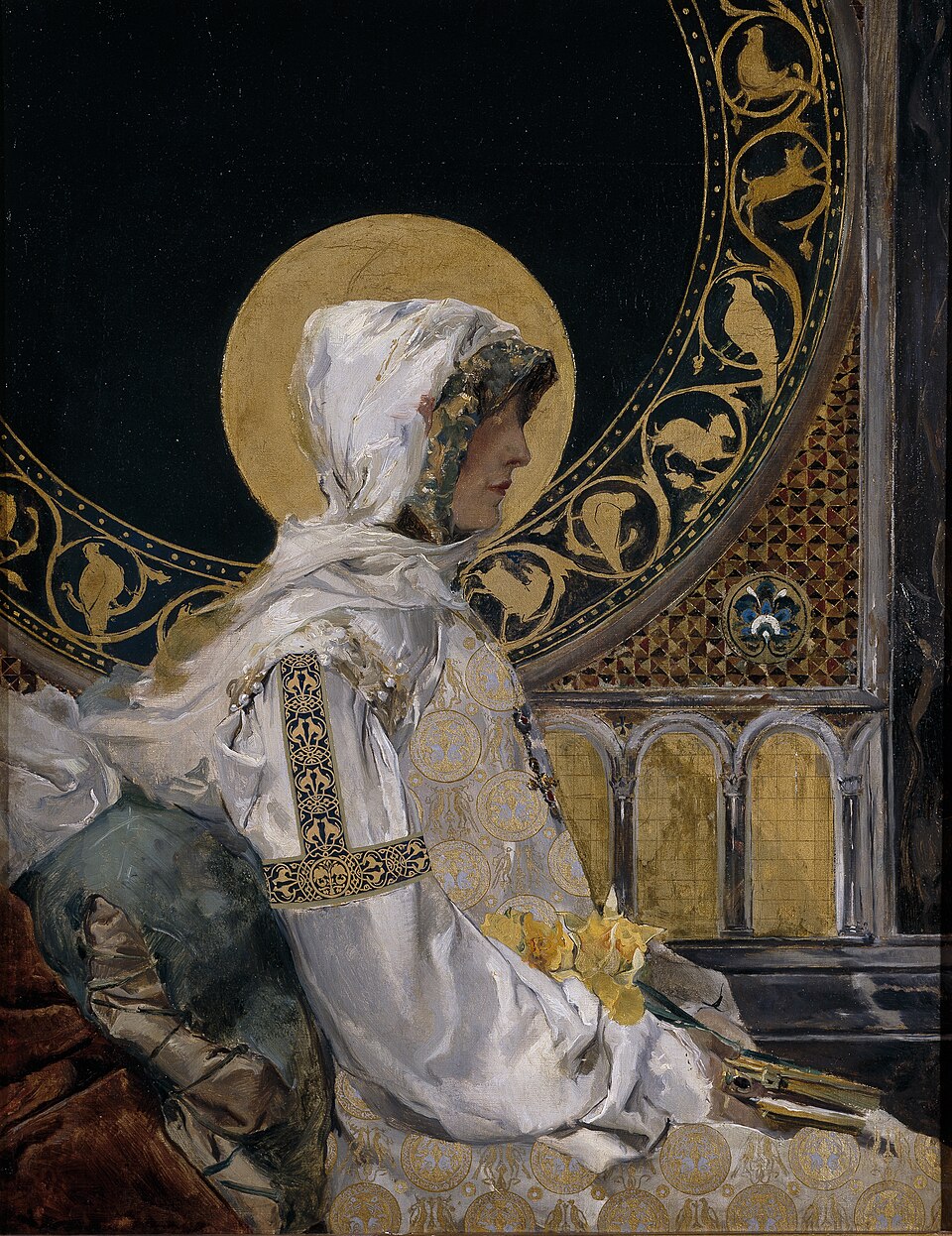
A woman in profile prays before a wall of gold, lilies in her lap. Sorolla painted this small canvas in Italy in the first year of his marriage, and he and his wife Clotilde kept it close for the rest of their lives.
The story behind the painting
Sorolla painted Saint at Prayer in 1888, the date given by his signature, while he was staying in Italy. These were also the first days of his marriage to Clotilde, when the couple faced their first hardships together. That helps explain the sentimental attachment both felt for this small work, which stayed with them throughout their lives. It appears in many photographs of the painter's studio, always in a place of honour, and Sorolla even painted it into the background of some of his portraits. The Museo del Prado acquired it in 1993.
What to look for
The holy woman is shown in profile against a sumptuous gold background with geometric decoration clearly inspired by early medieval art. Sorolla gives this background so much weight that it almost takes over the picture. Look at the play of shapes: the circles on the wall, on her robe and in her halo set against the squares and straight lines of the wall decoration, all balanced around the figure. He is thought to have used stencils for some motifs. Against this flat gold, the hood, the tunic, the cushions and the lilies in her lap are painted with strong volume.
Meaning and intent
Who is she? Attempts have been made to identify the woman with a particular saint, but her attributes, the book in her hands, the cross on her breast and the lilies, are not conclusive. She has sometimes been called a Virgin at Prayer, but the cross pendant rules out a depiction of the Virgin Mary. Some identify her with Saint Clotilde, mainly for sentimental reasons, since that was his wife's name. The uncertainty suits the picture: it reads less as a portrait of a saint than as a quiet image of devotion.
Legacy
The canvas is small, 78 by 61 centimetres, oil on canvas, and is now in the Museo del Prado in Madrid. Its value for Sorolla's story lies in its closeness to his private life: a picture from a year of beginnings that the painter chose to keep in view in his studio and to repeat inside other paintings. For visitors used to Sorolla's sunlit beaches, this gold, still, inward image shows another side of the young painter in Italy, experimenting with flat ornament and solid form side by side.
Did you know?
- Signed and dated 1888, painted during Sorolla's stay in Italy.
- Kept by Sorolla and his wife Clotilde throughout their lives.
- The saint cannot be identified with certainty.
- Acquired by the Museo del Prado in 1993.
About the artist
Joaquín Sorolla (1863-1923)
Museo del Prado · Post-impressionism · book
More by Joaquín Sorolla
 Walk on the mountain - Joaquín Sorolla (1909)
 Sad Inheritance - Joaquín Sorolla (1898)
 Chicos en la playa - Joaquín Sorolla (1910)
 White slave trade - Joaquín Sorolla (1894)
 And They Still Say Fish is Expensive! - Joaquín Sorolla (1894)
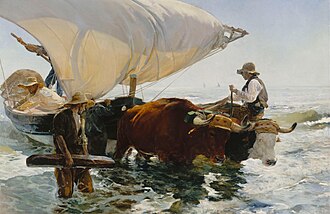 The Return from Fishing - Joaquín Sorolla (1894)
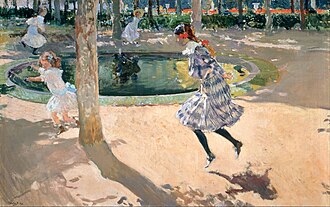 The Skipping Rope - Joaquín Sorolla (1911)
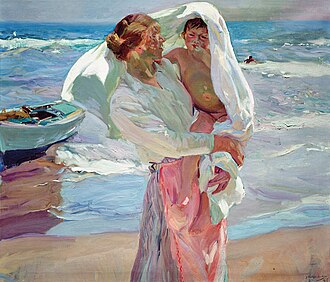 After Bathing - Joaquín Sorolla (1915)
Paintings by related artists
 The Starry Night - Vincent van Gogh (1889)
 Café Terrace at Night - Vincent van Gogh (1888)
 Where Do We Come From? What Are We? Where Are We Going? - Paul Gauguin (1897-1898)
 The Yellow Christ - Paul Gauguin (1889)
 Les Grandes Baigneuses - Paul Cézanne (1900s)
 The Boy in the Red Vest - Paul Cézanne
 Dance at Le Moulin de la Galette - Pierre-Auguste Renoir (1876)
 Luncheon of the Boating Party - Pierre-Auguste Renoir (1881)
 At the Moulin Rouge - Henri de Toulouse-Lautrec (1892)
 La Toilette - Henri de Toulouse-Lautrec (1896)