Saint Jerome and a Donor
Piero della Francesca · 1440
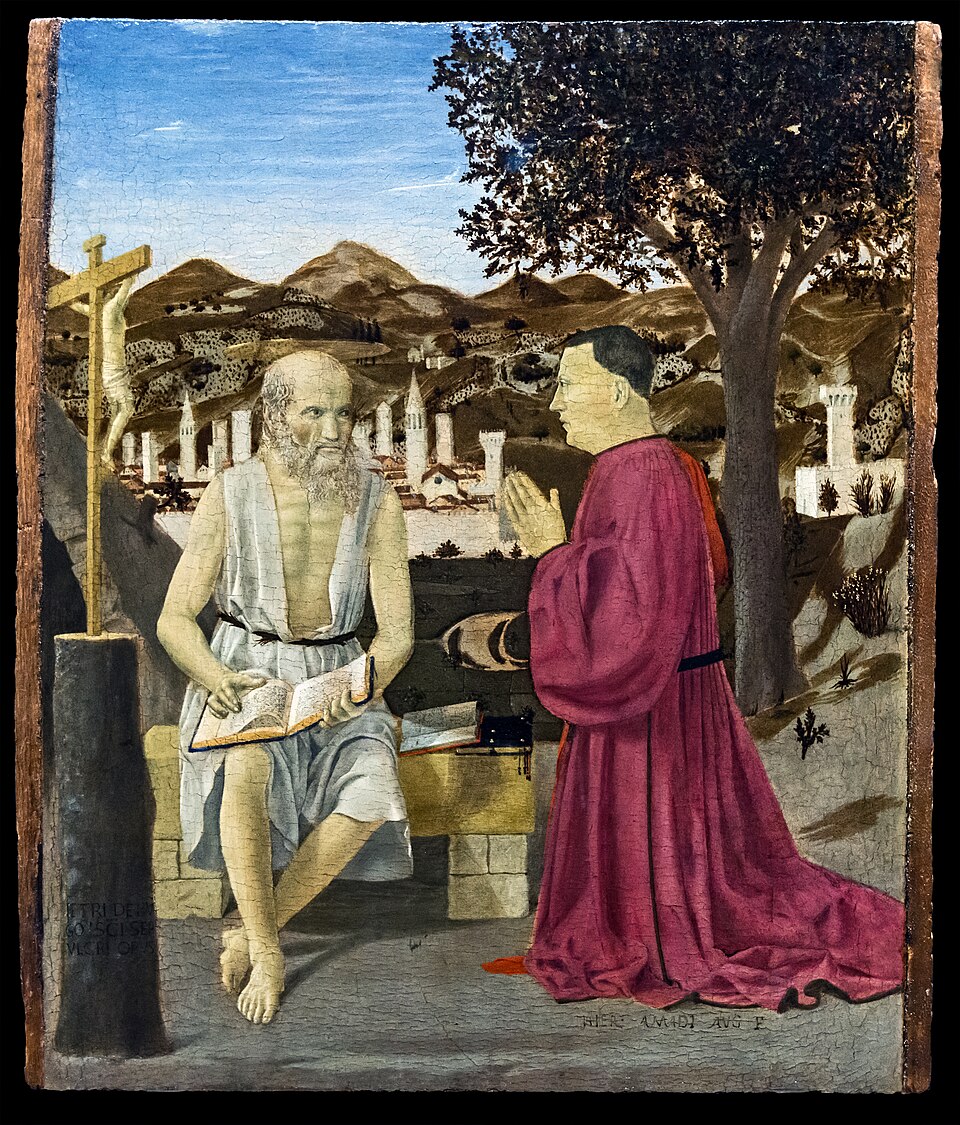
A Venetian gentleman in red kneels beside his patron saint, as large as the saint himself. Piero della Francesca signed the small panel on a tree trunk and named the donor at his knees.
The story behind the painting
The picture was probably a private devotional painting, judging by its subject and small size, about 49 by 42 cm. Its owner, Girolamo Amadi, a Venetian gentleman who loved painting, is named on a small inscription at the foot of the kneeling figure. The artist is named on another, on the tree trunk at left: the work of Piero of Borgo San Sepolcro. Wikipedia dates the painting between 1440 and 1450, while Wikidata gives 1440. It has only been known since it entered the Gallerie dell'Accademia in Venice in 1850 through the Hellman-Renier bequest.
What to look for
Saint Jerome, translator of the Bible, sits facing us on a stone bench, near his cave in the desert, yet studying his books. The donor, dressed in red, kneels at right on the same plane, and seems to interrupt his reading, drawing the saint's gaze toward him. Behind the saint a town, perhaps Sansepolcro, lies in hilly country under a blue sky; behind the donor are a fortress, possibly a Malatesta one, and foliage. A crucifix is planted on the tree trunk at left.
Meaning and intent
The panel joins two ways of showing Jerome that were usually kept apart: the hermit who renounced the world and the humanist scholar at his studies. The donor, whose own name is Girolamo, Jerome, prays before his protector. Most striking, he is painted the same size as the saint, following the new principles of Renaissance humanism, as Piero leaves behind the medieval habit of making holy figures larger. Only the crucifix is drawn in steep perspective, while the rest of the picture recedes in a series of planes toward the sky.
Legacy
For centuries this small panel left no trace, appearing only in 1850 when it entered the Accademia in Venice, where it remains today. Its two inscriptions make it unusually clear about who made it and for whom. It shows Piero della Francesca, early in his career, already giving an ordinary man and a saint equal space in one calm, luminous landscape, a quiet sign of how the Renaissance was changing the place of the individual in religious art.
Did you know?
- Signed by Piero on the tree trunk; donor named at his knees.
- Donor: the Venetian Girolamo Amadi.
- Dated 1440 to 1450 (Wikidata: 1440).
- In the Gallerie dell'Accademia, Venice, since 1850.
About the artist
Piero della Francesca (1415-1492)
religious art · Early Renaissance · Jerome · Gallerie dell'Accademia · donor
More by Piero della Francesca
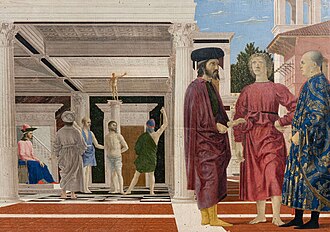 Flagellation of Christ - Piero della Francesca (1450s)
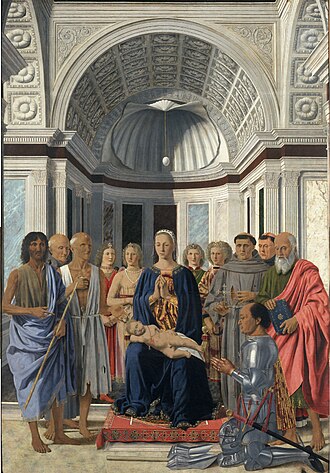 Madonna and Child with Saints, Angels and Federico da Montefeltro - Piero della Francesca (1472)
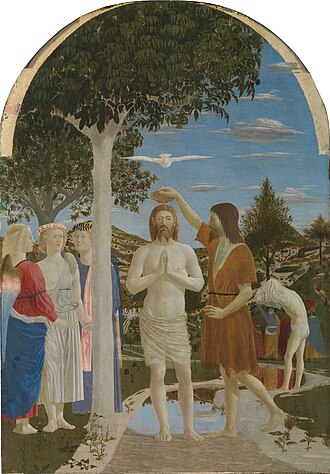 The Baptism of Christ - Piero della Francesca (1448)
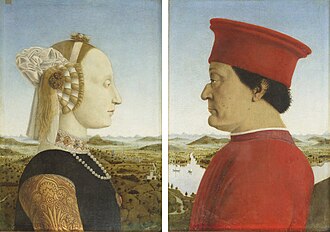 Diptych of Federico da Montefeltro and Battista Sforza - Piero della Francesca (1465)
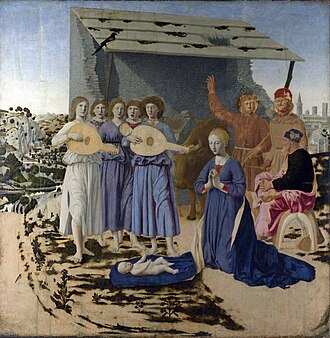 The Nativity - Piero della Francesca (1480s)
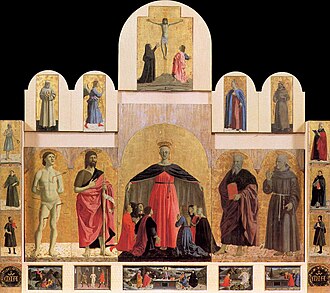 Polyptych of the Misericordia - Piero della Francesca (1460s)
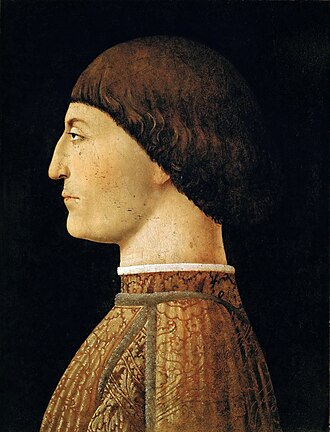 Portrait of Sigismondo Pandolfo Malatesta - Piero della Francesca (1450s)
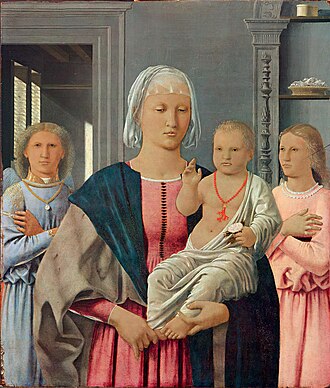 Madonna di Senigallia - Piero della Francesca (1470s)
Paintings by related artists
 The Birth of Venus - Sandro Botticelli (c. 1485)
 Primavera - Sandro Botticelli (1480s)
 Mona Lisa - Leonardo da Vinci (1503-1519)
 Lady with an Ermine - Leonardo da Vinci (1490)
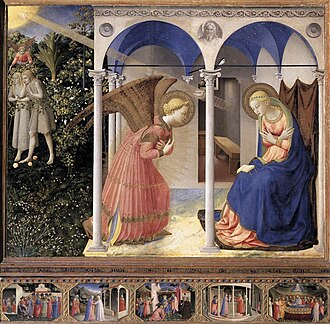 Annunciation - Fra Angelico (1425)
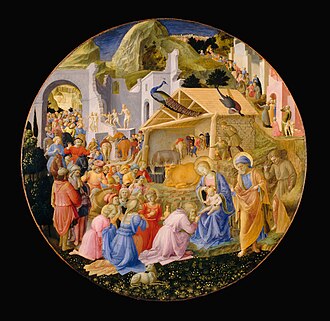 Adoration of the Magi - Fra Angelico (1430)
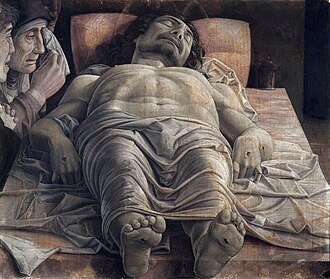 Lamentation of Christ - Andrea Mantegna (1483)
 Madonna della Vittoria - Andrea Mantegna