Adoration of the Magi
Fra Angelico · 1430
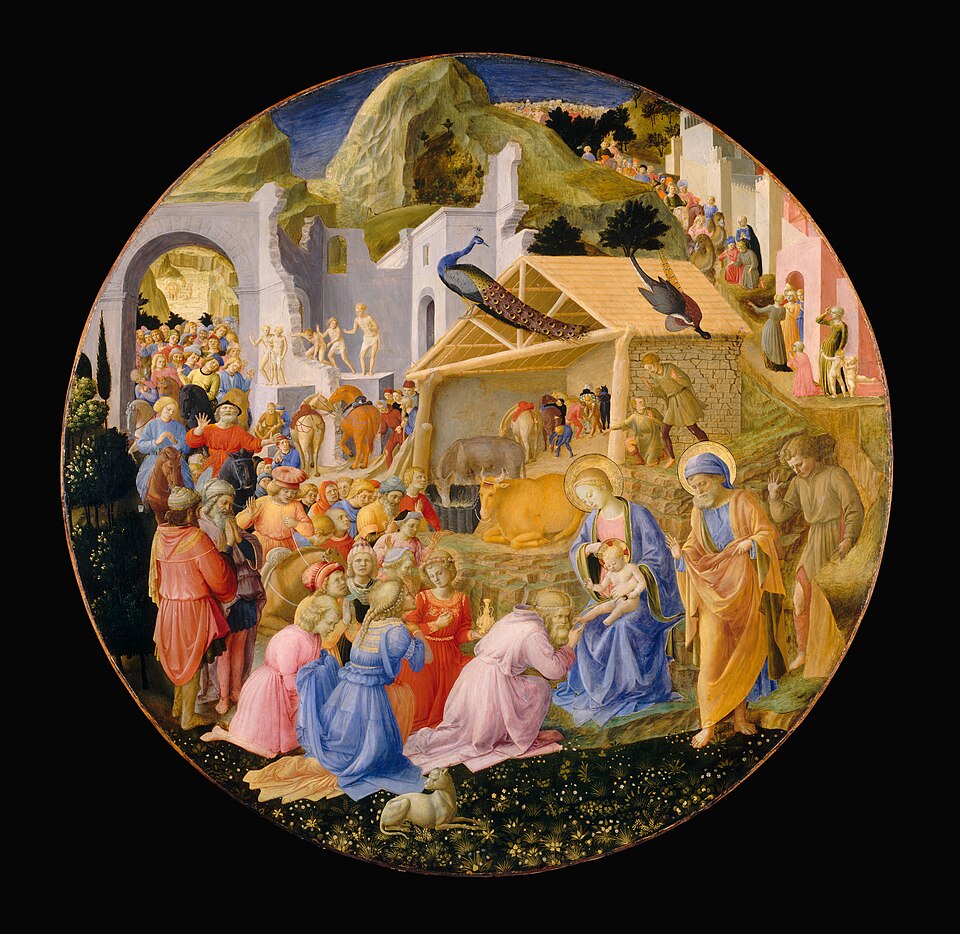
A round painting crowded with kings, shepherds, horses, camels and a strutting peacock, this Florentine tondo was painted by more than one master over many years. Its seams are part of its fascination.
The story behind the painting
This tondo, painted in tempera on a wood panel, is generally identified with a work recorded in 1492 in the Medici Palace in Florence as by Fra Angelico, and valued there above any other painting in the palace, including Uccello's Battle of San Romano panels. Art historians agree it was produced over a long period by several hands. In the usual reconstruction, first proposed by Bernard Berenson, Fra Angelico and his workshop began it, probably in the 1440s, and his own hand is seen in the Virgin's face. Progress stalled, and perhaps on Angelico's death in 1455 the unfinished panel passed to the workshop of Filippo Lippi, who most historians think painted more of it. Later additions followed. Wikidata gives the date as 1430, while the National Gallery of Art dates it c. 1440/1460.
What to look for
The Magi present their gifts to the Child on Mary's lap, with Joseph beside her and the ox and ass behind. Shepherds in ragged dress join them, though only one actually looks at the holy family. On the left a long procession passes through the arch of a ruined building, where nearly naked youths stand on the ruins; their purpose has puzzled historians, though they make the building seem grander. On the right, riders on camels and horses descend a steep path below Bethlehem's walls. Inside the stable, grooms unsaddle horses and check a horseshoe. Look up at the roof: a huge peacock looks over its shoulder, near a goshawk seizing a pheasant. The peacock is far too large for the figures below, one of several surprising differences of scale.
Meaning and intent
Those discrepancies tell the story of the painting's long making. Many small figures on both sides face or point in directions that no longer match the composition, a sign of changes over time. The stable has been called an awkward later addition, and the birds were painted over finished areas. They have been linked to emblems of Cosimo de' Medici's sons: Piero's falcon and Giovanni's peacock. Together with the dog in the foreground, they were perhaps added by Benozzo Gozzoli, Angelico's former assistant, around the time he painted the Magi Chapel frescoes in the Medici Palace in 1459-1461. John Walker, second director of the National Gallery of Art, saw the tondo as standing at a crossroads, where the colourful fairy-tale style of the Middle Ages meets a new, observant realism.
Legacy
The painting's later travels were nearly as eventful as its making. It belonged to the Guicciardini family from at least the late sixteenth century and in 1810 was sold as a Botticelli to Florence's police chief under Napoleonic occupation. In England it was attributed in turn to Fra Angelico, Filippo Lippi and Filippino Lippi, before entering the Cook collection, which gave it the name Cook Tondo. Sent to the United States for safekeeping in 1941, it was sold in 1947, bought by the Samuel H. Kress Foundation, and donated in 1952 to the National Gallery of Art in Washington. The painted surface measures 137.3 centimetres across; Wikidata gives 137.2.
Did you know?
- Tempera on wood panel, a tondo about 137 cm across.
- Wikidata dates it 1430; the National Gallery of Art says c. 1440/1460.
- Begun by Fra Angelico's workshop, largely continued by Filippo Lippi's.
- National Gallery of Art, Washington, Kress Collection, since 1952.
About the artist
Fra Angelico (1400-1455)
religious art · woman · Mary · Christ Child · boy · Galería Nacional de Arte · adoration · Biblical Magi
More by Fra Angelico
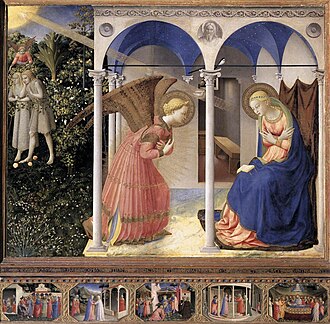 Annunciation - Fra Angelico (1425)
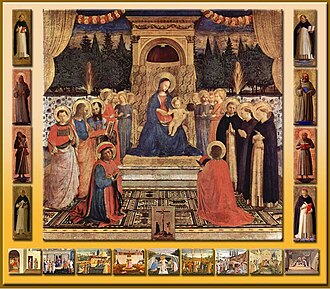 San Marco Altarpiece - Fra Angelico
%2C%20ante%201432%2C%2001.jpg) Deposition of Christ - Fra Angelico (1432)
Deposition of Christ - Fra Angelico (1432)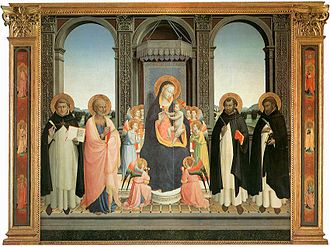 Fiesole Altarpiece - Fra Angelico (1422)
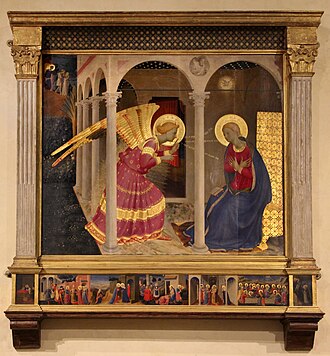 Annunciation of Cortona - Fra Angelico (1430s)
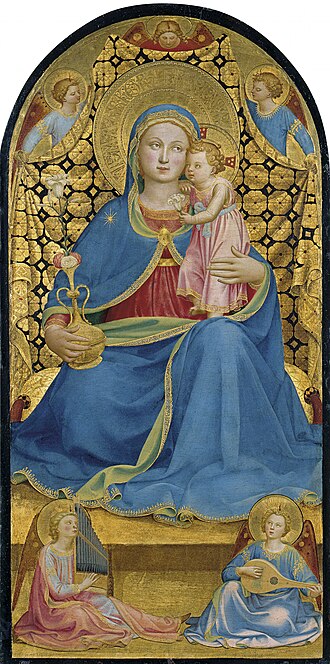 Madonna of Humility - Fra Angelico (1433)
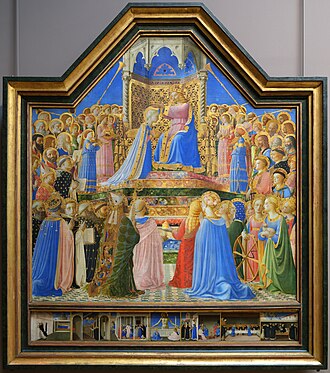 Coronation of the Virgin - Fra Angelico
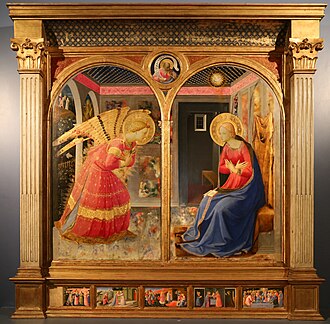 Annunciation of San Giovanni Valdarno - Fra Angelico (1430)
Paintings by related artists
 Mona Lisa - Leonardo da Vinci (1503-1519)
 Lady with an Ermine - Leonardo da Vinci (1490)
 Doni Tondo - Michelangelo (1500s)
 The Torment of Saint Anthony - Michelangelo (1487)